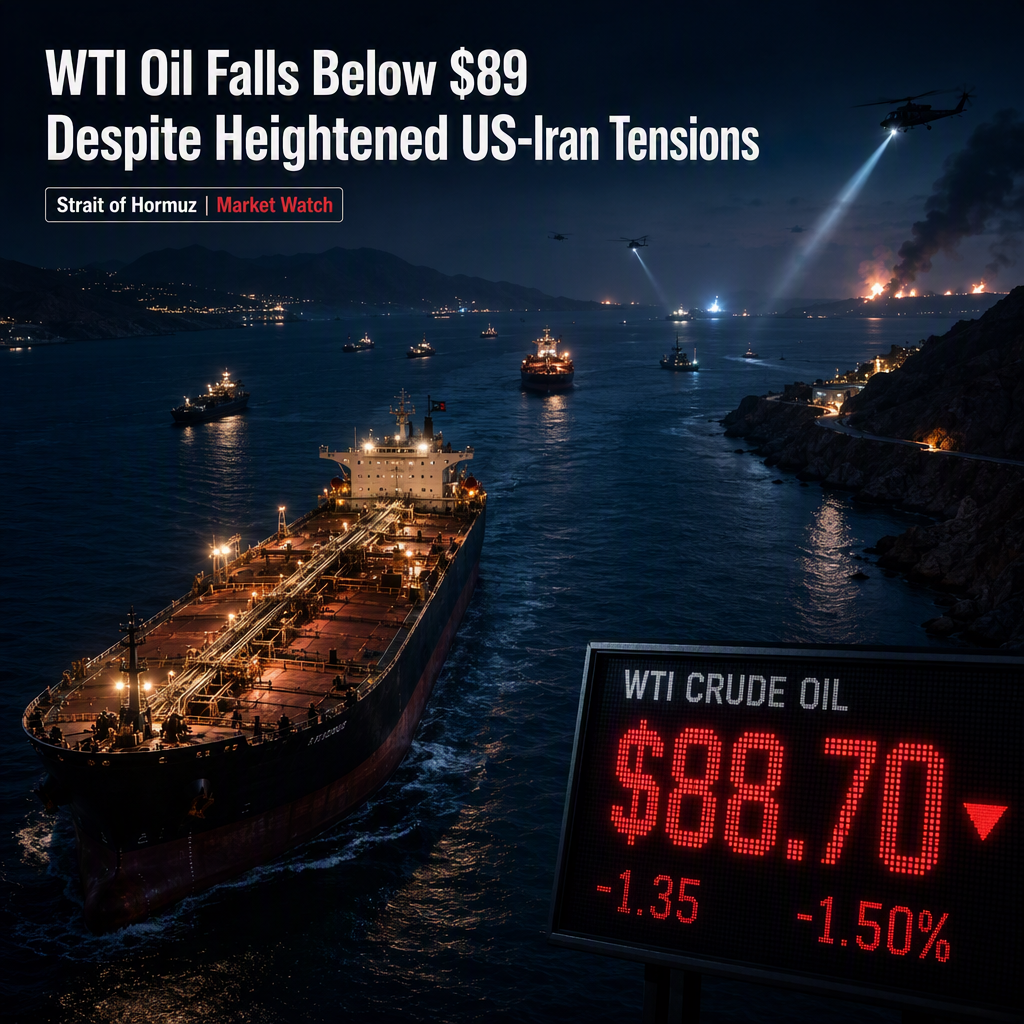
West Texas Intermediate (WTI) oil prices declined to around $88.70 during European trading hours on Wednesday, slipping below the $89.00 mark after two consecutive days of gains, despite escalating hostilities between the United States and Iran near the Strait of Hormuz [1]. US President Donald Trump announced new strikes against Iranian targets in the region, citing retaliation for Tehran’s attempts to lay mines in the strategic waterway and a prior attack on a US military base. Trump warned of a significantly larger military response if Iran retaliates further [1]. In response, Iran claimed to have already targeted US bases across the region and launched missiles toward Jordan [1].
US Treasury Secretary Scott Bessent stated that Iran’s economy has entered an 'acceleration phase' of bankruptcy, but emphasized that 17 million barrels of crude oil passed through the Strait of Hormuz on Monday, indicating that Tehran does not control the vital trade corridor [1].
Rabobank highlighted that the global energy and agricultural sectors are already under pressure from ongoing Russian and Ukrainian strikes. The bank noted that the combination of US-Iran tensions, potential disruptions to energy flows, and warnings from Ukrainian President Zelenskyy about the closure of Russian airspace due to increased drone attacks could further disrupt the global economy. Rabobank suggested that these mounting supply-side shocks and potential airspace closures add significant uncertainty to commodity markets and global trade flows [1].
CONCLUSION
Despite heightened geopolitical risks and threats to energy flows in the Middle East, WTI oil prices retreated below $89.00, reflecting market uncertainty and resilience in crude supply through the Strait of Hormuz. Analysts warn that ongoing conflicts and potential disruptions could further strain global commodity markets and trade. The situation remains fluid, with significant downside and upside risks for energy prices.