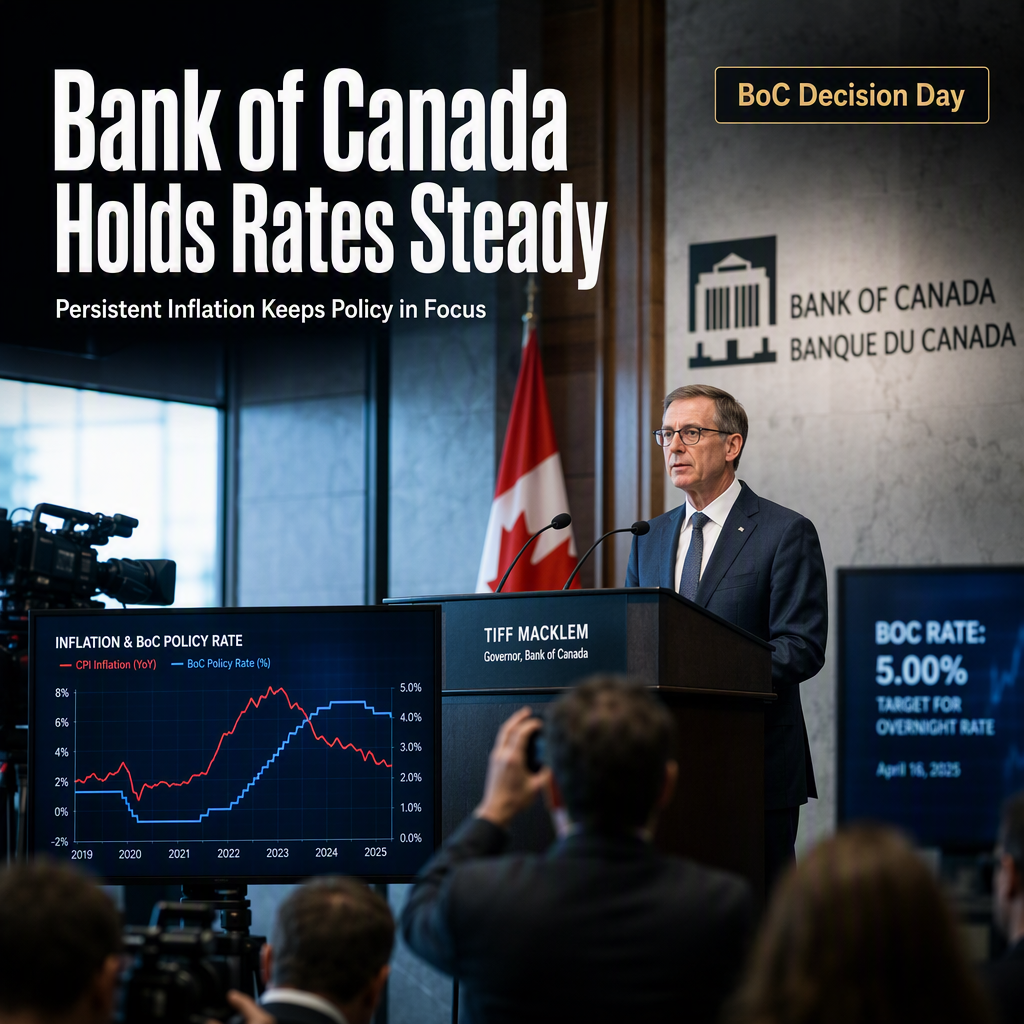
The Bank of Canada (BoC) is widely anticipated to keep its policy rate unchanged at 2.25% during its upcoming meeting, marking the seventh consecutive time the central bank has maintained this stance [1]. The BoC previously left its policy rate at 2.25% in July, a move that was broadly expected by markets [1]. Governor Tiff Macklem and the BoC statement highlighted that persistent increases in oil prices could necessitate consecutive rate hikes, though this is not currently the bank’s base case scenario [1].
The BoC has revised its economic forecasts, sharply downgrading Canadian growth for 2026 to 0.7% from 1.2%, while improving its near-term outlook. The bank now projects annualized GDP growth of 2.5% in Q2, up from the 1.5% forecast in April, before moderating to 1.5% in Q3. Governor Macklem described Q2 growth as “pretty solid” and suggested the improvement could be sustainable, though he acknowledged uncertainty regarding the recovery’s durability. Growth is expected to strengthen to 1.8% in both 2027 and 2028, despite a persistent output gap [1].
Inflation remains a central concern, with the BoC revising its 2026 inflation forecast higher to 2.5% from 2.3%, before easing to 2% in 2027 and edging up to 2.1% in 2028. Oil prices are cited as the main upside risk to this outlook. Macklem warned that a renewed and sustained rise in energy prices that spills over into broader inflation could require consecutive rate hikes, but emphasized the BoC would not react mechanically to a temporary oil price spike [1].
Recent inflation data shows all measures ticking higher in July: headline CPI rose 3.0% year-on-year, up from 2.8% the previous month, and the BoC’s core reading increased to 2.3%. The bank’s preferred measures—CPI-Common, Trimmed, and Median—stood at 2.7%, 1.9%, and 2.0%, respectively, with nearly all remaining above the BoC’s target [1].
The BoC will announce its policy decision on Wednesday at 13:45 GMT, followed by a press conference with Governor Macklem at 14:30 GMT. Markets expect the central bank to maintain its current stance, with a projected tightening of just over 2 basis points by the end of 2026. Analyst Pablo Piovano notes that USD/CAD technical levels to watch include resistance at 1.3915 and 1.4040, with further upside targets at 1.4080 and 1.4129, while key support lies at 1.3840 and 1.3731 [1].
CONCLUSION
The Bank of Canada is set to keep rates steady amid persistent inflation and a mixed economic outlook, with near-term growth revised higher but longer-term forecasts downgraded. Inflation remains above target, and oil prices pose a key risk to the outlook. Markets are not expecting significant policy changes in the near term, and attention will focus on Governor Macklem’s guidance following the decision.