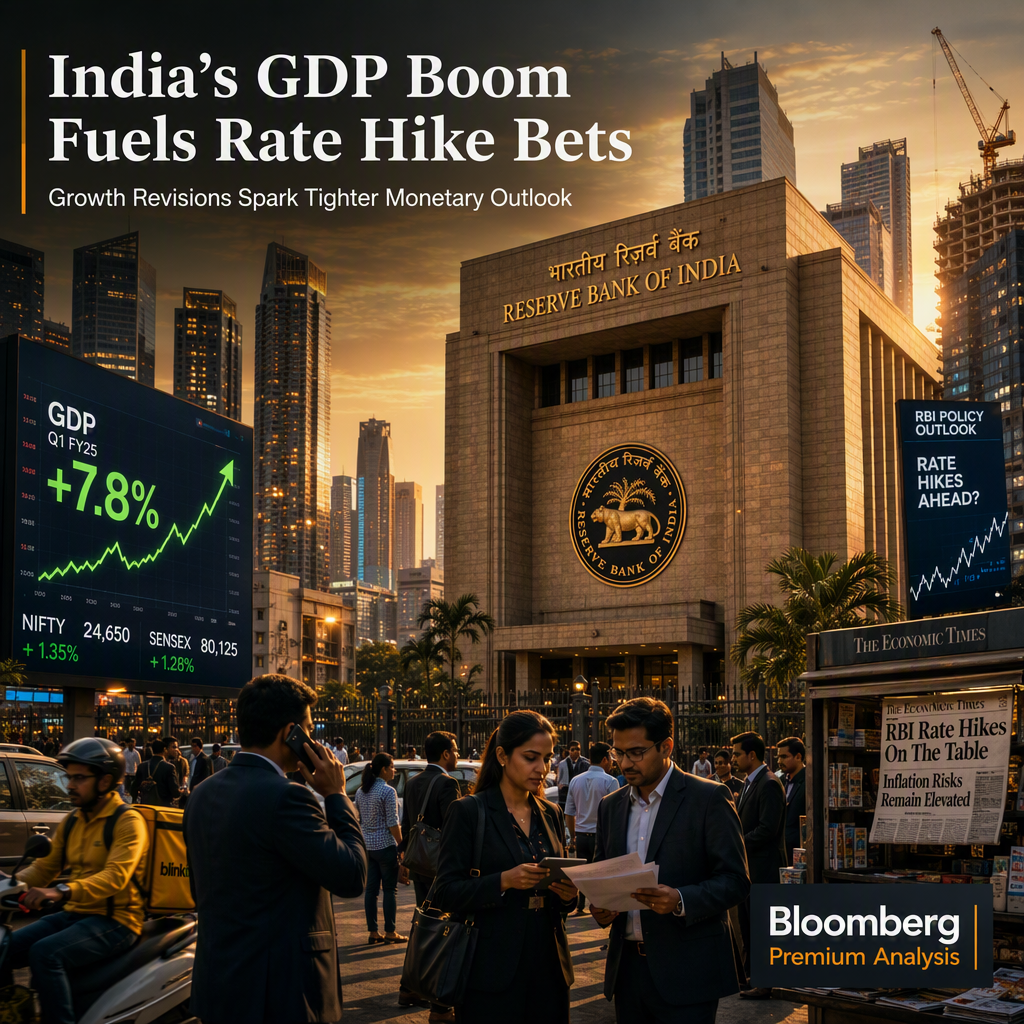
India's macroeconomic outlook has strengthened significantly following a sharp Q1-FY27 Gross Domestic Product (GDP) growth of 7.8%, which has prompted major financial institutions to upgrade their medium-term growth projections and adjust expectations for monetary policy tightening. Standard Chartered has revised its full-year FY27 GDP forecast upward to 7.2%, up from 6.6%, citing the robust 7.8% Q1 expansion and a projected 7.4% growth in Q2. Societe Generale also highlights that economic activity is outperforming the Reserve Bank of India's (RBI) baseline projection of 6.7%, indicating a faster absorption of spare capacity in the economy [1].
On the policy front, Societe Generale now anticipates three consecutive 25 basis point rate hikes by the RBI—in October, December, and February—raising the repo rate from 5.25% to 6.00% by early 2027. This is a revision from their previous expectation of only two hikes, reflecting the view that a cumulative 50 basis point increase would be insufficient to manage rising price risks and maintain an effective real policy-rate buffer. The institution points to persistent cost pressures, including food, fuel, and input costs, which are increasingly likely to spill over into core inflation as economic capacity tightens [1].
Standard Chartered, while focusing on the acceleration in growth, acknowledges potential downside risks in the second half of the year, such as El Niño effects and higher inflation, which could slow H2 growth to 6.7%. Nevertheless, the bank maintains that underlying economic momentum remains strong, supported by robust high-frequency indicators and anticipated demand during the upcoming festival season [1].
Analysts from both institutions agree that India's economic outperformance is eroding spare capacity more quickly than previously assumed. Societe Generale's Kunal Kundu emphasizes that, given the hawkish global policy backdrop and the risk of core inflation spillovers, a more aggressive tightening cycle is warranted to restore an appropriate real policy-rate buffer [1].
CONCLUSION
India's stronger-than-expected Q1 GDP growth has led to upward revisions in growth forecasts and heightened expectations for RBI rate hikes. Both Societe Generale and Standard Chartered see robust economic momentum, but caution that inflation risks and global monetary conditions may necessitate a more aggressive policy response. The market is likely to interpret these developments as signaling tighter monetary conditions ahead.