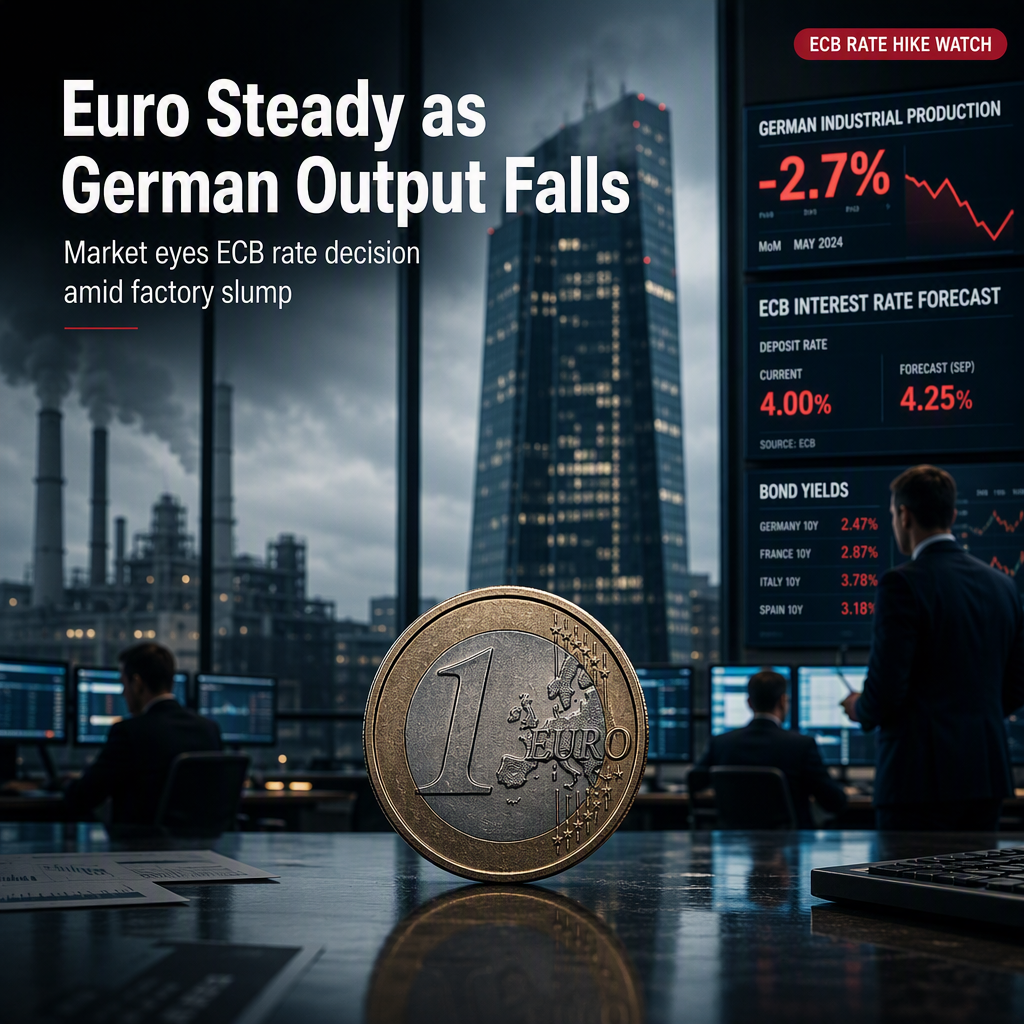
German Industrial Production declined by 1.1% month-on-month (MoM) in July, according to data released by Destatis on Monday, missing market expectations of a 0.3% increase and coming in below the previous revised reading of 0% (from 0.2%) [1][2][4]. On a year-over-year (YoY) basis, industrial activity contracted by 1.6% in July, accelerating from a 0.5% decline in June [1][2][4]. This weak performance in Germany, the Eurozone's largest economy, has contributed to mild selling pressure on the Euro, with EUR/USD edging down to near 1.1610 and EUR/GBP losing ground to around 0.8585 during early European trading hours [1][2][4].
Despite the disappointing German data, the Euro remains relatively stable against the US Dollar, trading in a narrow 1.1610–1.1620 range, as US markets are closed for Labor Day, limiting volatility [2][3][4]. The EUR/USD pair quickly reversed losses from a stronger US jobs report on Friday, which showed a 162K increase in net employment in August, nearly three times the forecasted 56K gain [2][3]. Analysts note that rising oil prices and tensions in the Middle East are putting additional pressure on the Euro, but USD rallies are capped for now [2].
Market focus is shifting to the European Central Bank's (ECB) monetary policy meeting scheduled for Thursday. The ECB is widely expected to raise its key interest rates by 25 basis points, with some sources citing an increase from 2.25% to 2.5% [1], while others expect the benchmark rate to reach 2.25% [2][3]. Investors will closely watch ECB President Christine Lagarde's comments for hints of further rate hikes before the end of the year [2][3]. Danske Bank and Brown Brothers Harriman strategists both highlight the likelihood of a rate hike and anticipate heightened market volatility around the US Consumer Price Index (CPI) release later in the week [2][3].
In the UK, the Bank of England (BoE) is expected to leave interest rates unchanged at 3.75% at its next meeting on September 17, though markets are fully pricing in a quarter-point hike by year-end [1]. Analysts at ING note that UK Chancellor John Healey's speech today will be closely watched as markets prepare for the October 28 budget [1].
Technical analysis suggests EUR/GBP maintains a neutral bias, with price action confined between support at 0.8565 and resistance at 0.8600. The Relative Strength Index (14) around 58 hints at modest underlying support, but a decisive breakout trigger is lacking [1].
CONCLUSION
The unexpected decline in German Industrial Production has weighed on the Euro, but the currency remains stable ahead of key central bank decisions. Market participants are now focused on the ECB's anticipated rate hike and upcoming US CPI data, which are expected to drive volatility later in the week. Overall, sentiment is cautious, with the Euro holding its ground despite negative economic signals from Germany.