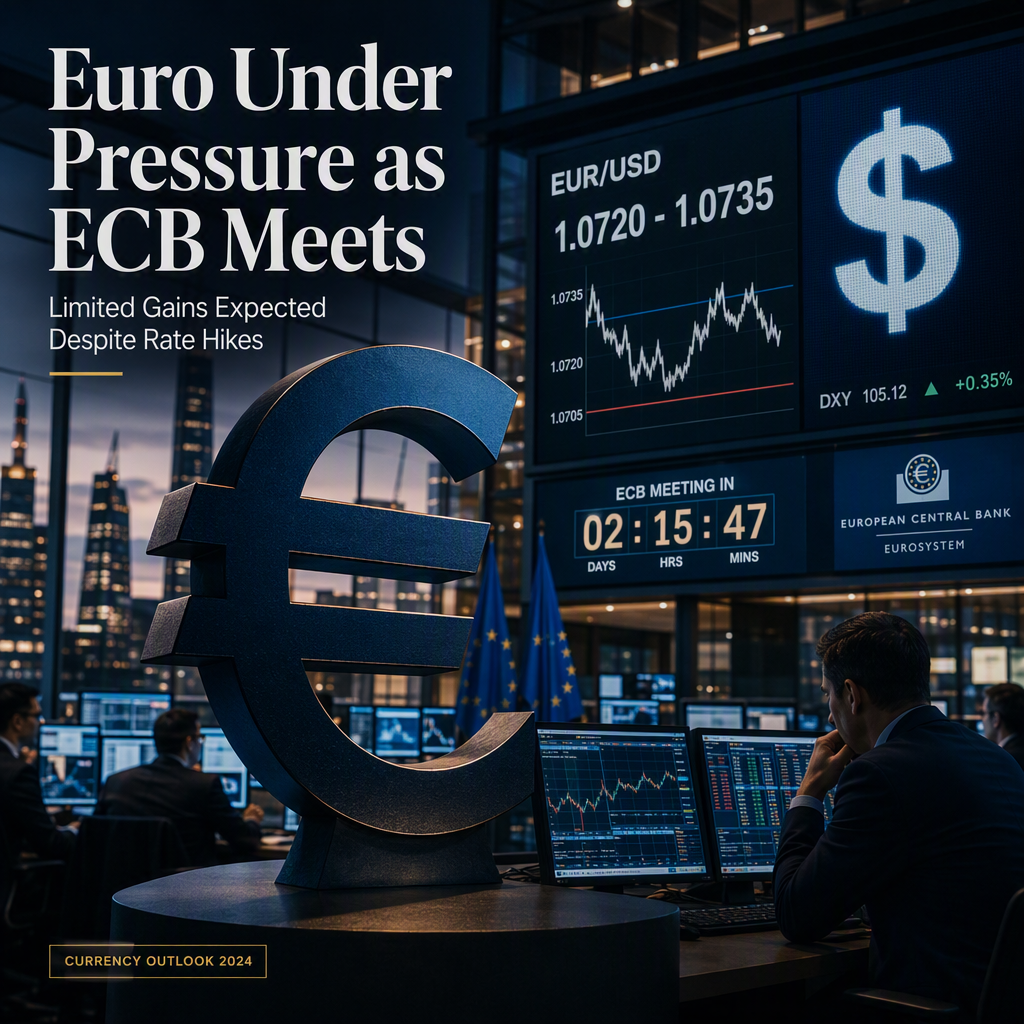
The Euro is trading within a tight range against the US Dollar, with analysts from both ING and Commerzbank highlighting a downside bias ahead of this week's European Central Bank (ECB) meeting [1][2]. ING's Chris Turner notes that despite recent German regional election results underscoring political tensions for Chancellor Merz’s CDU, Eurozone fundamentals remain contained. Solid growth prospects, supported by government infrastructure and defense spending, are expected to be confirmed by a 0.4% quarter-on-quarter increase in second-quarter Eurozone GDP and a further rise in Sentix investor confidence data [1]. However, ING sees downside risks for the euro stemming from the upcoming ECB meeting, projecting EUR/USD to remain in a narrow 1.1580-1.1640 band with a slight downside bias [1].
Commerzbank’s Thu Lan Nguyen emphasizes that the EUR/USD exchange rate is primarily driven by the US Dollar, with Eurozone developments only amplifying or dampening existing trends rather than reversing them [2]. According to Commerzbank, the Euro has derived limited benefit from both past and anticipated ECB rate hikes. Markets perceive these hikes as necessary corrections to an overly low policy rate, aimed at preserving the Euro’s value rather than materially boosting it [2]. The dominance of the US Dollar as the world’s primary reserve currency continues to attract significant capital flows, further limiting the Euro’s upside potential [2].
Both sources agree that the ECB meeting is the main event for the week, but expectations for a significant positive impact on the Euro are muted. ING highlights the risk of further downside for the Euro, while Commerzbank underscores that ECB tightening is viewed as value preservation rather than a catalyst for Euro appreciation [1][2].
CONCLUSION
Analysts from ING and Commerzbank agree that the Euro is likely to remain under pressure, with limited upside expected from the ECB's anticipated rate hike. The US Dollar's dominance and market perceptions of ECB policy suggest that the Euro will continue to trade in a tight range with a downside bias. Investors are advised to watch the ECB meeting for further direction, but significant gains for the Euro appear unlikely in the near term.