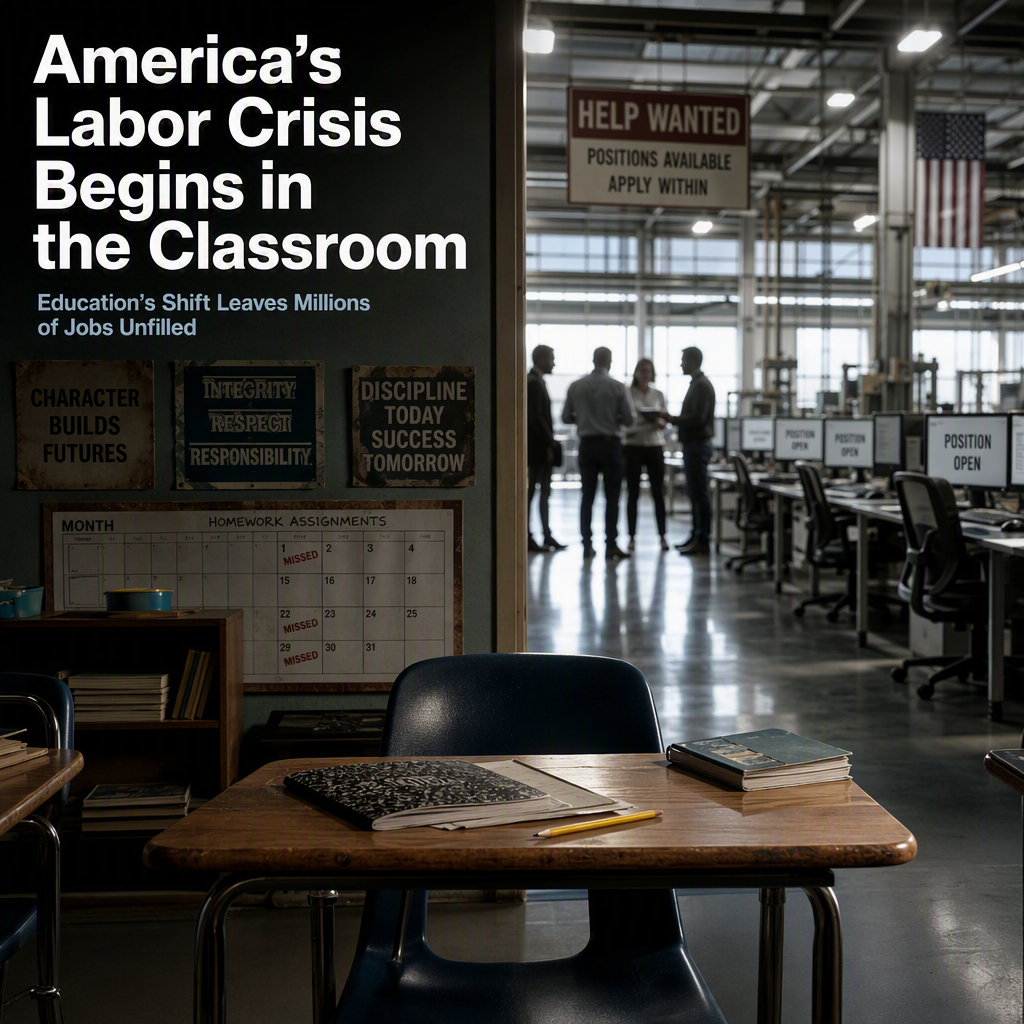
According to the article, America is currently facing a massive labor crisis, with nearly 7 million unfilled jobs across the country [1]. While some of these positions remain vacant due to a lack of technical skills among candidates, business owners report that the core issue is a deficiency in essential workplace behaviors and character traits, such as punctuality, initiative, resilience, and the ability to accept constructive criticism [1].
The article argues that the roots of this crisis are not found in the workplace, but rather in the classroom. The author, drawing on experience as a teacher and school administrator, claims that schools have gradually abandoned their responsibility to build character, focusing instead on protecting students' self-esteem at the expense of academic rigor and personal growth [1]. Practices such as eliminating homework, lowering standards, minimizing testing, and discouraging honest criticism have, according to the article, left students unprepared for the demands of adulthood and the workforce [1].
This shift in educational priorities is said to have contributed to workplace phenomena such as 'quiet quitting,' increased grievances, and a tendency to seek legal recourse rather than learning from negative feedback [1]. The article suggests that the lack of meaningful consequences and challenges in school has led to a generation of employees who expect little from themselves because little was expected of them during their formative years [1].
No specific market reactions, analyst opinions, or forward-looking statements are provided in the article [1].
CONCLUSION
The article links America's labor shortage to shortcomings in the education system, particularly the failure to instill resilience, responsibility, and initiative in students. While no direct market reactions are discussed, the analysis suggests that addressing educational practices could be key to resolving workforce challenges.