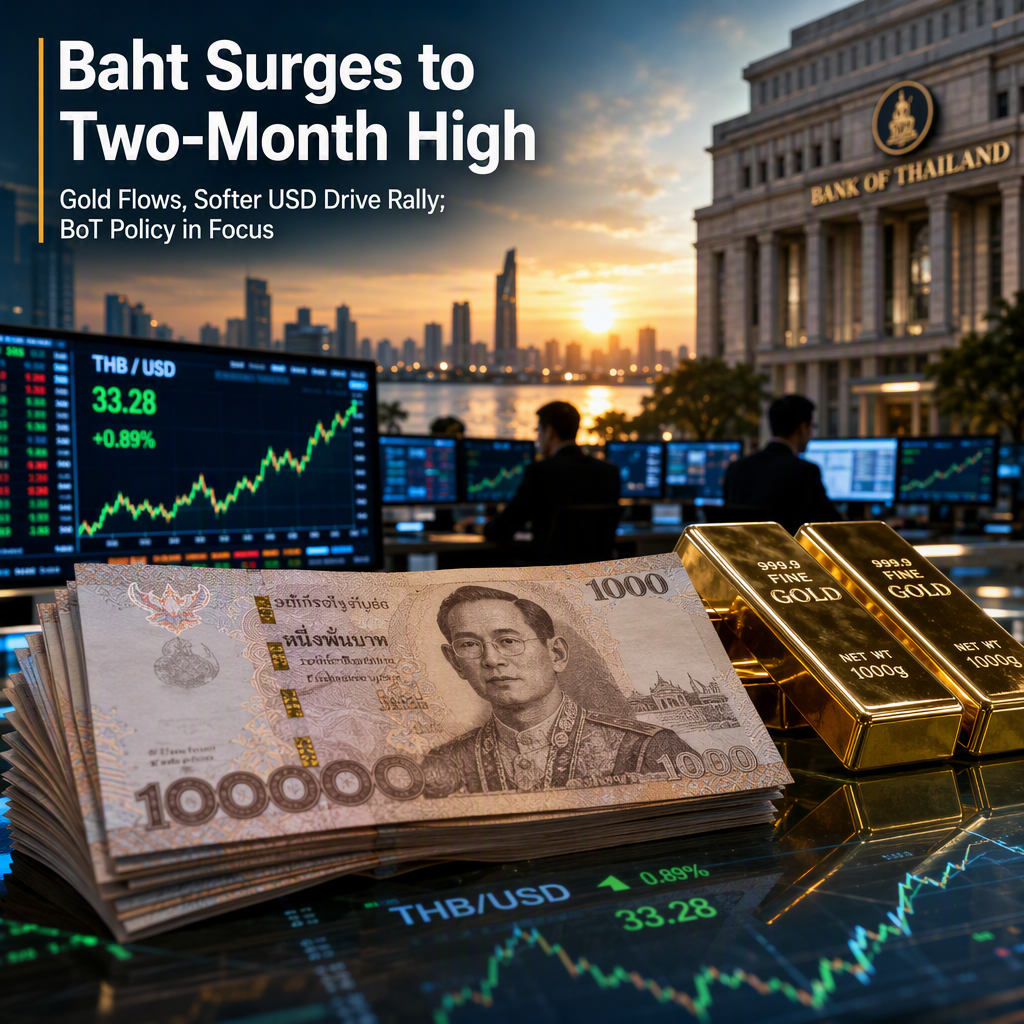
The Thai Baht (THB) has rallied to a two-month high against the US Dollar (USD), driven by a combination of factors including a softer USD, lower oil prices, strong electronics exports, and renewed gold-related flows, according to OCBC analysts Sim Moh Siong and Christopher Wong [1]. The analysts note that the domestic gold market in Thailand has played a marginal role in supporting the Baht, while electronics exports have also contributed positively, though they caution against attributing too much of the recent strength to the tech cycle [1].
Despite the recent gains, the upcoming Bank of Thailand (BoT) meeting is in focus, as policymakers may be sensitive to excessive currency strength, especially in light of softer domestic growth [1]. This sensitivity could limit further appreciation of the Baht in the near term [1]. Technical analysis indicates that while bearish momentum remains on the daily chart, the Relative Strength Index (RSI) is near oversold conditions, suggesting potential for some consolidation [1]. Key resistance levels are identified at 32.87 (100-day moving average) and 33.14 (23.6% Fibonacci retracement of the 2026 low to high), with support at 32.30/35 (200-day moving average, 50% Fibonacci retracement) [1].
Overall, while the Baht's recent rally has been supported by several positive factors, market participants are advised to watch for potential policy responses from the BoT that could temper further gains [1].
CONCLUSION
The Thai Baht's rally to a two-month high is underpinned by a softer USD, lower oil prices, and gold flows, but further appreciation may be capped by the Bank of Thailand's sensitivity to currency strength. Technical indicators suggest possible consolidation ahead, with market attention turning to the upcoming BoT meeting for policy signals.