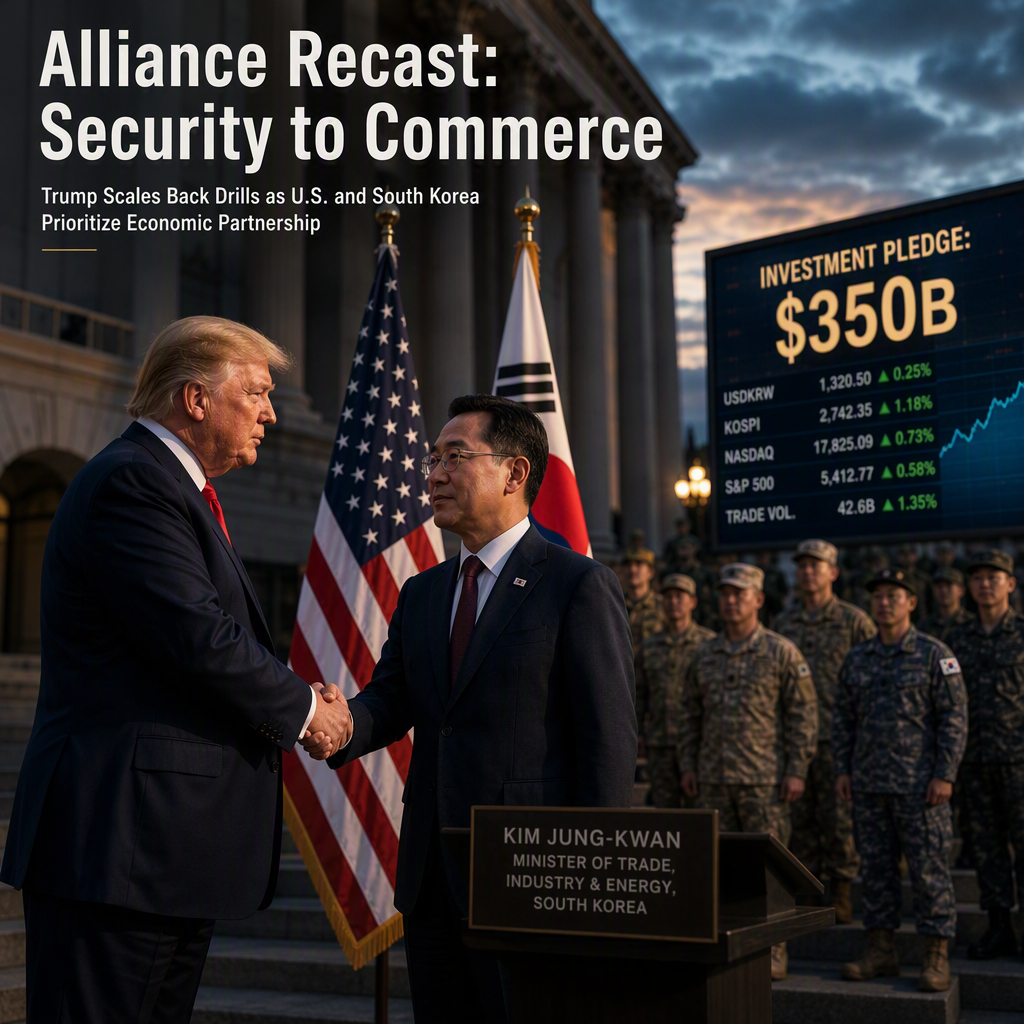
President Donald Trump has scaled back annual military drills with South Korea, signaling a shift in the U.S.-South Korea alliance from a security-based relationship to one centered on economic cooperation, according to experts cited in the article [1]. This move comes as South Korea finalizes hundreds of billions of dollars in investment commitments to the United States, including a $350 billion pledge made in exchange for lower 'reciprocal' tariffs last year [1].
Trump announced on August 16 that he had instructed the Pentagon to reduce military exercises, citing their high cost and the 'inappropriate and hostile' signals they send to North Korea [1]. The decision coincided with Korean Trade Minister Kim Jung-kwan's visit to Washington, D.C., to discuss investment commitments and tariffs with U.S. Commerce Secretary Howard Lutnick [1]. The order to scale back drills was reportedly influenced by Korea's slower pace of deploying investments compared to Japan [1].
The Ulchi Freedom Shield exercise, which dates back to 1954, involved around 18,000 Korean troops and an undisclosed number of American soldiers this year [1]. Experts, such as Darcie Draudt‑Véjares of the Carnegie Endowment for International Peace, note that the alliance is evolving toward integrated industrial ecosystems, with economics taking precedence over security [1]. Jennifer Kavanagh of Defense Priorities cautioned that increased defense spending or economic ties should not be seen as guarantees of continued U.S. military commitment [1].
Korean businesses, particularly in the semiconductor sector, are benefiting from Trump's push for reindustrialization and efforts to compete with China, with Nvidia identified as a key client for Korean chip giants [1]. The U.S. Commerce Department and the Korean Trade Ministry did not provide comments on the developments [1].
CONCLUSION
President Trump's decision to scale back military drills with South Korea marks a significant pivot toward prioritizing economic ties over traditional security commitments. While Korean investments in the U.S. are increasing, experts warn that economic cooperation does not guarantee sustained military support. The evolving alliance could reshape both countries' strategic and economic landscapes.