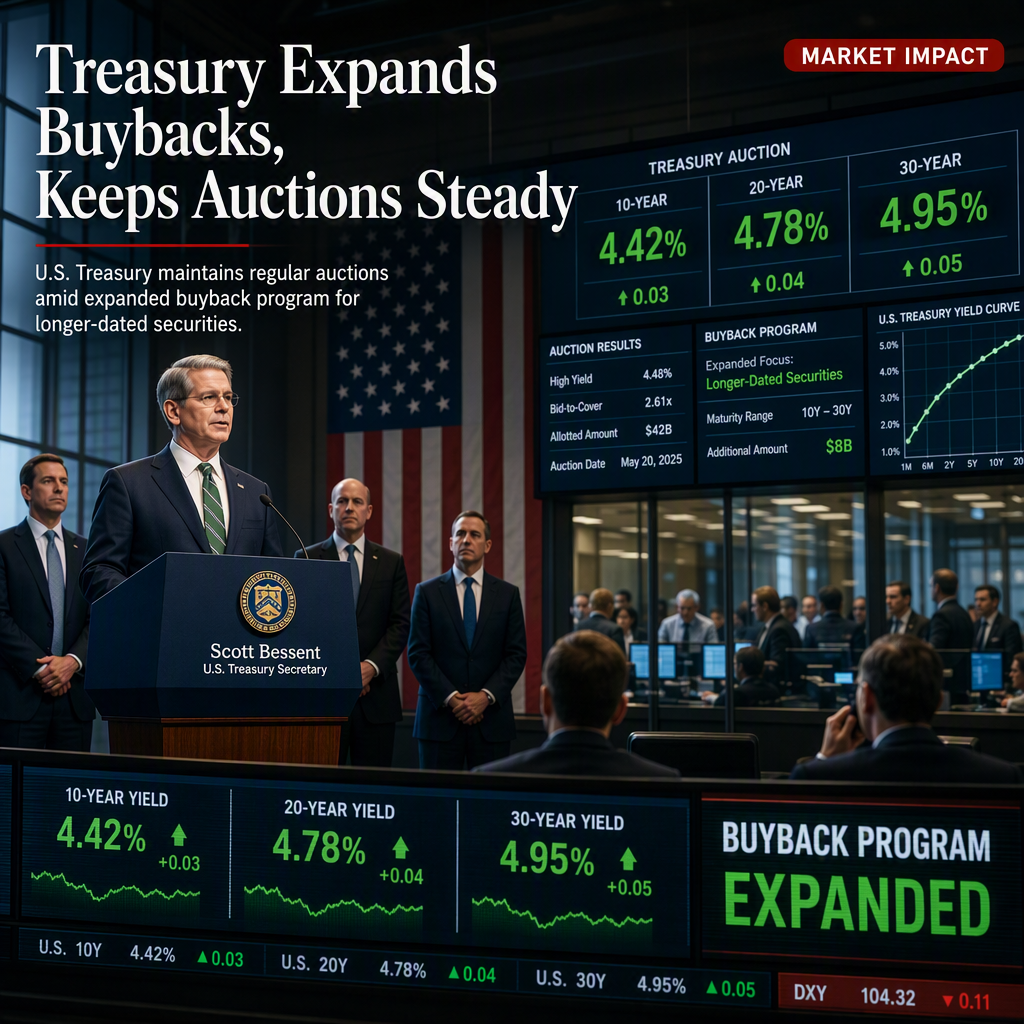
U.S. Treasury Secretary Scott Bessent announced that regularly scheduled Treasury auctions of U.S. debt will continue as usual, even as the department increases the size of its buybacks for longer-dated securities [1]. The expanded buyback program, which was announced on August 19, raises the Treasury's maximum buyback authority from $2 billion per operation to at least $4 billion per operation. This new threshold will serve as a floor, not a cap, allowing the size of buybacks to adjust in response to market conditions [1].
The change is set to take effect on September 9, with the earliest impact expected during the next auctions of longer-dated Treasurys, such as the 10-year note and the 20- and 30-year bonds, which are scheduled for mid-September [1]. The expanded buyback program is expected to remain in place through the rest of the quarter, or until November 4, after which the Treasury will provide further guidance on future buyback sizes [1].
According to the Treasury, the increase in buyback operations is intended to provide greater liquidity support in longer-dated nominal sectors, where there is consistent strong demand from market participants, as evidenced by the significant volume of high-quality offers received in these operations [1]. Bessent emphasized that the department has not yet purchased any bonds under the new program [1].
The announcement of the expanded buyback program led to a temporary decline in yields on the 10-year Treasury note and on 20- and 30-year bonds, although these declines were largely retraced by the end of the week. Yields were reported to be down modestly on Monday [1]. Bessent noted that the higher buybacks are aimed at supporting liquidity in the more thinly traded 30-year sector, which is also facing competition from heavy issuance of corporate bonds at higher yields, particularly amid the ongoing artificial intelligence (AI) buildout [1]. Higher yields on Treasurys increase fiscal pressure on the federal government by raising the cost of servicing the national debt [1].
CONCLUSION
The U.S. Treasury's decision to expand buybacks of longer-dated securities while maintaining regular auction schedules is aimed at supporting market liquidity without disrupting issuance plans. The move initially lowered yields, but the effect was short-lived, indicating a moderate market impact. Further updates on the buyback program are expected after November 4.