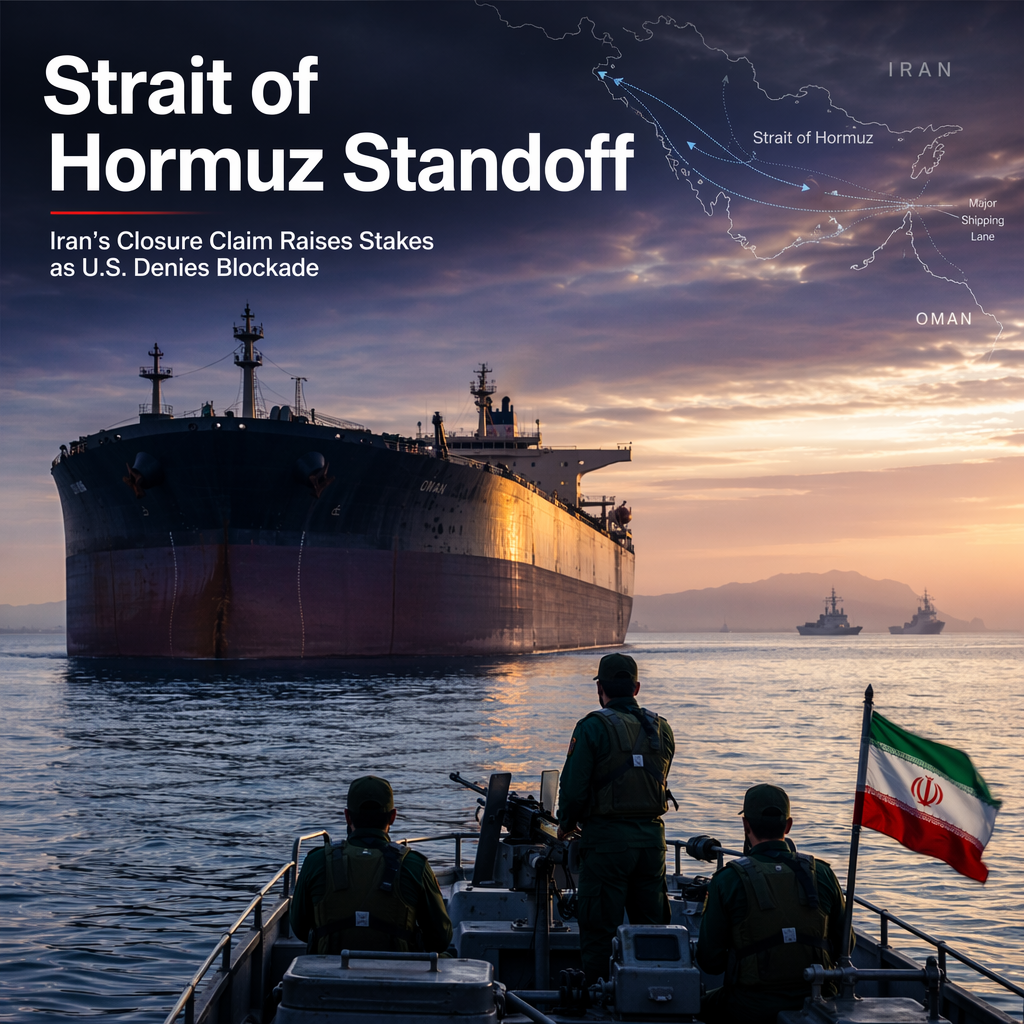
On June 20, 2026, Iran announced the closure of the Strait of Hormuz, a critical shipping route, and warned vessels to avoid the area. This move was declared by Iran's military and the Islamic Revolutionary Guard Corps as a response to ongoing Israeli military operations in Lebanon and what Iran described as U.S. 'bad faith' and failure to uphold commitments under a recently established truce framework [1]. Iranian state television indicated that further steps could be taken if perceived aggression continues [1].
However, the U.S. military denied Iran's claim, stating that the Strait of Hormuz remained open and that U.S. forces were actively monitoring the situation to ensure continued traffic flow. Navy Captain Tim Hawkins, spokesperson for U.S. Central Command, emphasized, 'Iran does not control the Strait of Hormuz,' and confirmed that maritime traffic was ongoing [1].
The announcement comes just days after an interim agreement was reached between U.S. President Donald Trump and Iranian President Masoud Pezeshkian, aiming to end hostilities in the region. The agreement, signed on Wednesday, called for an immediate end to Israeli military actions in Lebanon and the full reopening of the Strait of Hormuz without Iranian tolls for at least 60 days [1]. Despite Iran's latest threat, U.S. Vice President JD Vance expressed optimism about the ongoing negotiations, noting that technical-level talks were set to begin in Switzerland and that discussions were 'going well' [1].
The situation escalated further following Israeli strikes in southern Lebanon, which reportedly killed at least 16 people, including two children, and left seven individuals trapped under rubble, according to Lebanese authorities [1]. The attempt by Iran to shut down the strait has heightened tensions ahead of the Switzerland talks, which are intended to advance the interim agreement [1].
CONCLUSION
Iran's claim to have closed the Strait of Hormuz has introduced significant uncertainty into the region, though the U.S. maintains that the waterway remains open and secure. The conflicting statements underscore heightened tensions as technical negotiations between Iran and the U.S. proceed in Switzerland. The outcome of these talks will be closely watched by markets given the strategic importance of the Strait of Hormuz.