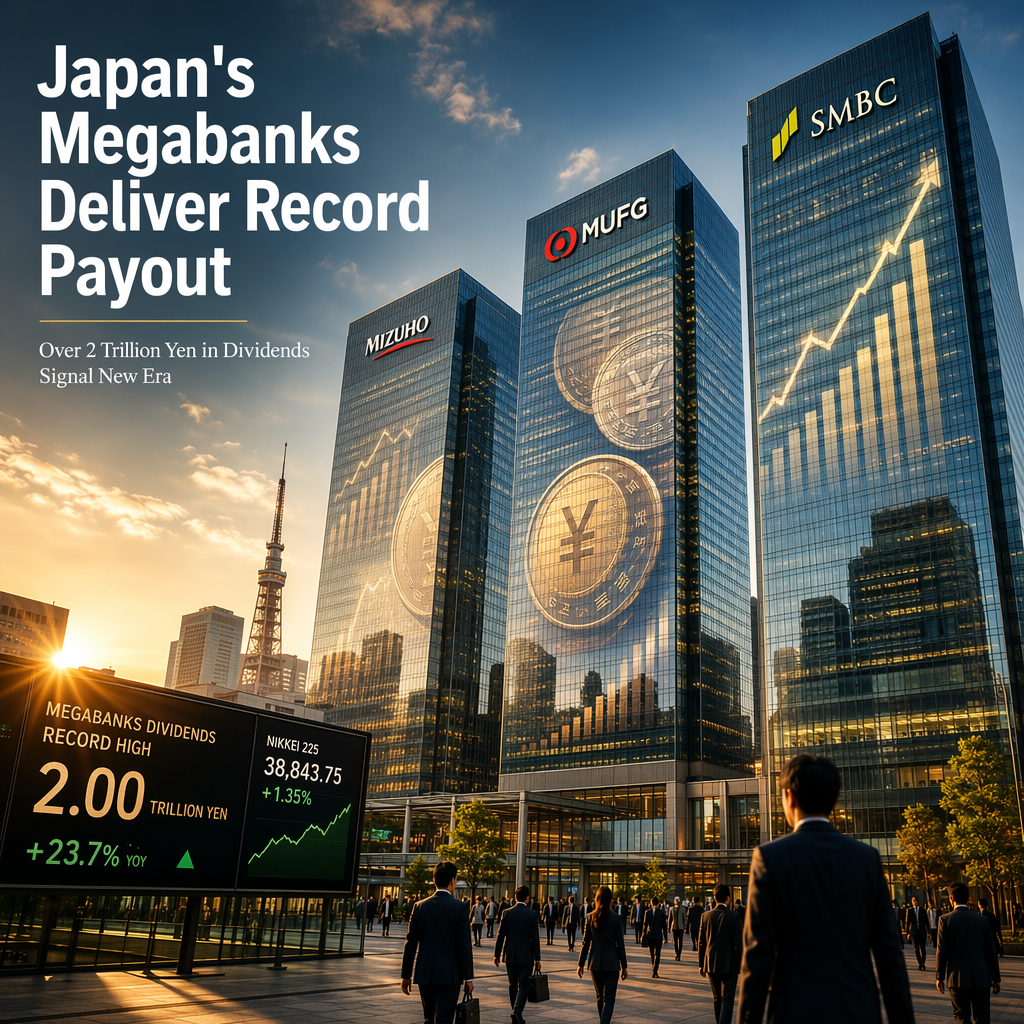
Japan's three megabanks are projected to pay more than 2 trillion yen ($12.4 billion) in dividends combined for the first time in the current fiscal year, marking a historic milestone for the country's banking sector [1]. This record payout is attributed to rising interest rates on loans, which have significantly boosted profits for these major financial institutions following the Bank of Japan's decision to end its negative interest rate policy three years ago [1].
The increased dividend payments underscore the megabanks' enhanced ability to return profits to shareholders, representing a notable shift after years of ultra-low and negative interest rates that had previously constrained profitability and shareholder returns [1]. The development signals a new era for Japan's banking industry, with higher lending rates directly translating into improved financial performance for the nation's largest banks [1].
While the article does not specify the individual banks involved or provide further breakdowns, the overall implication is that the sector's profitability and shareholder returns are on an upward trajectory due to the changed interest rate environment [1]. No specific market reactions, analyst opinions, or forward-looking statements are mentioned in the source [1].
CONCLUSION
Japan's three megabanks are set to deliver a record combined dividend payout of over 2 trillion yen this fiscal year, driven by higher lending rates following the end of negative interest rate policy [1]. This marks a significant positive shift for the sector and its shareholders, reflecting improved profitability in Japan's banking industry [1].