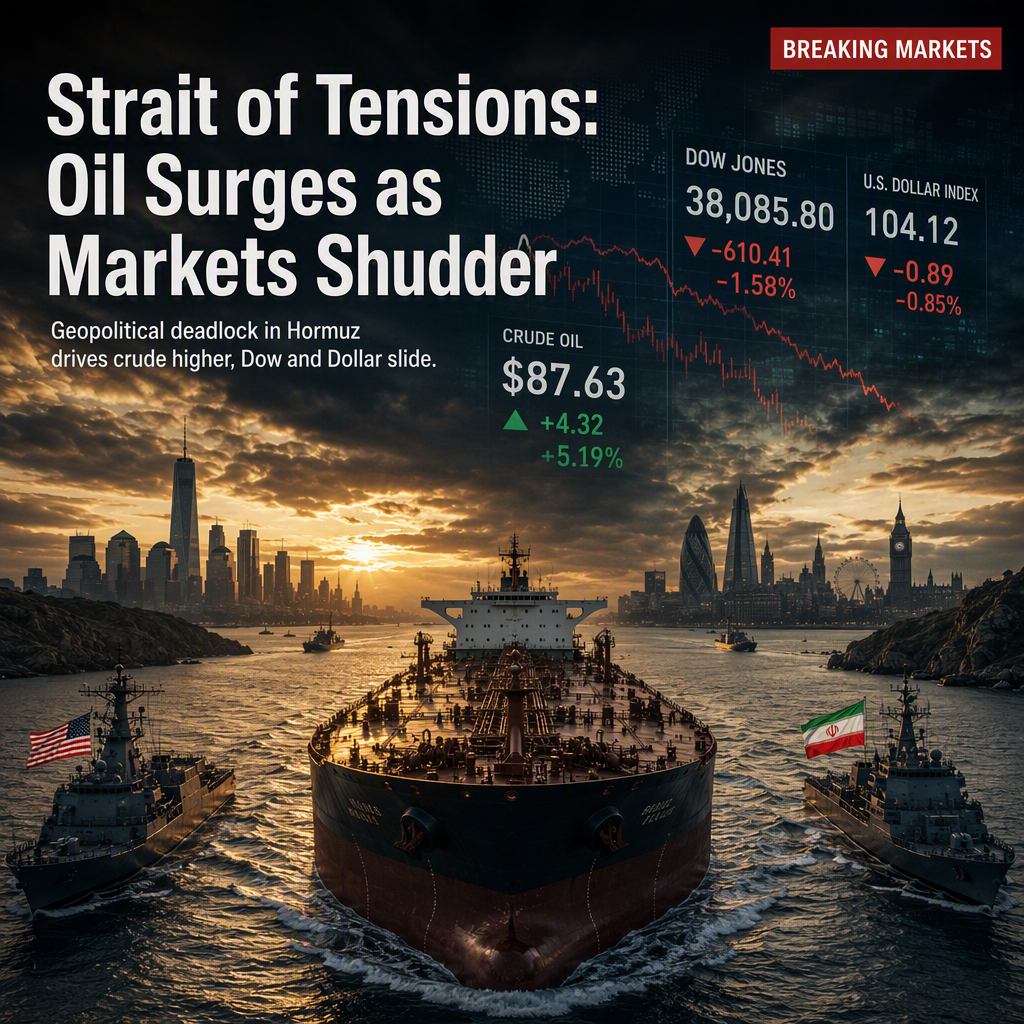
The expiration of a 60-day negotiating window intended to resolve the conflict over the Strait of Hormuz has passed without an agreement, intensifying geopolitical tensions between the United States and Iran [1][2][3]. Iranian officials have signaled a potential shift from defensive to offensive policies if diplomacy fails, with only three vessels crossing the waterway on Sunday compared to a five-day average of 12 and roughly 130 per day before the war [1][2]. Iranian Foreign Minister Abbas Araghchi confirmed that no negotiations are currently underway, and the US must accept Iran's conditions for shipping to resume [3]. US President Donald Trump has threatened Oman with bombing if it interferes, and Iranian Deputy Foreign Minister Kazem Gharibabadi called on Trump to “accept the reality of defeat,” following Trump's suggestion that he would soon declare the Strait of Hormuz a “territory of the United States” [2][3].
Crude Oil prices have responded to these developments, with West Texas Intermediate (WTI) trading near $83.00 and Brent above $88.00 [1][2]. WTI specifically advanced to $82.10, up 0.68% on the day, supported by the deadlock and heightened supply concerns [3]. Technical analysis shows WTI holding a constructive bias above key moving averages, with resistance at $82.28, $83.57, and $84.60, and support at $81.53 and $80.00 [3]. The oil market is also monitoring disruptions in Russia, where Ukrainian strikes have taken Russian refining offline, contributing to global supply uncertainty [2][3].
The Dow Jones Industrial Average trades near 53,550, down close to 200 points and roughly 1,200 beneath its August 5 record, as the index is sold from the opening print for a second consecutive session [2]. Despite the supply war, the Dow does not include major refiners benefiting from high diesel margins, such as Valero (VLO), Marathon Petroleum (MPC), and Phillips 66 (PSX), which are trading at or near record levels. Valero and Marathon Petroleum have more than doubled this year, and Phillips 66 is up roughly 85%, with diesel margins near $100 a barrel [2]. The only energy name in the Dow is Chevron (CVX), whose refining arm is a segment within a larger business [2].
The US Dollar Index trades near 99.50, about a tenth of a percent lower, having failed to rally despite the haven bid and higher oil prices. The Euro is at a two-month high, the Pound near three-month peaks, and Gold is bid, indicating a market that has stopped buying safety and started selling the Dollar [1]. The Dollar's rate premium was dismantled by soft CPI, PPI, and a 0.6% contraction in July retail sales, moving September hike odds from a coin flip on August 10 to roughly a third by Friday [1]. Monday's Empire State manufacturing survey printed 20.6 against an 11 consensus and 15.6 in July, the strongest reading in over four years, but was largely ignored by the market [1][2].
Looking ahead, traders are awaiting the American Petroleum Institute (API) weekly US Crude Oil inventory report, which could provide further insight into the supply-demand balance [3].
CONCLUSION
The unresolved tensions in the Strait of Hormuz have driven oil prices higher and benefited US refiners, while the Dow Jones and US Dollar Index have failed to rally despite the geopolitical risks. The market is pricing in supply concerns and inflationary pressures, with attention now turning to upcoming US crude inventory data for further direction.