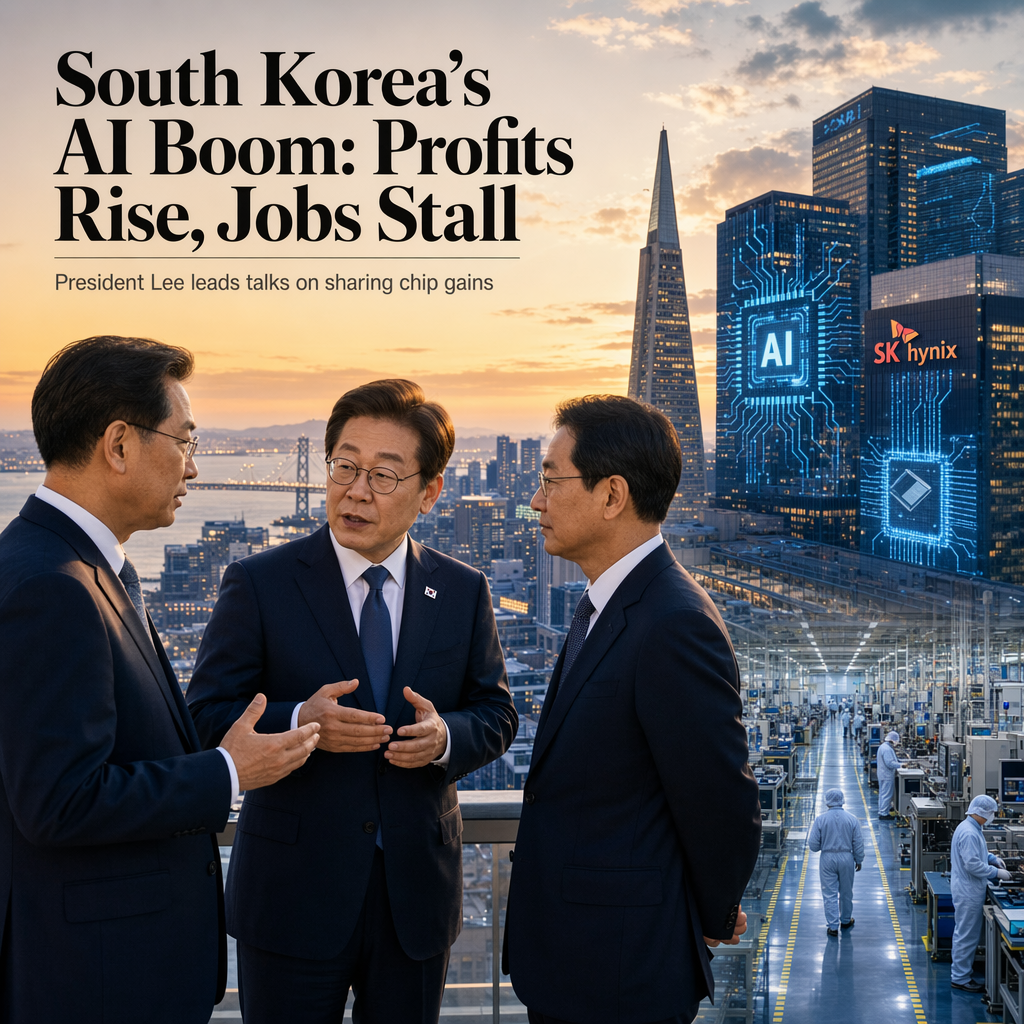
South Korean President Lee Jae Myung is set to travel to San Francisco on Friday, accompanied by the chairmen of Samsung Electronics and SK Hynix, to meet with global tech leaders and discuss strategies to convert the ongoing global AI investment boom into broader economic gains for South Korea [1]. The administration is planning a permanent fund aimed at sharing the profits generated from the AI boom, with further details expected to be discussed during the president's meetings in San Francisco [1].
Despite record earnings for South Korean chipmakers, job creation has not kept pace. In June, South Korean exports surpassed $100 billion for the first time, driven by strong demand for semiconductors [1]. However, analysts point out that the capital-intensive nature of the semiconductor industry has limited its impact on employment, leading to concerns about 'growth without jobs' [1].
In response, the government is proposing measures such as a permanent fund to redistribute profits from the AI and chip sectors, aiming to ensure that the benefits of these industry booms are more widely shared across the economy [1]. Market analysts remain cautiously optimistic about the broader economic outlook, acknowledging that chip profits have powered export growth and contributed to modest overall growth, but express skepticism about whether these gains can translate into sustainable job creation without structural reforms or targeted redistributive measures [1].
South Korea continues to position itself as a leader in the global semiconductor supply chain, but policymakers recognize the need for policies that ensure the economic benefits are distributed more equitably [1].
CONCLUSION
South Korea's chip sector is driving export growth and profits, but job creation remains a challenge. The government's proposed permanent fund and ongoing discussions with industry leaders highlight efforts to ensure that the benefits of the AI and chip booms are more broadly shared across the economy.