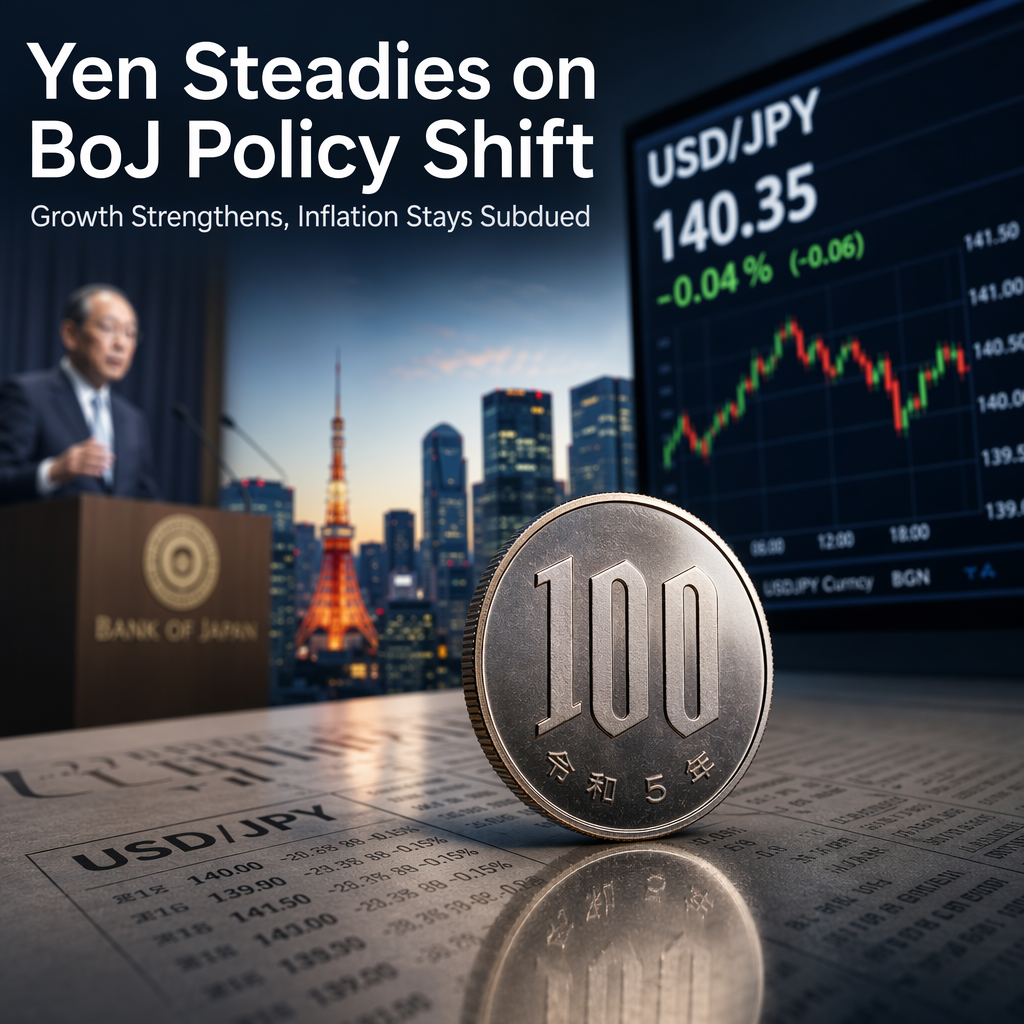
The Japanese Yen (JPY) is finding support as market participants reprice expectations for the Bank of Japan's (BoJ) monetary policy, according to Brown Brothers Harriman’s (BBH) Elias Haddad. The USD/JPY currency pair is consolidating just below a multi-decade high, with Japan's private sector growth reaching a five-month high in July. The composite Purchasing Managers' Index (PMI) improved to 53.1 from 52.8 in June, driven by the steepest increase in manufacturing production since February 2014, although services growth was softer [1].
Inflation data for June showed headline Consumer Price Index (CPI) rising to 1.7% year-over-year from 1.5% in May, supported by government energy subsidies. Core CPI excluding fresh food increased to 1.6% year-over-year from 1.4% in May, while core CPI excluding both fresh food and energy unexpectedly dipped to 1.7% year-over-year (consensus: 1.8%) from 1.8% in May. Both measures of core CPI remain well below the BoJ’s 2026 forecasts of 2.8% and 2.6%, respectively, indicating a gradual tightening cycle by the central bank [1].
Markets widely expect the BoJ to keep its policy rate on hold at 1.00% next week, following a well-telegraphed 25 basis point hike in June. The swaps curve is pricing in a 25 basis point rate hike by year-end and a total of 60 basis points of tightening over the next twelve months, which would bring the policy rate to between 1.50% and 1.75%. This would still place the rate near the middle of the BoJ’s estimated neutral range of 1.10% to 2.50%, even as the Japanese economy operates above potential, leaving room for further upward adjustments to BoJ rate expectations in favor of the JPY [1].
CONCLUSION
The Japanese Yen is being supported by stronger private sector growth and the potential for further BoJ tightening, despite inflation measures remaining below the central bank’s long-term forecasts. Market pricing suggests scope for additional rate hikes, which could further bolster the JPY against the US Dollar.