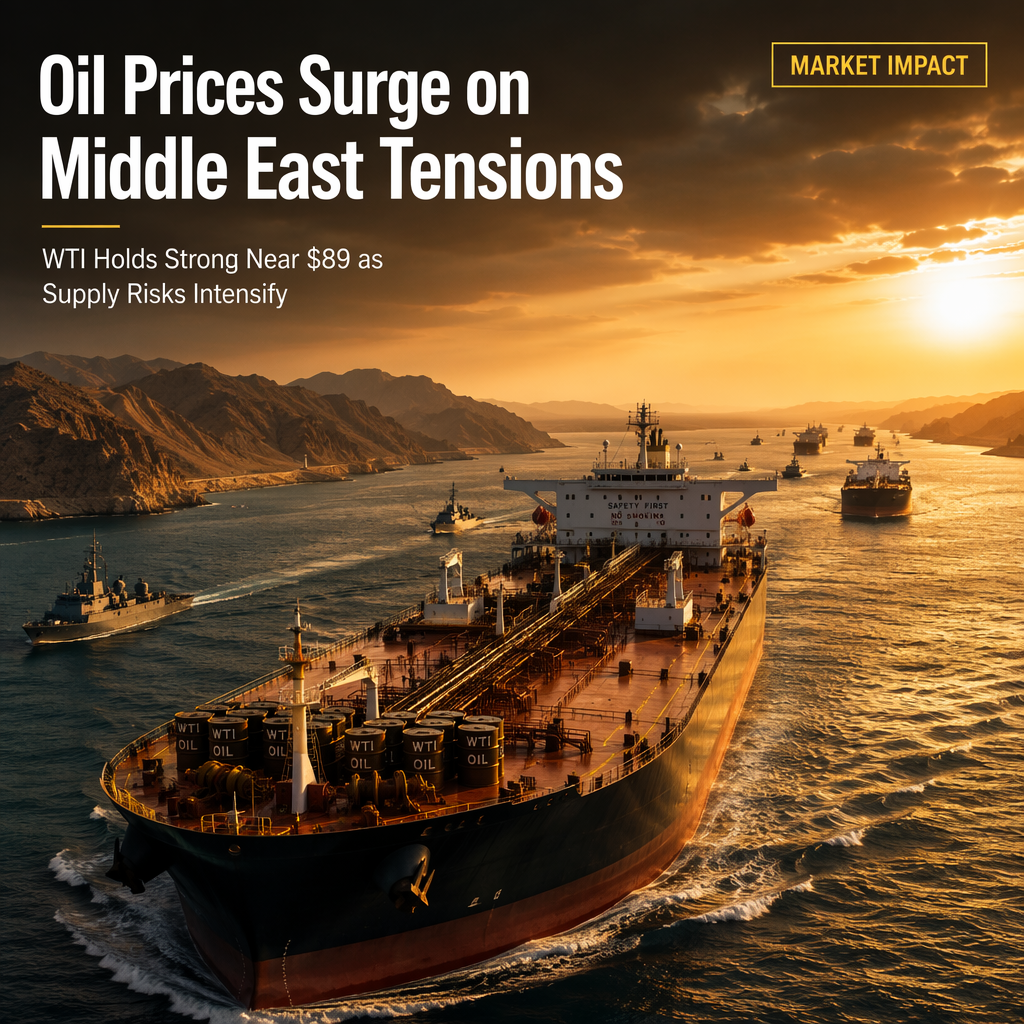
West Texas Intermediate (WTI) crude oil prices eased on Friday as traders took profits after a significant 6% surge the previous day. Despite this pullback, WTI remained robust, trading around $89 per barrel and posting a notable gain of approximately 9% for the week [1]. The primary driver behind this bullish momentum is the intensifying conflict in the Middle East, which has heightened supply risks around two critical energy-shipping routes: the Strait of Hormuz and Bab el-Mandeb [1].
From a technical standpoint, WTI has demonstrated strong performance, rebounding from near $67 at the start of the month and reclaiming its 50-day, 100-day, and 200-day Simple Moving Averages (SMAs). The price is currently retesting the 100-day SMA at $88.30, which serves as immediate support [1]. Momentum indicators such as the Relative Strength Index (RSI) near 65 and a positive Moving Average Convergence Divergence (MACD) reading suggest that buyers remain in control, while the Average Directional Index (ADX) in the low 30s points to a strengthening trend [1].
On the upside, Thursday’s high of $92.25 is identified as immediate resistance, with further resistance at the $95.00 level. A sustained move above these levels could pave the way toward the psychological $100.00 mark and potentially the war-driven peak near $113.00 [1]. On the downside, the 100-day SMA at $88.31, the 50-day SMA near $82.16, and the 200-day SMA around $74.55 are seen as key support levels that would need to be breached to signal a deeper corrective phase [1].
The article notes that the technical analysis was assisted by an AI tool and provides background on WTI as a benchmark for the oil market, emphasizing that supply and demand dynamics, geopolitical instability, and OPEC decisions are major price drivers [1].
CONCLUSION
WTI oil prices remain elevated near $89 per barrel, supported by escalating Middle East tensions and strong technical momentum. Key resistance and support levels will be closely watched by traders, with the potential for further gains if supply risks persist. The market impact is high, as geopolitical developments continue to drive volatility in oil prices.