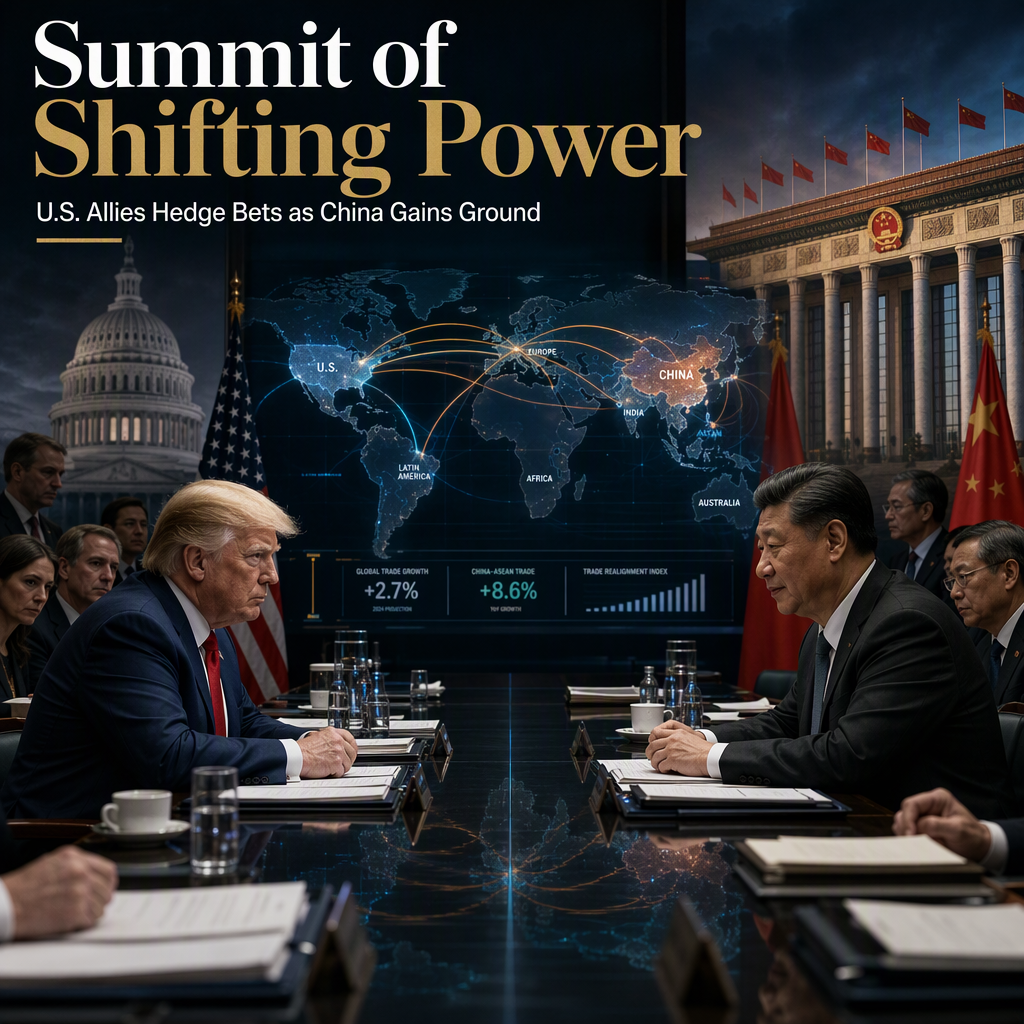
President Donald Trump is meeting with Chinese President Xi Jinping at a two-day summit amid heightened tensions and shifting global alliances. The summit comes as the U.S. faces challenges in isolating China, with traditional allies increasingly seeking to balance their relationships between Washington and Beijing rather than aligning strictly with the U.S. [1]. Polling data from Pew indicates a significant decline in allied confidence in the U.S., with the share of Canadians viewing the U.S. as a reliable partner dropping from 83% in 2022 to 35% in 2026 [1].
China has strengthened its global position by deepening trade ties and leveraging critical resources such as rare earths. Its global trade surplus is projected to exceed $1 trillion for the second consecutive year, reaching a record $1.2 trillion in 2025, despite a decline in exports to the U.S. [1]. These developments have complicated the U.S.'s efforts to pressure China, as allies are less willing to support American-led initiatives on issues like tariffs, defense spending, and technology restrictions [1].
The summit is seen as a test of whether recent strains with U.S. allies have diminished America's ability to marshal collective power against China. According to Ryan Hass, director of the John L. Thornton China Center at the Brookings Institution, "America retains unmatched power on the world stage, but leverage requires a united front and there are a shrinking number of countries willing to follow America's lead right now" [1].
Key topics at the summit include Taiwan, trade, and Iran, with both sides seeking to convert their economic and diplomatic relationships into leverage [1]. The changing global order is evident as China presents itself as a stable alternative to what it describes as an "erratic and violent United States" [1].
CONCLUSION
The Trump-Xi summit underscores the challenges facing U.S. leadership as allies increasingly hedge their positions between Washington and Beijing. With declining allied confidence and China's growing economic leverage, the U.S. faces a more complex environment in rallying support for its China policy.