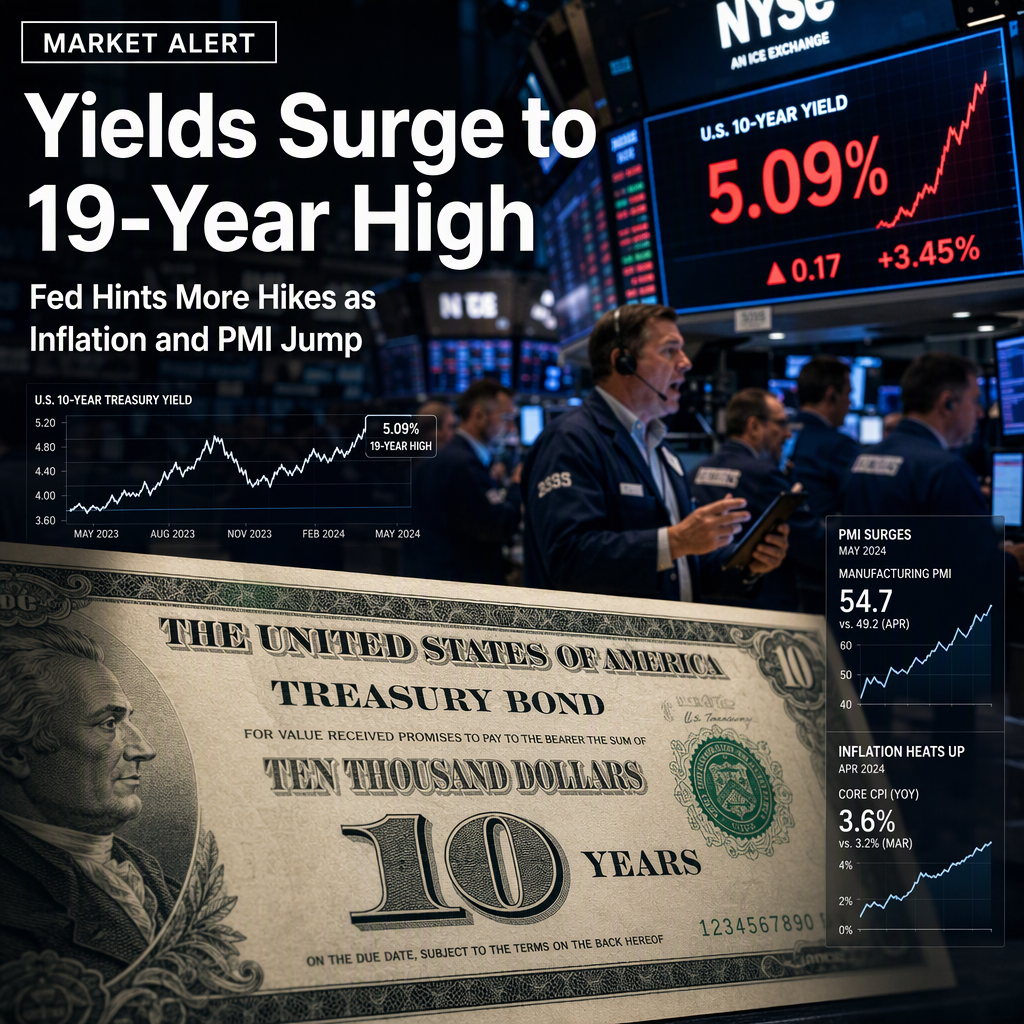
On Wednesday, the US 10-year Treasury yield surged to just under 5.10%, marking its highest level in 19 years, following remarks from Federal Reserve Governor Michael Barr supporting further interest rate hikes to combat persistent inflation pressures [1][3]. Barr stated at a Chicago Fed conference that 'further policy adjustments are likely to be needed to ensure inflation comes down to target in a timely fashion,' emphasizing the Fed's commitment to price stability and maximum employment [3]. His comments came after S&P Global's flash Purchasing Managers Index (PMI) surveys showed robust business activity, with the manufacturing index at 57 (forecast: 53.5) and services at 58.7 (forecast: 56), both reaching their highest levels since 2021 and more than four years, respectively [2][3]. The composite PMI rose to 58.4, a 62-month high, indicating broad economic expansion [3].
The PMI surveys also revealed intensifying price pressures, with input costs rising at the steepest rate in four years, driven by higher fuel and transportation costs and rising wages. S&P Global's price gauges hit their highest since October 2022, signaling further inflation in the coming months [1][2][3]. Employment growth accelerated, with service sector hiring at its fastest rate since June 2002 and manufacturing employment at its highest since February 2021 [3].
Market reactions were pronounced: the odds of an October rate hike jumped to about 71-73%, according to CME's FedWatch and rate futures, up from under 10% in August [1][2][3]. The 2-year Treasury yield, highly sensitive to Fed policy, climbed more than 13 basis points to 4.9% [3]. The Dow Jones Industrial Average continued its slide, trading near 51,500 and erasing about two-thirds of its June-to-August rally, with McDonald's (MCD) as the biggest faller on company news [2]. The S&P 500 and NASDAQ Composite also declined, reflecting broad market selling [2].
Rate futures now suggest the Fed's most likely setting will be 4.75-5.00% by July 2027, with four more quarter-point increases expected and no rate cuts anticipated through the end of 2027 [2]. Barr also cited the boom in artificial intelligence (AI) investment, tariffs, and the war in the Middle East as factors contributing to inflation [2]. Upcoming events include speeches by Cleveland Fed President Hammack and the University of Michigan consumer survey, forecast to show 4.6% inflation expectations for the next year, more than twice the Fed's 2% target [2].
CONCLUSION
The combination of strong PMI readings, surging inflation, and hawkish Fed commentary has pushed US Treasury yields to multi-year highs and increased market expectations for further rate hikes. Equity markets responded negatively, with major indices declining and rate-sensitive sectors under pressure. The outlook remains cautious as investors brace for continued monetary tightening and persistent inflation risks.