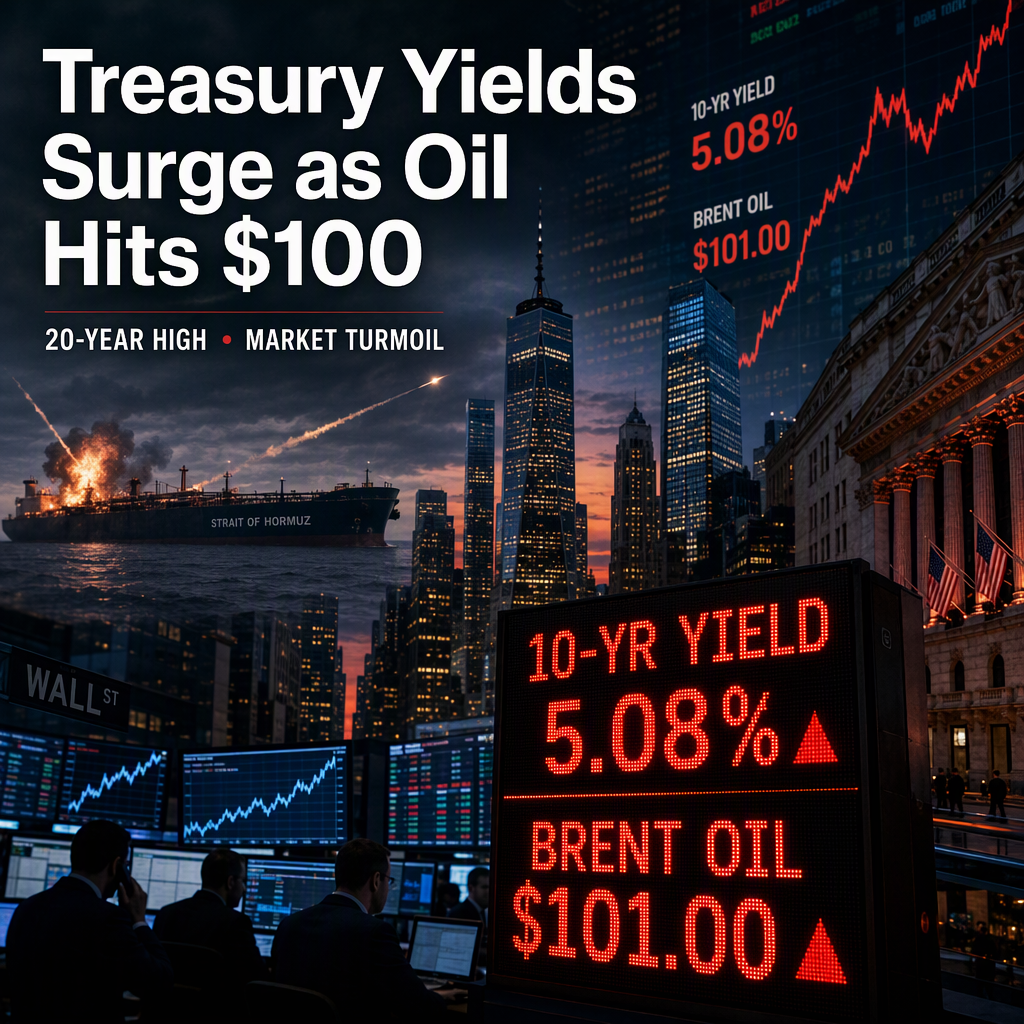
U.S. Treasury yields surged to levels not seen in nearly two decades on Wednesday, driven by a sharp rise in oil prices and renewed inflation fears [1]. The 10-year Treasury yield climbed as high as 5.08%, its highest since June 2007, while the 30-year yield reached 5.38%, a level last observed before the global financial crisis [1]. European Brent oil prices rose above $101 per barrel, and U.S. crude oil approached $92, reflecting heightened concerns over energy supply disruptions and inflationary pressures [1].
The market's anxiety was further fueled by geopolitical developments. On Tuesday, President Donald Trump stated that U.S. officials were in communication with Iranian representatives at the U.N. General Assembly, which initially led to a dip in oil prices and optimism about a potential resolution to the Iran war, now in its seventh month [1]. However, hopes faded after a U.K. maritime trade monitoring agency reported Wednesday morning that a cargo vessel was 'stuck by an unknown projectile' in the Strait of Hormuz, a critical chokepoint for global energy supplies that has been nearly paralyzed due to the ongoing conflict [1].
President Trump also unsettled energy markets by expressing support for a ban on U.S. diesel fuel exports, stating, 'I’ve said ‘Let’s not send out the diesel,’ I’ve called for it within my people. I’ve been talking about it' [1]. The American Petroleum Institute warned that such a ban could lead to reduced refinery runs, global economic damage, and even higher U.S. prices, while Energy Secretary Chris Wright said, 'The blunt tool of banning diesel exports definitely doesn’t work' [1]. Following these remarks, benchmark diesel futures surged as much as 7% in European trade [1].
In addition to energy market turmoil, fresh economic data contributed to the rise in Treasury yields. S&P Global reported that U.S. business activity growth accelerated for the fourth consecutive month in September, reaching its fastest rate in over five years [1]. However, firms' input costs jumped at the steepest rate in four years, driven by higher fuel and transport costs, which are expected to add further upward pressure on selling prices and inflation [1].
CONCLUSION
The combination of surging oil prices, geopolitical tensions in the Middle East, and rising business costs has driven Treasury yields to their highest levels in nearly 20 years. Market sentiment remains negative as inflation fears intensify and energy market volatility persists.