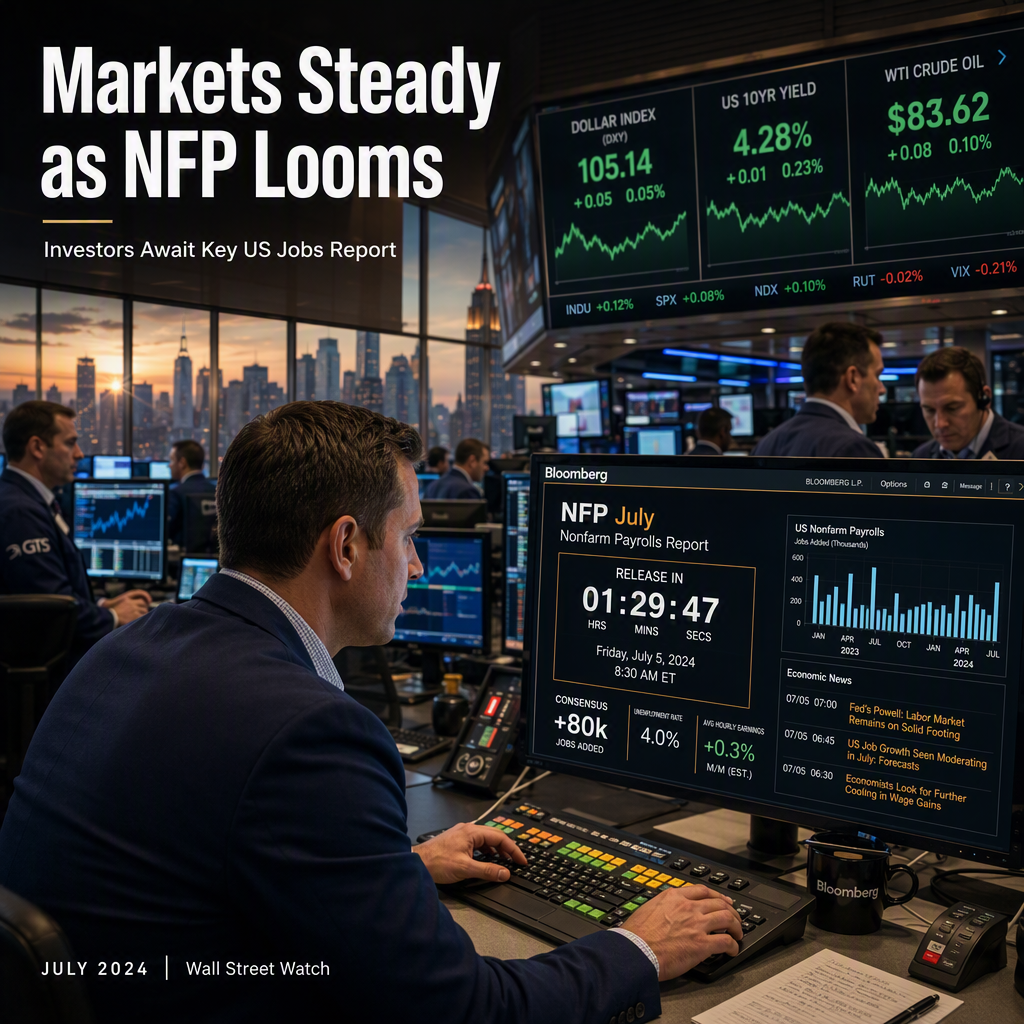
The US Bureau of Labor Statistics is set to release the July Nonfarm Payrolls (NFP) report, a key indicator for assessing the health of the US labor market and influencing Federal Reserve policy decisions [1][2][3][5][6]. Market consensus expects an increase of 80,000 to 83,000 new jobs in July, following June's print of 57,000 [1][2][6]. The unemployment rate is widely forecast to remain unchanged at 4.2% [1][2][3][6]. Average hourly earnings are projected to rise by 0.3% month-over-month and 3.5% year-over-year [1][2][3].
Economists at Deutsche Bank anticipate a slightly firmer labor market, projecting +65,000 jobs and private payrolls also up by +65,000, with the unemployment rate steady at 4.2% but with a risk of rounding up to 4.3% if labor force participation rebounds [1]. Danske Bank forecasts +70,000 jobs and highlights that leading data still point to solid labor market conditions, though weak labor supply growth weighs on employment growth [3]. BNY Mellon strategists emphasize that the breakeven rate to keep the unemployment rate steady is not much above 50,000 jobs per month, given slower labor force growth [1].
Market reactions have been muted ahead of the report. The US Dollar has ticked up slightly, with the GBP/USD and AUD/USD pairs trading within established ranges as traders await the NFP data for direction [2][5]. Treasury yields have held steady, with the 10-year yield at 4.6719%, the 2-year at 4.2431%, and the 30-year at 5.2189% [6]. Energy prices have risen, with West Texas Intermediate futures up 0.67% at $77.81 and Brent crude nearly 1% higher at $83.31 [6].
Analyst opinions are mixed regarding the Federal Reserve's next move. While some, such as Dan Lacalle of Tressis, argue that further rate hikes would be detrimental to the economy and unnecessary given current inflation data, others note that the upcoming NFP report will be a crucial input for the Fed's September policy decision [1][6]. The CME FedWatch tool indicates a 54.5% probability of a rate hike at the next meeting [3].
Technical analysis across major currency pairs suggests that traders are cautious, with key support and resistance levels identified but no decisive moves expected until after the jobs data is released [2][3][5].
CONCLUSION
Markets are in a holding pattern as investors await the July US Nonfarm Payrolls report, with consensus expecting modest job growth and a steady unemployment rate. The outcome of the report is likely to influence both currency and bond markets, as well as the Federal Reserve's upcoming policy decisions. Until the data is released, market participants remain cautious, with limited directional moves across major asset classes.