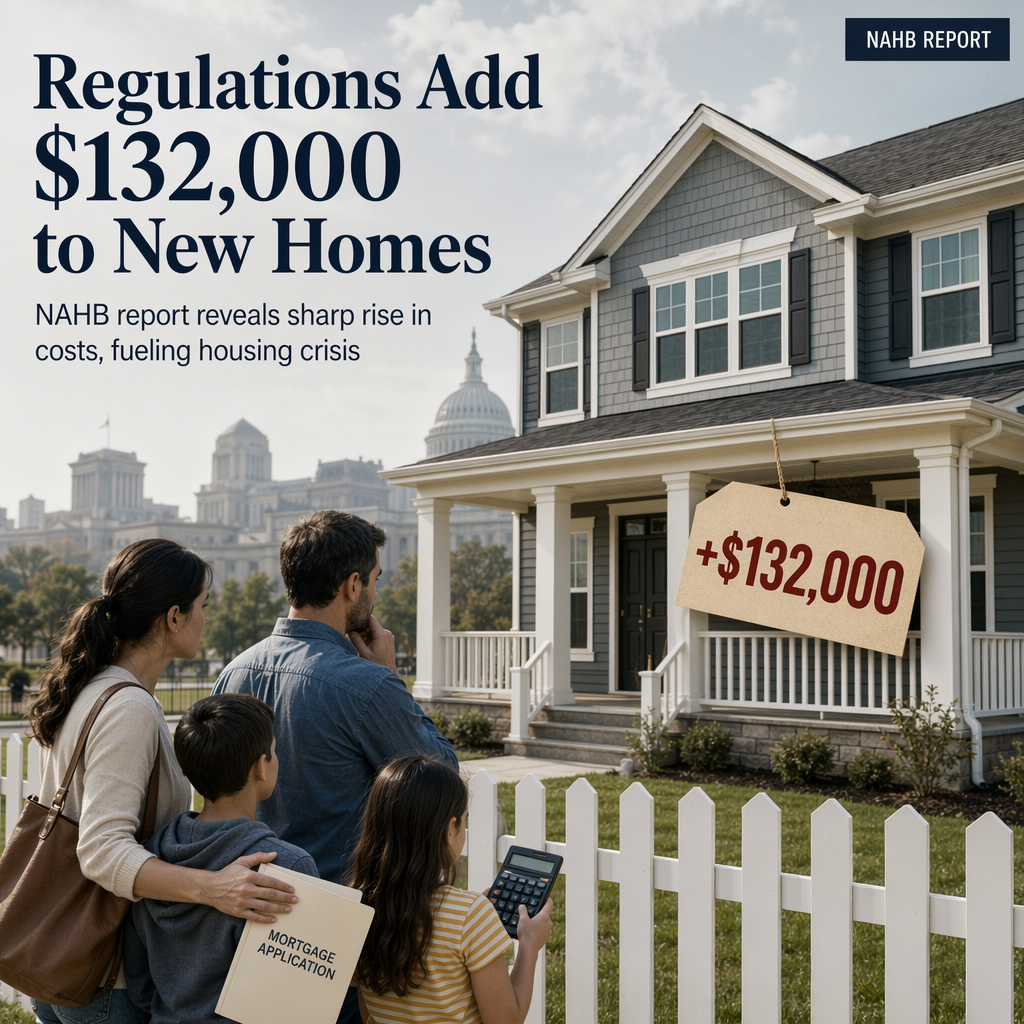
A new report commissioned by the National Association of Home Builders (NAHB) reveals that government regulations are adding an average of $131,734 to the cost of newly built homes in the United States, representing 26.4% of the final sale price based on an average new-home price of $499,500 [1]. This marks the largest increase between consecutive NAHB surveys since 2011, with regulatory costs climbing 40% since 2021 [1].
NAHB President and CEO Jim Tobin stated that the escalating regulatory burdens at federal, state, and local levels are exacerbating the nation's housing affordability crisis, making homeownership increasingly unattainable for many families amid elevated mortgage rates and limited inventory [1]. The report estimates the U.S. faces a structural housing shortage of 1.2 million homes, with rising regulatory costs making it more difficult to increase supply [1].
The study highlights regional disparities, noting that states in the Southeast such as Texas, Florida, and the Carolinas generally have lower regulatory costs compared to states like California, New York, New Jersey, and Illinois [1]. Tobin expects regulatory costs to continue rising but believes that reforms, such as those proposed in the bipartisan 21st Century ROAD to Housing Act, could help slow the pace by streamlining permitting, reducing barriers to new construction, and expanding financing tools [1].
The NAHB clarified that the study is not intended to argue for the elimination of all regulations, but rather to quantify their cumulative effect on housing affordability [1]. The issue of housing affordability and regulatory costs is expected to be a key focus in the upcoming 2026 midterm elections as lawmakers face growing pressure to address the crisis [1].
CONCLUSION
The NAHB report underscores the significant impact of government regulations on new home prices, with costs rising sharply in recent years and contributing to the nation's housing shortage. As affordability remains a central concern, the findings are likely to intensify policy debates and legislative efforts aimed at reducing regulatory barriers and increasing housing supply.