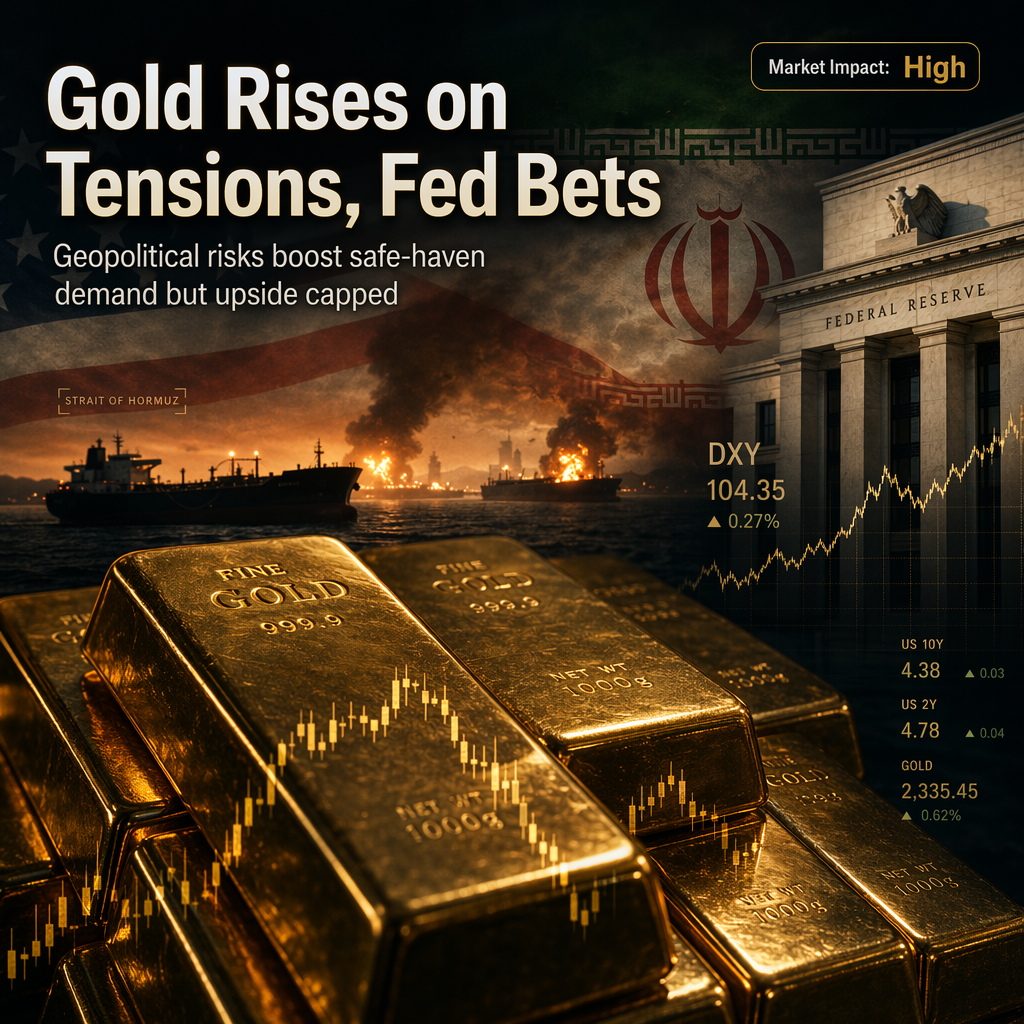
Gold (XAU/USD) traded higher on Thursday, consolidating modest gains as renewed hostilities between the United States and Iran revived concerns over energy-driven inflation and reinforced expectations that the Federal Reserve (Fed) may need to raise interest rates [1][4]. At the time of writing, gold was trading around $4,102, up 0.66% on the day according to one source [1], and near $4,110, up 0.8%, according to another [4]. The US Dollar Index (DXY) was reported at around 101.00 after touching an intraday low of 100.79 [1], and at 100.95, down 0.1% on the day, in another report [4].
The escalation in US-Iran tensions included an exchange of attacks overnight, with US President Donald Trump stating, "This is in retribution for yesterday's bombing of ships by Iran. If it happens again, it will get much worse!" [1]. Iranian state media reported that multiple US artillery shells struck a railway bridge west of Aghala in Golestan, causing several explosions [4]. Iran reiterated its threat to close the Strait of Hormuz if fresh attacks occur, raising concerns about potential disruptions to global oil flows [1]. Despite the heightened tensions, risk aversion in broader markets remained contained, with some hope for the resumption of negotiations as President Trump suggested Tehran "wants to make a deal so badly" [3].
Hawkish Fed expectations are providing additional support to the US Dollar. According to the CME FedWatch Tool, markets are pricing in a 63% chance of a rate hike at the September meeting [1], while another source reports that the odds of the Fed raising interest rates at least once this year have increased to 83.4% from almost 78% a week ago [4]. Minutes from the Fed's June 16-17 meeting showed officials remained divided on the interest rate outlook, with some seeing a case for higher rates if inflation remains elevated [1][3]. Analysts at OCBC Bank noted that while geopolitics would normally support gold, the current move is working more through the oil, inflation, and rates channel, and rallies in gold and silver may struggle to sustain unless oil stabilizes or Fed/rates concerns ease [1].
Technical analysis from both sources indicates that gold maintains a bearish near-term bias, trading below key moving averages such as the 20-day Simple Bollinger middle band at $4,135 [1] and the 20-day EMA at $4,153.16 [4]. The Relative Strength Index (RSI) remains below the neutral 50 mark, suggesting subdued upside momentum [1][4]. Resistance levels are identified at $4,135 and $4,200 [1], and $4,153.16 and $4,200 [4], while support is seen at $4,000 and $3,944 [1], and at $3,941.76 and $3,886.62 [4].
The broader FX market also reflected the impact of these developments. The New Zealand Dollar (NZD/USD) advanced after a hawkish Reserve Bank of New Zealand rate hike, but its gains were capped by US-Iran tensions boosting demand for safe-haven assets like the US Dollar [2]. The British Pound (GBP/USD) hit fresh three-week highs above 1.3400 as the US Dollar pulled back, with markets hopeful for continued US-Iran negotiations and the Fed minutes showing division on the rate outlook [3].
CONCLUSION
Gold prices rose modestly amid renewed US-Iran tensions and increased expectations of a Fed rate hike, but upside momentum remains limited due to technical resistance and hawkish monetary policy prospects. While geopolitical risks are supporting safe-haven demand, analysts caution that sustained rallies in gold may be difficult unless oil prices stabilize or Fed concerns ease. The market impact is high, with broader FX markets also reacting to the evolving geopolitical and monetary policy landscape.