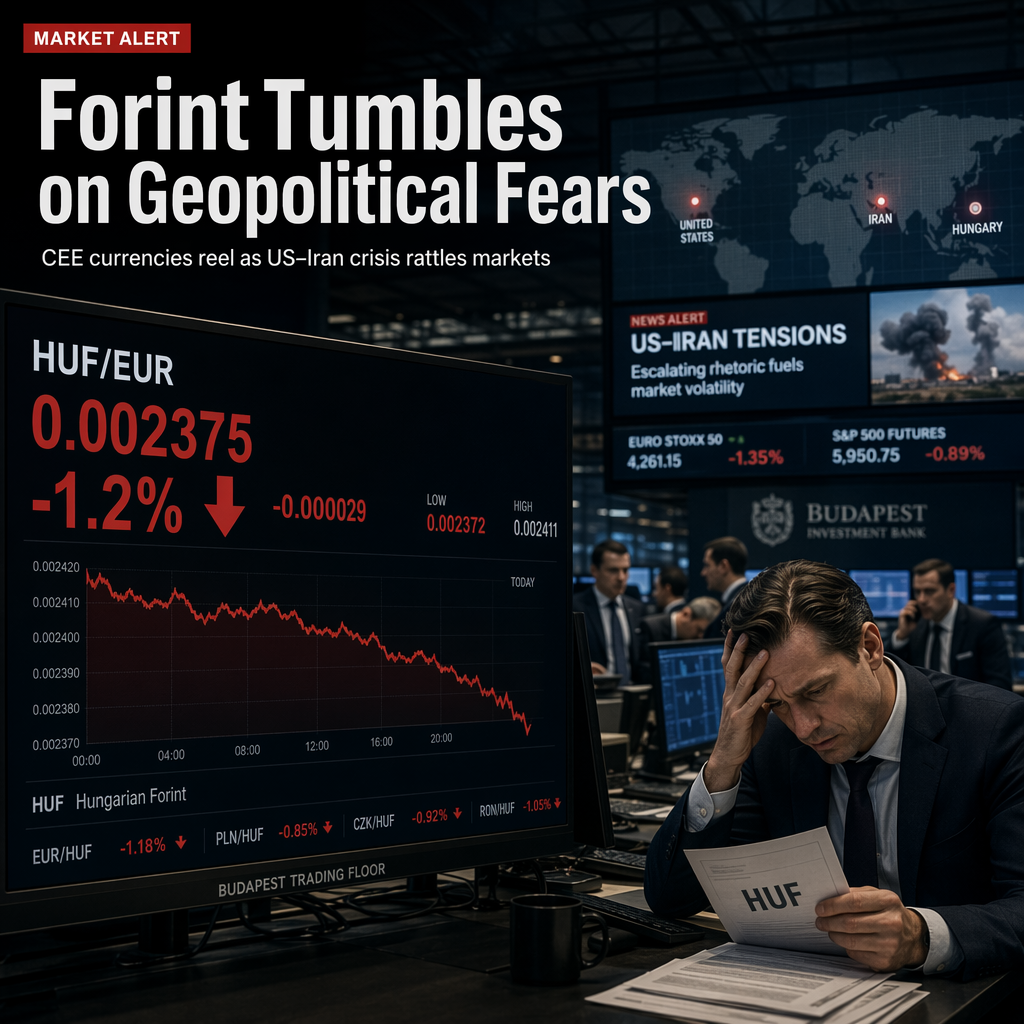
The Central and Eastern European (CEE) foreign exchange markets experienced significant volatility following headlines related to US–Iran tensions, according to ING’s Frantisek Taborsky [1]. The National Bank of Poland (NBP) maintained a neutral policy stance, with its latest statement largely unchanged from June. The Monetary Policy Council (MPC) acknowledged factors such as lower oil prices, weaker growth in Poland’s key trading partners, and a recent decline in inflation [1].
The geopolitical developments triggered a broad sell-off in CEE rates and FX markets. The EUR/HUF currency pair saw a notable 1.2% increase, marking its largest upward move since early March at the onset of the conflict, highlighting the Hungarian forint’s vulnerability due to substantial long positioning built up after the April general election [1]. In the Czech Republic, market participants priced in an additional half rate hike, bringing the total expected hikes to one and a half. In Poland, expectations shifted from a 50% probability of a rate cut to stable rates for an extended period [1].
Taborsky notes that the forint’s vulnerability is compounded by the Hungarian central bank’s indication of a series of rate cuts at its June meeting, making it an outlier in the region. He suggests that if geopolitical tensions prove temporary and EUR/HUF returns below 356, levels around 360 could be attractive for new forint long positions [1].
CONCLUSION
Geopolitical tensions have led to a sharp sell-off in CEE FX markets, with the Hungarian forint particularly impacted. While the National Bank of Poland remains neutral, market participants are closely watching for a resolution of tensions, which could present opportunities for new positions in the forint if stability returns.