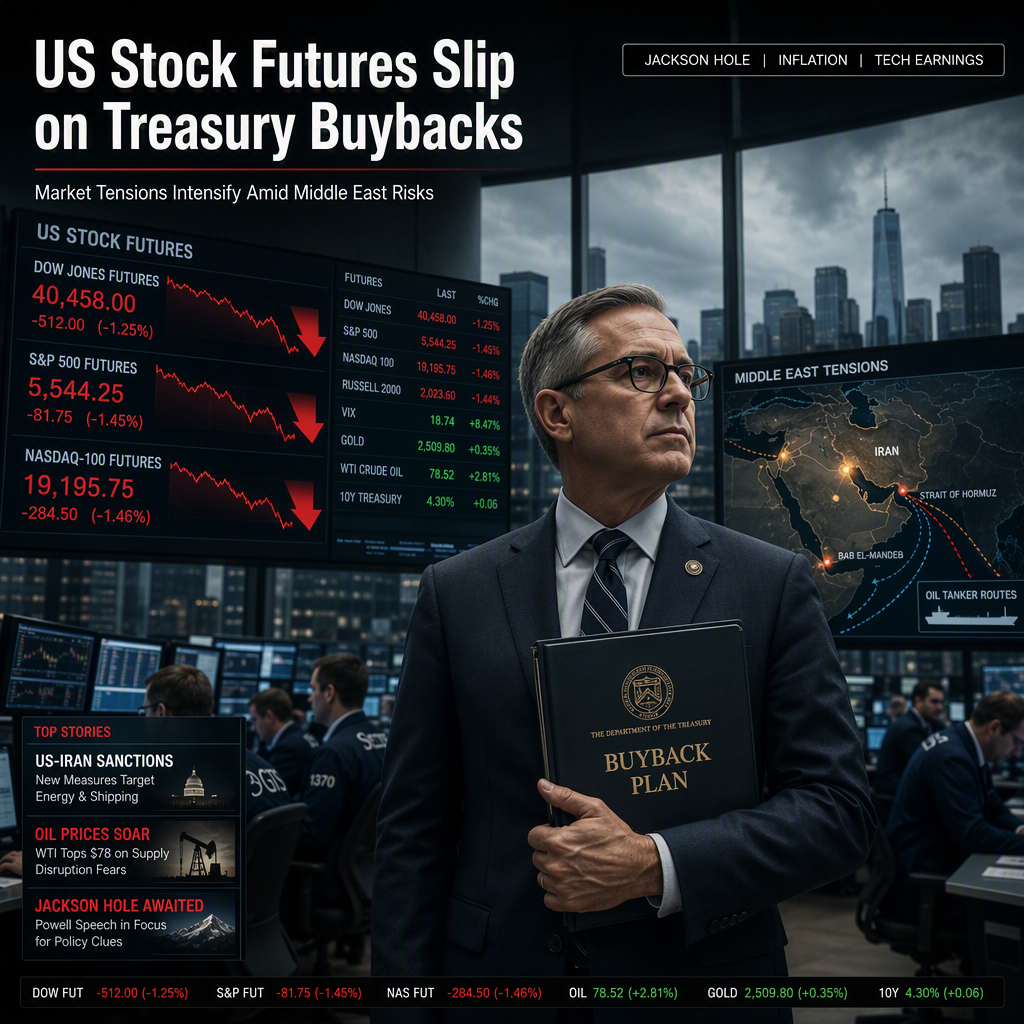
US stock futures declined during European hours on Monday, with Dow Jones futures subdued around 53,350, S&P 500 futures down 0.17% near 7,680, and Nasdaq 100 futures falling 0.65% to approximately 29,200 [1]. The cautious market tone follows the US Treasury Department's announcement to double its buybacks of longer-dated government debt, a move intended to counteract surging bond yields. Treasury Secretary Scott Bessent stated that buybacks could exceed $4 billion, aiming to demonstrate that elevated yields do not accurately reflect the underlying economic fundamentals [1].
Despite this intervention, market sentiment remains pressured by ongoing geopolitical risks, particularly the US-Iran conflict, which is expected to keep oil prices elevated and inflation persistent, thereby limiting the scope for interest rate cuts [1]. Secretary Bessent also announced plans for unprecedentedly tough sanctions targeting Iran and its trade partners, which could further constrain global energy supplies as Iranian oil shipments face severe disruptions and offers to Chinese buyers diminish amid a US naval blockade. Tehran has dismissed these measures as ineffective, citing its experience with economic blockades [1].
These developments follow a period of market weakness, with the Dow Jones falling 0.8% last week for its second consecutive weekly decline, while the S&P 500 and Nasdaq Composite dropped 1.4% and 2%, respectively, ending three-week winning streaks. The selloff coincided with the 30-year US Treasury yield reaching its highest level in nearly two decades, alongside multi-year high bond yields in Japan, France, and Germany [1].
Looking ahead, investors are focused on upcoming economic catalysts, including the July PCE inflation report and Federal Reserve Chair Kevin Warsh’s speech at the Jackson Hole symposium. Market participants are also awaiting quarterly earnings reports from major technology companies Nvidia and Marvell Technology [1]. According to Deutsche Bank’s US economists, Warsh’s Jackson Hole address may emphasize structural themes such as artificial intelligence and internal Fed initiatives, rather than immediate rate decisions [1].
CONCLUSION
US stock futures are under pressure as the Treasury's increased buybacks and escalating Middle East tensions heighten market uncertainty. Investors are closely watching upcoming inflation data, Fed commentary, and tech earnings for further direction. The market remains cautious amid persistent geopolitical and macroeconomic risks.