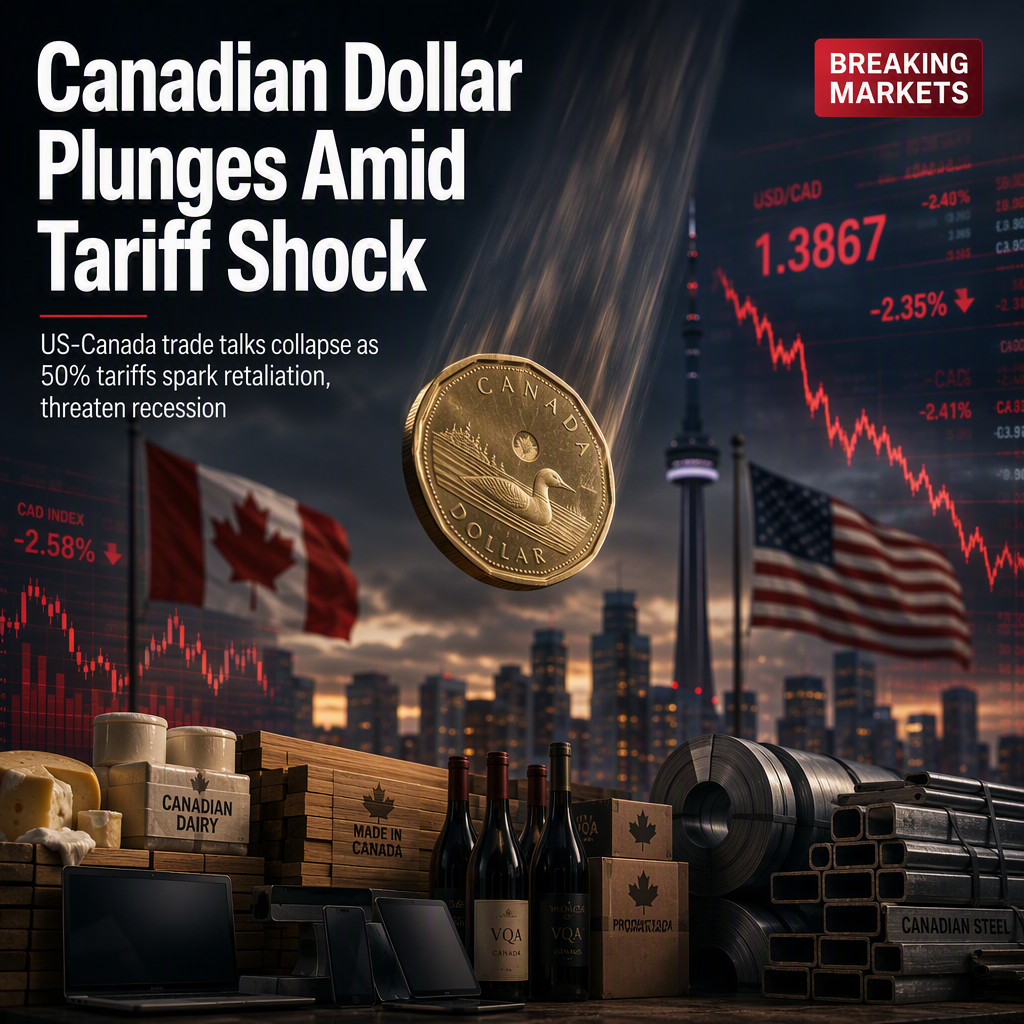
The Canadian dollar (CAD) experienced a significant decline after trade negotiations between Canada and the United States collapsed, resulting in the US imposing 50% tariffs on approximately $20 billion worth of Canadian imports [1][2]. The affected goods include dairy, wine, wood products, ceramics, and a range of other sectors [2]. In response, Canadian Prime Minister Mark Carney announced plans for dollar-for-dollar retaliatory tariffs starting September 8, targeting industries such as steel, dairy, agricultural equipment, paper, and electronics, with further details to be released in the coming days [1][2].
The breakdown in trade talks has injected fresh uncertainty into the future of the United States-Mexico-Canada Agreement (USMCA), which is currently under renegotiation, and has raised concerns about Canada's economic outlook [1][2]. Domestic conditions in Canada had shown improvement, with unemployment falling for a third consecutive month in July to a two-year low of 6.4%, supporting a recent recovery in the CAD [1]. However, the renewed trade tensions threaten to derail this momentum and leave the loonie vulnerable [1].
Market reaction was swift, with the Canadian dollar falling 0.55% against the US dollar as of 4:30 a.m. ET, and also declining against the euro, British pound, and Japanese yen [2]. ING strategists noted that as a smaller, more open economy, Canada stands to lose more from the trade conflict, though Prime Minister Carney has indicated a willingness to consider fiscal stimulus to support affected businesses [2].
Analysts highlighted the potential economic impact, with Bradley Saunders of Capital Economics warning that the high tariff rate could cripple the most exposed industries, especially since there is no longer an exemption for goods compliant with the USMCA [2]. Although the targeted goods represent only about 0.6% of Canada's GDP, Saunders cautioned that a collapse in exports could push already-weak GDP growth toward zero, particularly if weaker US demand for finished goods affects upstream industries [2]. Saunders further estimated that if the US extends the 50% tariffs to 20% of Canada's US-bound exports (up from 5%), it could reduce Canadian GDP by around 2% and potentially push the country into recession [2].
CONCLUSION
The collapse of US-Canada trade talks and the imposition of steep tariffs have triggered a sharp decline in the Canadian dollar and heightened uncertainty over Canada's economic outlook. With both sides preparing for retaliatory measures and analysts warning of significant downside risks to growth, the situation poses a high-impact threat to Canadian markets and industries. The potential for further escalation remains, with the risk of recession looming if trade tensions intensify.