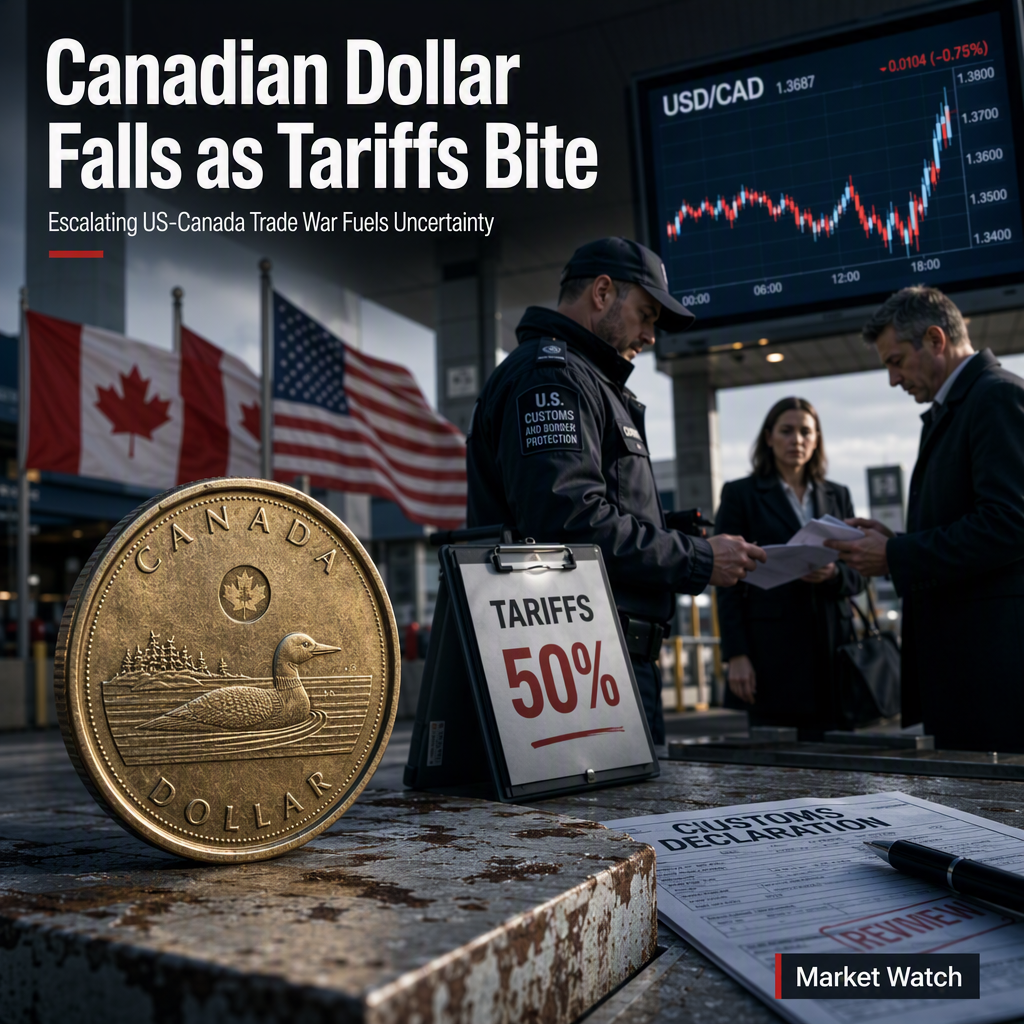
The USD/CAD currency pair maintained a positive bias for the second consecutive day, trading around the mid-1.3800s during the Asian session on Tuesday, following a recent recovery from a three-month low last week [1]. The Canadian Dollar (CAD) remains under pressure due to several factors, including a firmer US Dollar (USD), ongoing geopolitical tensions, and the escalation of a US-Canada trade war [1].
On Saturday, the United States imposed 50% tariffs on $20 billion worth of Canadian goods after trade negotiations between the two countries collapsed on Friday [1]. In response, Canadian Prime Minister Mark Carney announced retaliatory tariffs set to begin on September 8 [1]. Strategists at Scotiabank noted that the abrupt collapse of trade talks has undermined the positive sentiment surrounding the CAD developed over the past four weeks and signals a period of heightened uncertainty in US-Canada relations [1]. The Canadian government has pledged to respond 'dollar for dollar' to the US tariffs and promised another round of domestic aid for affected businesses [1].
Geopolitical risks also remain elevated, with US Treasury Secretary Scott Bessent announcing a campaign to isolate Iran from the global economy and warning of US sanctions for countries doing business with Iran [1]. Iran's Supreme National Security Council secretary, Mohsen Rezaei, threatened to halt all oil exports through the Strait of Hormuz if economic warfare continues, supporting crude oil prices and the safe-haven USD [1]. While higher oil prices could benefit the commodity-linked CAD, the negative impact of trade tensions and a stronger USD are currently outweighing this support [1].
Market participants are cautious, awaiting further cues on the US Federal Reserve's policy path, with inflation risks from volatile energy prices keeping bets for at least one Fed rate hike in 2026 on the table [1]. Attention is now focused on the upcoming release of the US Personal Consumption Expenditures (PCE) Price Index on Wednesday and Fed Chair Kevin Warsh’s keynote address at the Jackson Hole Symposium on Friday [1].
CONCLUSION
The Canadian Dollar is facing significant headwinds from escalating trade tensions with the US and a stronger USD, despite support from higher oil prices. The market is bracing for increased uncertainty in US-Canada relations and awaiting key US economic data and Fed commentary for further direction. Overall, sentiment remains negative for the CAD in the near term.