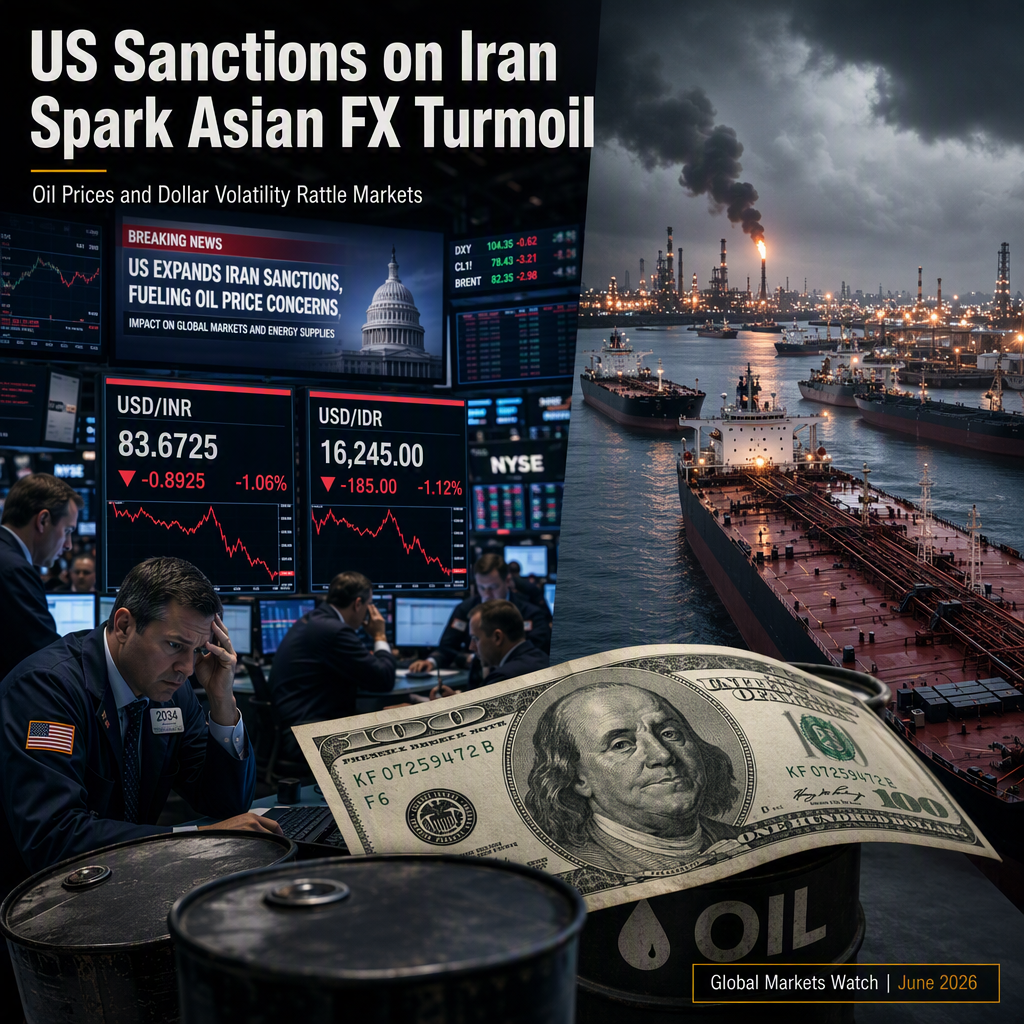
The US Dollar has seen increased volatility against both the Indian Rupee (INR) and the Indonesian Rupiah (IDR) following the United States' announcement of expanded sanctions targeting entities trading with Iran. US Treasury Secretary Scott Bessent warned of an 'economic onslaught against Iran's financial connections around the globe,' outlining plans for an 'economic D-Day' and emphasizing that no country, including China, would be exempt from these measures [1][2]. Bessent also indicated that a major financial institution could face enforcement action this week [2]. In response, Iran stated it is fully prepared to counter US sanctions and expressed confidence that China and Russia would resist US measures [1].
For India, the INR traded marginally higher against the USD in early Tuesday trading, with the USD/INR pair ticking lower to near 95.70. This move was attributed to possible Reserve Bank of India (RBI) intervention in both the spot and Non-Deliverable Forwards (NDFs) markets to counter excessive moves against the domestic currency [1]. Traders expect the USD/INR to remain within the 95.50-96 range in the near term, with RBI interventions curbing gains. However, analysts warn that such support may be short-lived due to persistently high global energy prices, exacerbated by the prolonged closure of the Strait of Hormuz—a critical chokepoint for nearly 20% of global energy supply [1]. The MCX Crude Oil contract expiring September 21 traded 0.25% higher near Rs. 8,160, close to its four-week high of Rs. 8,404 [1]. MUFG analysts highlighted the risk of escalation if China is targeted, but noted that oil markets appeared skeptical of immediate supply disruptions, as Brent crude was down 1.4% on the day [1].
In Indonesia, the Rupiah struggled amid a record current account deficit of USD 12.5 billion in Q2 2026, with the USD/IDR pair trading around 17,770 after halting a three-day losing streak [2]. The deficit was attributed to elevated oil prices, strong import demand, and weaker exports. Market sentiment remained cautious ahead of upcoming July trade data and August inflation figures, with El Niño risks adding to concerns over food prices [2]. Despite these pressures, optimism about Bank Indonesia's policy stance—specifically, its decision to hold interest rates steady for a second consecutive month after a cumulative 100-basis-point hike since May—helped limit further downside for the Rupiah [2]. Technical analysis showed the USD/IDR pair maintaining a bearish near-term bias, with resistance at the nine-period EMA (17,830.89) and the 50-period EMA (17,877.96) [2].
Financial markets expressed concern that the US sanctions could further fuel oil prices, strengthening the US Dollar and US Treasury yields, which could in turn raise fiscal concerns for Washington [1]. However, further gains for the Greenback may be capped by the US Treasury's decision to double its buyback operations for longer-dated bonds, with reports suggesting up to $1 trillion could be used from the Treasury General Account to finance these repurchases, potentially impacting market liquidity and yields [2].
CONCLUSION
The US expansion of sanctions against Iran has heightened volatility in Asian currency markets, particularly impacting the Indian Rupee and Indonesian Rupiah. While central bank interventions and policy stances have provided some support, persistent external pressures—especially elevated oil prices—continue to weigh on these currencies. Market participants remain cautious, closely monitoring geopolitical developments and central bank actions for further direction.