
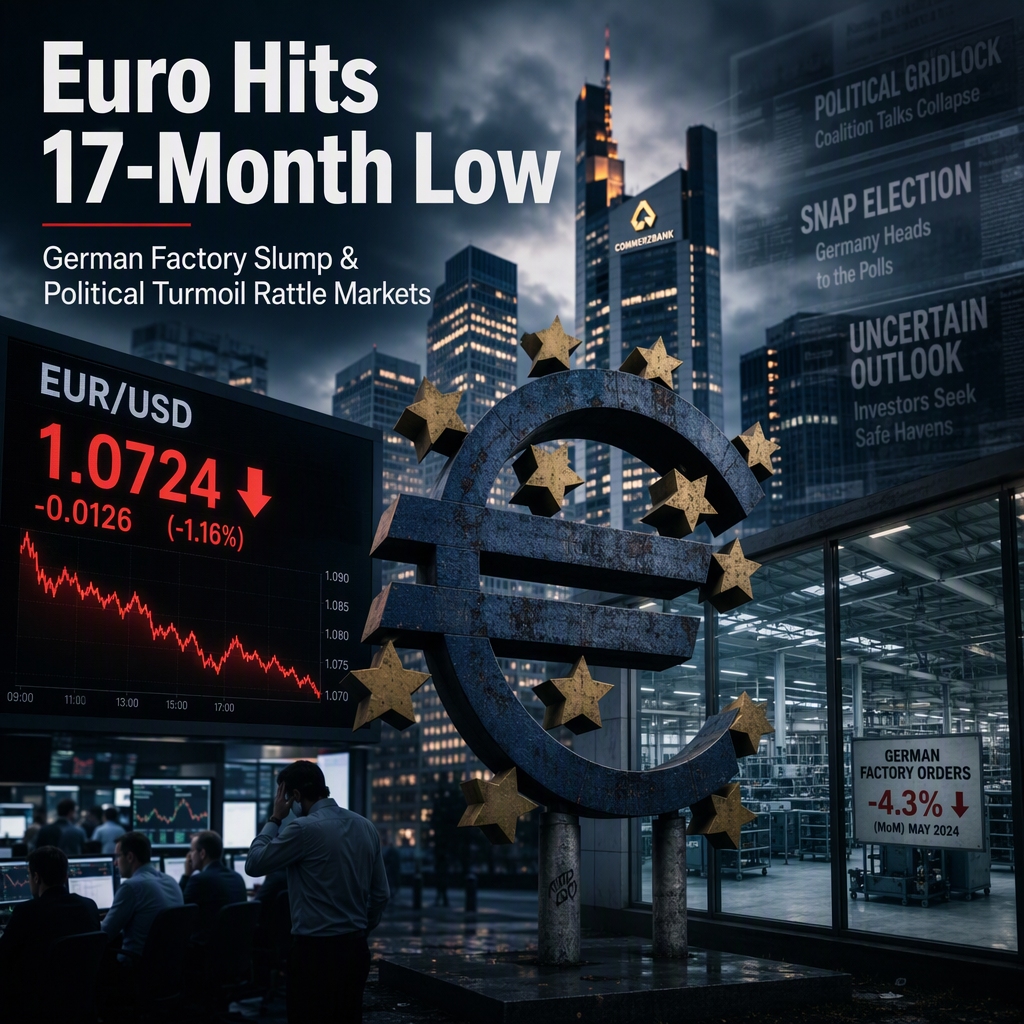
The Euro (EUR) continued its decline against the US Dollar (USD) on Tuesday, driven by a combination of weak German economic data, heightened political uncertainty, and concerns over debt contagion in the Eurozone [1][2]. Destatis reported that German Factory Orders plunged 10.6% in August, sharply reversing a 3.2% increase in July and far exceeding the previous month's 1% decline. Year-over-year, factory orders grew 2.7%, a significant slowdown from the 14% increase seen in July. The main contributor to the August drop was a 61% fall in sales of transport equipment, including aircraft, ships, trains, and military vehicles, after these sales had doubled in July. Excluding large-scale orders, sales of other items declined only 0.1% [1].
Political instability is compounding the Euro's weakness. The gap between France’s OAT yield and the German Bund has reached levels not seen since the 2009 financial crisis, reflecting investor concerns about public finances. France faces political gridlock, with no major savings plan expected until the 2027 presidential elections, while Spain’s President Pedro Sanchez has announced a snap election for November. Additionally, the fragility of Frederich Merz's cabinet in Germany adds to the uncertain political landscape, deterring investors from the Euro [1].
Market reactions have been pronounced. The EUR/USD pair briefly broke below 1.1180, hitting a 17-month low of 1.1160 before rebounding to close around 1.1220. UOB strategists note that while the pace of decline is slowing, the Euro remains under pressure and could test further lows, with technical targets at 1.1145 and 1.1215 over the next 1–3 months. Only a breach of 1.1285 would indicate stabilization in the decline [2].
Oil prices, another factor influencing the Euro, have retreated below $100 per barrel, providing some relief. However, prices remain more than 25% above August's lows, and the ongoing US-Iran conflict keeps prospects for a peace deal uncertain [1]. The European Central Bank (ECB) faces a challenging environment, as further monetary tightening could exacerbate government bond sell-offs, while inflation remains well above the 2% target and is unlikely to retreat without significant improvement in the Middle East situation [1].
CONCLUSION
The Euro's sharp decline is attributed to weak German factory data, escalating political uncertainty, and persistent debt concerns across the Eurozone. Market sentiment remains negative, with analysts warning of further downside risk unless key resistance levels are breached. The ECB faces a difficult balancing act as inflation stays elevated and political instability persists, suggesting continued volatility for the Euro in the near term.