
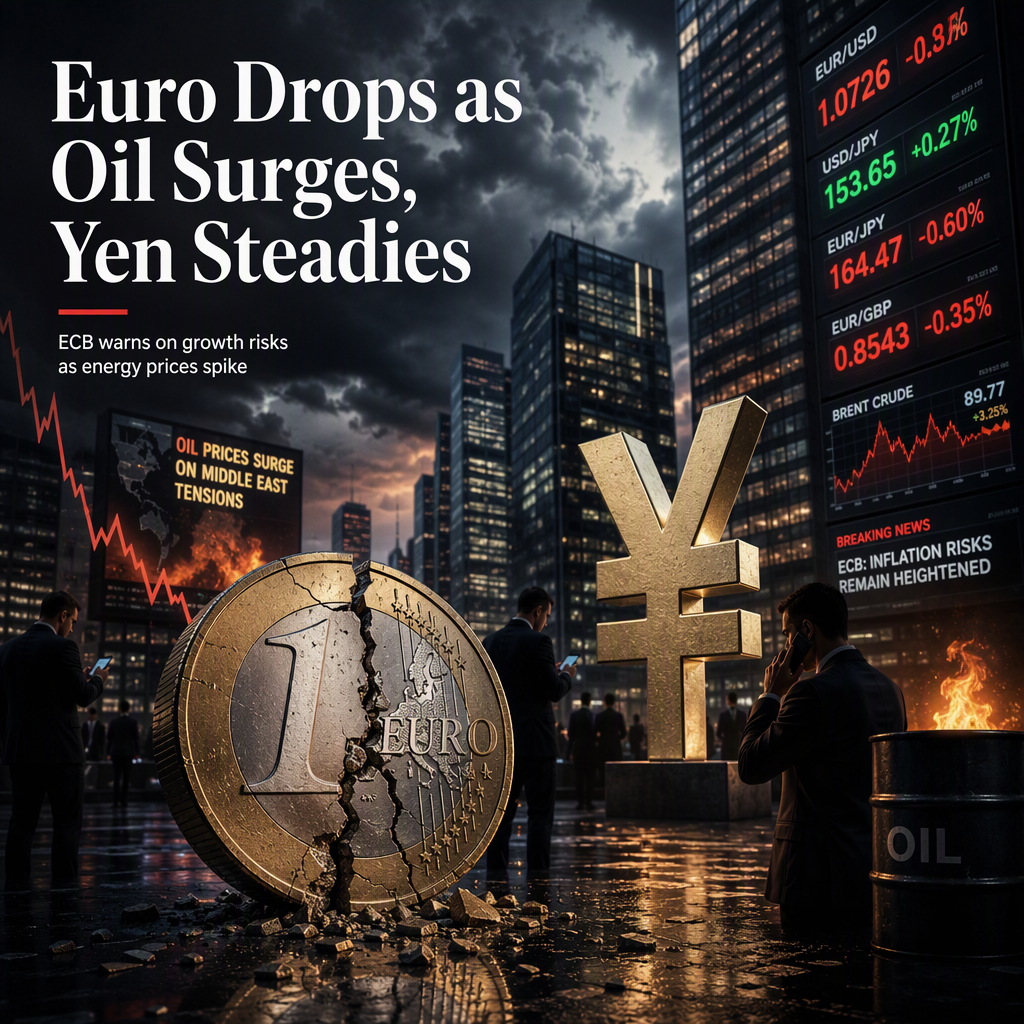
On Wednesday, the Euro (EUR) experienced significant weakness against its major currency peers, trading almost 0.55% lower at around 177.00 against the Japanese Yen (JPY) and showing the largest decline against the US Dollar (USD), with a -0.56% change [1][2]. The Euro also continued its losing streak against the Canadian Dollar (CAD), trading around 1.5920, marking the third consecutive day of declines despite a robust rebound in German industrial production, which surged 2% in September, far exceeding the forecast of 0.5% and reversing August's 1.2% contraction [3]. On an annualized basis, German industrial output rose 2.3%, recovering from a 1.6% decline in the previous month [3].
The Euro's underperformance was attributed to warnings from European Central Bank (ECB) officials about an economic slowdown, citing higher energy prices, tight monetary conditions, and surging bond yields as key concerns [1]. ECB Chief Economist Philip Lane adopted a slightly dovish tone, scoring 4.6/10 on FXS Speechtracker compared to the historic 5.3/10 baseline, and emphasized that underlying inflation has not shifted higher in the medium term. Lane suggested a measured policy stance, noting that demand destruction from elevated energy costs could limit the need for further ECB rate adjustments [1]. Finnish Central Bank Governor Olli Rehn also highlighted worries stemming from higher long-term interest rates [1].
Meanwhile, geopolitical tensions in the Middle East have pushed Brent crude oil prices back above $100 per barrel, intensifying fears of energy-driven inflation and slower growth across the Eurozone [3]. Iran has increased attacks on commercial vessels in the Strait of Hormuz, with nine incidents reported this month, and Saudi forces intercepted a Houthi missile targeting Khamis Mushait [3]. Additionally, a developing storm in the Gulf of Mexico threatens US offshore energy infrastructure, further supporting elevated oil prices and strengthening the commodity-linked Canadian Dollar at the expense of the Euro [3].
In Japan, the Yen (JPY) edged up from recent lows following hawkish comments from Bank of Japan (BoJ) board member Ayano Sato, who expressed openness to further monetary tightening and supported "adjusting gradually" the bank's policy, stating that higher rates "can contribute to achieving sustainable economic growth" [2]. Despite the Yen's appreciation after Sato's remarks, the impact on the USD/JPY pair was moderate, with the pair trading near 158.00, slightly below two-week highs at 158.51 [2]. Technical analysis shows USD/JPY remains capped below the 200-day simple moving average, with resistance at 158.50 and 159.00, and support at 156.40–156.60 [2]. UOB strategists expect USD/JPY to trade within a 156.35–158.70 range over the next 1–3 weeks, noting that while upward momentum is building, it lacks sufficient strength to breach major resistance at 158.70 [4].
Market sentiment remains risk-averse, with persistent risks to global energy flows keeping oil prices elevated and weighing on the Euro. The US Dollar maintains its firm tone, supported by investor caution ahead of the Federal Reserve's monetary policy meeting and rising oil prices impacting oil-importing countries like Japan [2].
CONCLUSION
The Euro's decline is driven by ECB warnings of economic slowdown and surging oil prices, which overshadow positive German industrial data and strengthen the Canadian Dollar. The Japanese Yen holds firm amid hawkish BoJ signals, but USD/JPY remains range-bound as upward momentum is constrained. Overall, heightened energy risks and cautious central bank outlooks are fueling volatility and risk aversion in currency markets.