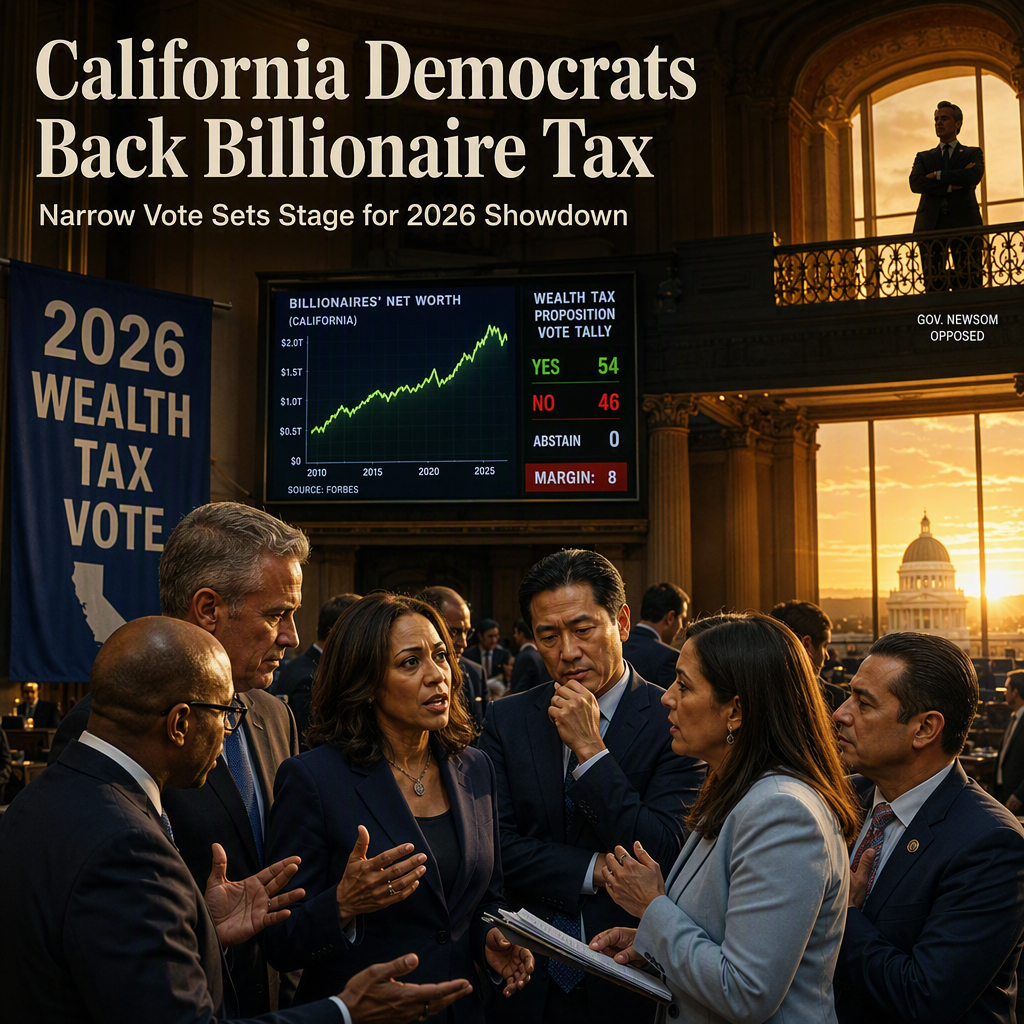
The California Democratic Party has officially endorsed a controversial proposal for a one-time wealth tax on billionaires, which will be presented to voters during the state's 2026 midterm election [1]. The party's executive board voted in favor of supporting the measure, with an initial vote narrowly missing the required 60% threshold for ratification at 59.2%, but a subsequent vote succeeded with approximately 61.7% support [1]. This close margin highlights significant division within the party regarding the proposal [1].
The proposed tax would impose a one-time levy of up to 5% on billionaires, with the intention of generating substantial revenue for California [1]. However, concerns have been raised among party members about how the revenue will be allocated and the potential broader impact on the state's economy [1]. U.S. Representative Ro Khanna (D-Calif.) has expressed support for the measure, while Governor Gavin Newsom has publicly stated his opposition, citing that the measure dedicates almost all of the revenue to a single category of state spending [1]. Newsom clarified his position by stating, "But I’m voting no because this measure dedicates almost all of the revenue it raises to a single category of state spending. So here is what I support: A national billionaires’ tax. A true minimum tax on billionaires — a modern Buffett Rule — that ensures the people at the very top pay at least the tax rate their own workers pay" [1].
The measure's financial implications are significant, as it targets the state's wealthiest residents for a one-time tax, but the internal party split and opposition from high-profile Democrats like Newsom suggest a contentious path ahead [1]. The ultimate decision will rest with California voters in 2026 [1].
CONCLUSION
The California Democratic Party's endorsement of the billionaire wealth tax proposal sets the stage for a high-stakes debate leading up to the 2026 midterm election. While the measure could generate significant revenue, internal party divisions and opposition from Governor Newsom highlight uncertainty about its future. The market and political implications will depend on voter sentiment and the evolving debate over wealth taxation in California.