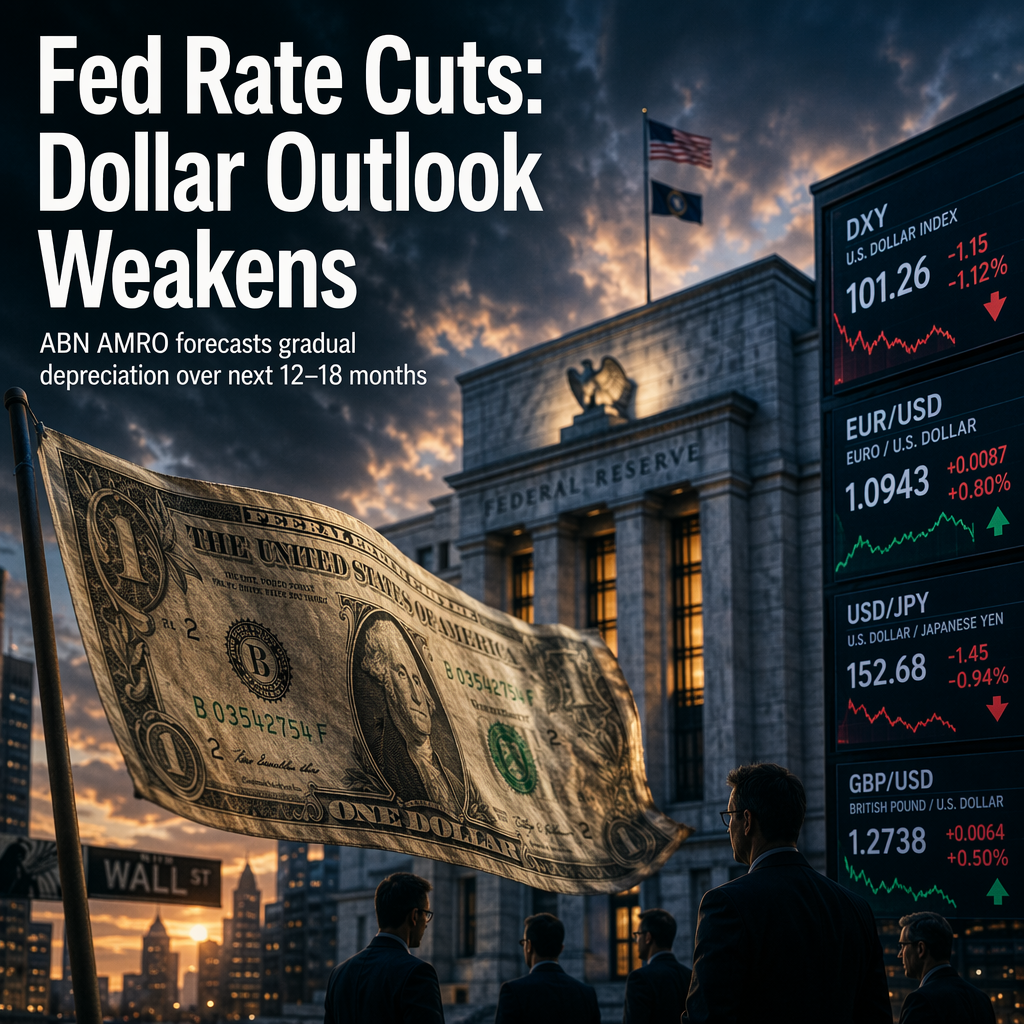
ABN AMRO economists anticipate a significant shift in Federal Reserve policy, projecting that the Fed will begin cutting interest rates in September, initiating a gradual easing cycle that is expected to bring the federal funds rate closer to its longer-run neutral level over the next two years [1]. This policy transition is seen as a key driver for the US Dollar's performance in the coming months, with the economists forecasting that the Dollar is likely to lose some of its recent exceptionalism, particularly if US economic growth converges with that of other advanced economies [1].
The report outlines a baseline scenario in which moderating US growth, easing inflation pressures, and a gradual Fed easing cycle collectively result in a modest depreciation of the Dollar over the next 12 to 18 months [1]. However, the economists caution that if inflation proves more persistent than anticipated, prompting the Fed to delay or reduce the extent of rate cuts, the Dollar could remain stronger for longer against both the Euro and other major currencies [1].
Risks to the Dollar outlook are described as two-sided: a sharper-than-expected US economic slowdown or a renewed flare-up in inflation could both lead to materially different Fed policy paths and, consequently, different trajectories for the Dollar [1]. The analysis focuses on macroeconomic drivers rather than short-term market moves, emphasizing the importance of evolving US growth and inflation dynamics in shaping the currency's outlook [1].
CONCLUSION
ABN AMRO expects the Federal Reserve's anticipated rate cuts to gradually weaken the US Dollar over the next 12 to 18 months, barring unexpected shifts in inflation or growth. The outlook remains sensitive to macroeconomic developments, with both upside and downside risks to the Dollar's trajectory.