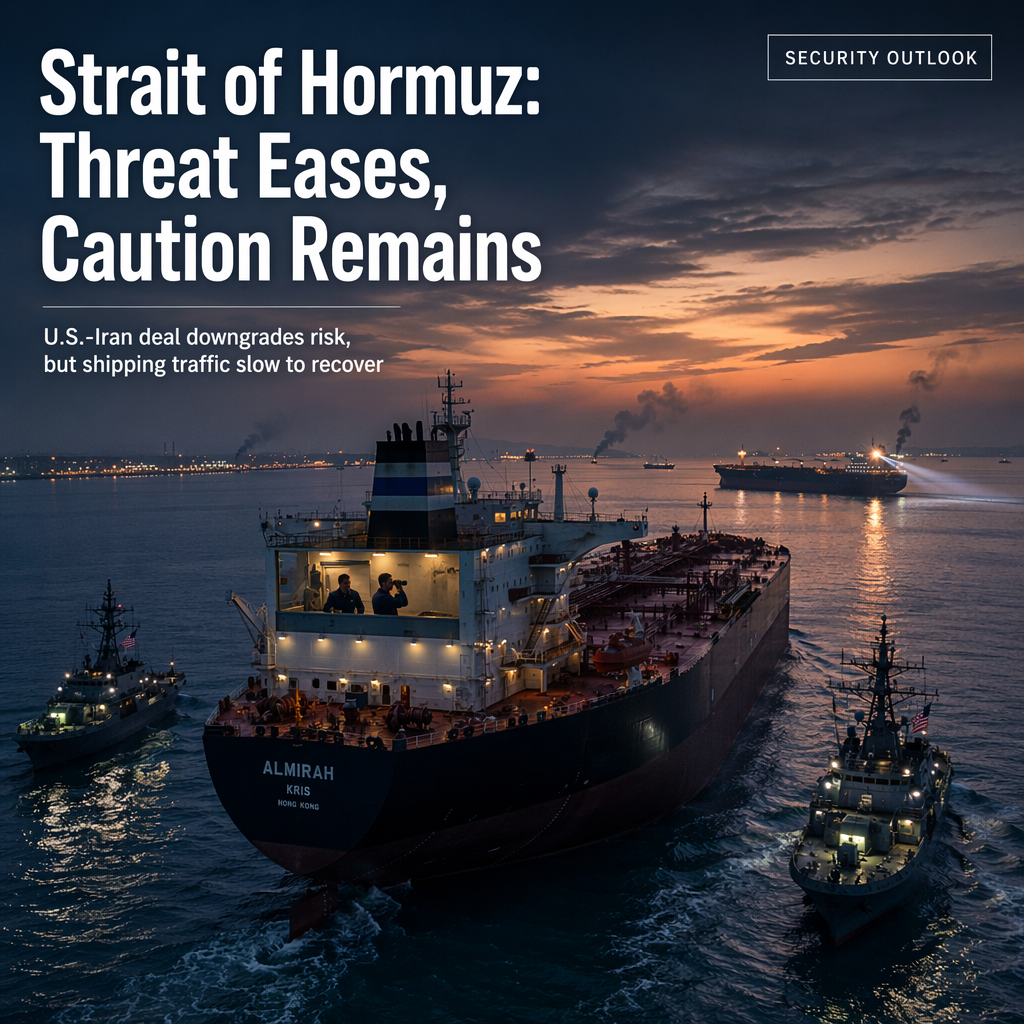
The threat level for ships transiting the Strait of Hormuz has been downgraded from 'severe' to 'substantial' by the Joint Maritime Information Center (JMIC), a U.S.-led coalition, following the announcement of a deal between the United States and Iran [1]. The JMIC, headquartered in Bahrain, coordinates security among allied navies and merchant ships in the Middle East and issued an advisory note to shippers this week reflecting the improved security outlook [1].
Despite the downgrade, the JMIC cautioned that 'an attack is still a strong possibility' and that mines remain a threat, advising continued caution for all vessels approaching the strait [1]. The behavior of Iran's Revolutionary Guard has reportedly become 'less volatile' since the deal's announcement, and the U.S. Navy continues to provide 'stabilizing oversight' in the region [1].
Oil tanker traffic through the Strait of Hormuz has not significantly increased since the U.S.-Iran deal was announced on Sunday. On Tuesday, six tankers and 13 commercial ships transited the strait, compared to more than 100 vessels daily before the war [1]. The JMIC noted that 'Strait of Hormuz traffic remained significantly reduced' [1]. The security situation had been classified as 'critical'—the highest threat level—as recently as June 4, and some shippers were waiting for a downgrade before resuming transits, according to Frontline CEO Lars Barstad [1].
The U.S.-Iran deal is expected to open Hormuz to commercial ships and lift the U.S. naval blockade of Iran, with a formal signing scheduled for Friday in Geneva, Switzerland [1]. Traffic through Hormuz had plunged after the U.S. and Israel attacked Iran on February 28, prompting Tehran to retaliate by targeting ships and causing the largest oil supply disruption in history. Before the conflict, about 20% of global oil supplies passed through the strait [1].
The global shipping trade group Bimco stated that 'credible assurances' from both Iran and the U.S. are needed before traffic can return to prewar levels. Jakob Larsen, Bimco's chief safety and security officer, emphasized that the security situation remains volatile and risky for ships, citing concerns about mines in the area both immediately and in the future [1].
CONCLUSION
The U.S.-Iran deal has led to a downgrade in the threat level for ships in the Strait of Hormuz, but shipping traffic remains well below prewar levels due to ongoing security concerns. Industry leaders and trade groups stress that credible assurances and further stabilization are necessary before normal operations can resume, highlighting persistent risks in the region.