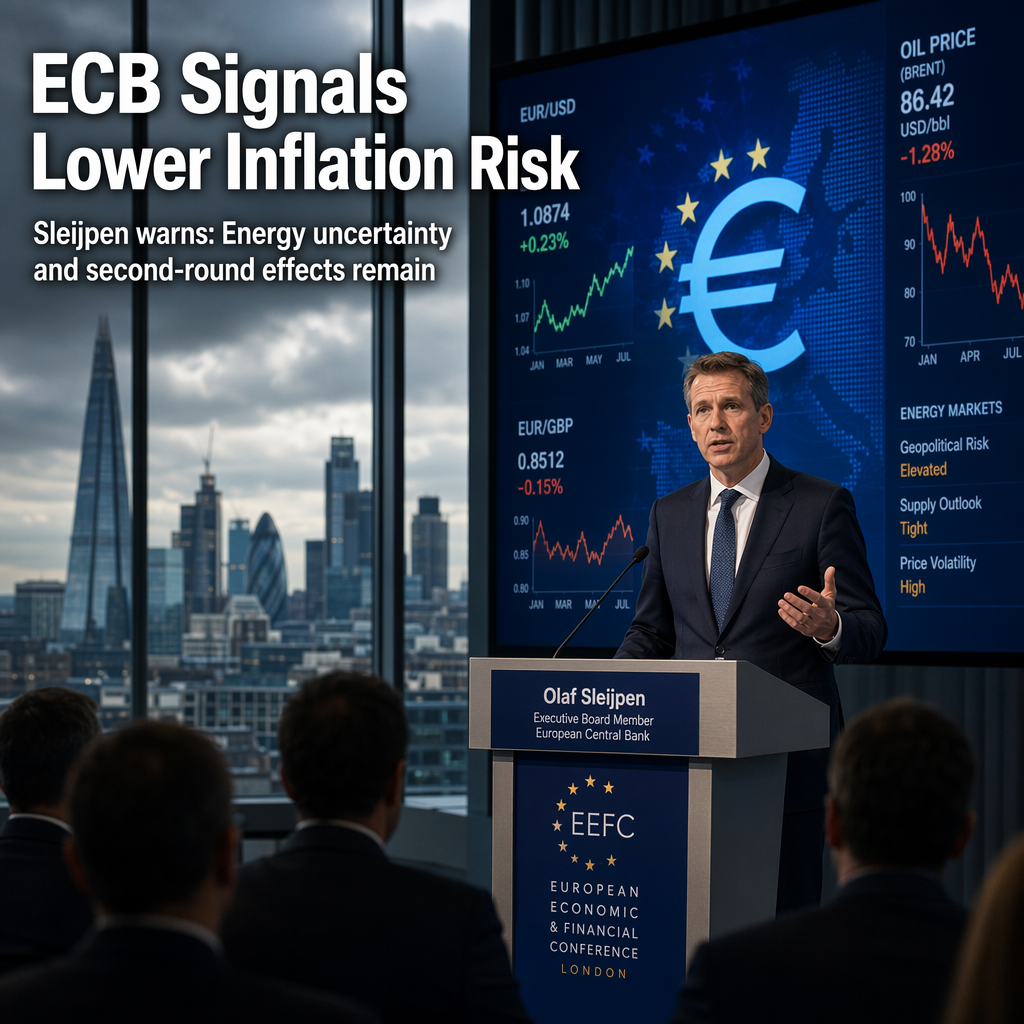
European Central Bank (ECB) policymaker Olaf Sleijpen stated at a European Economics & Financial Center (EEFC) event in London that a repeat of the significant inflation problems seen in 2022 appears less likely, though he cautioned that such risks cannot be fully excluded [1]. Sleijpen emphasized that the primary concern for Eurozone monetary policy is the potential for second-round effects, where initial inflation shocks could lead to further price and wage increases [1].
Sleijpen also noted that market expectations currently indicate a declining path for oil prices, but he highlighted that uncertainty in energy markets persists [1]. This ongoing uncertainty could influence future inflation dynamics and monetary policy decisions.
On the currency front, the Euro was the strongest against the New Zealand Dollar among major currencies today, with the EUR/NZD pair showing a 0.18% gain [1]. The Euro also showed modest strength against the Australian Dollar (0.08%) and Swiss Franc (0.16%), while it weakened slightly against the US Dollar (-0.06%) and British Pound (-0.02%) [1].
No forward-looking statements or analyst opinions beyond Sleijpen’s remarks were provided in the article.
CONCLUSION
ECB’s Sleijpen signaled reduced likelihood of a repeat of 2022’s inflation surge, though he warned that risks remain, particularly from second-round effects. The Euro showed relative strength against several major currencies, reflecting a moderately positive market sentiment. Market participants remain attentive to ongoing energy price uncertainties and their potential impact on Eurozone inflation.