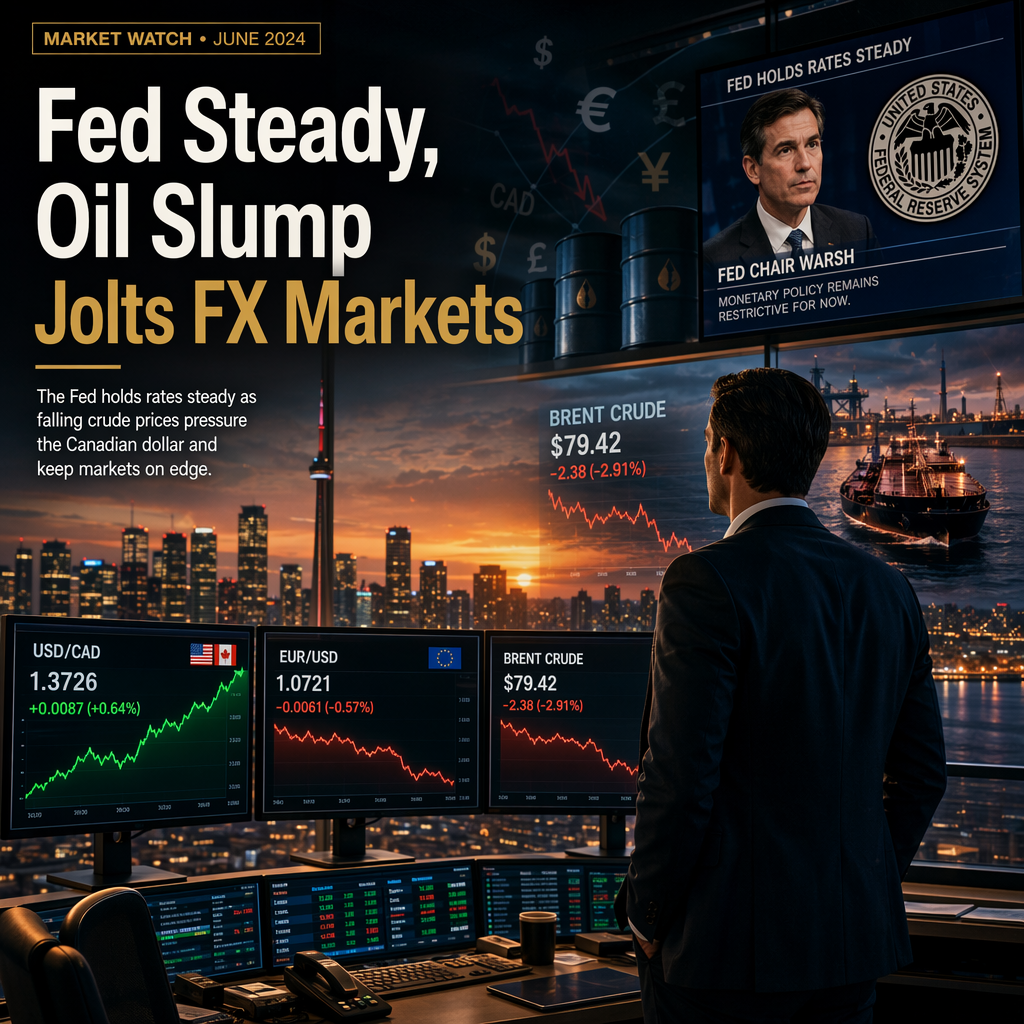
The US Federal Reserve is widely expected to leave its benchmark interest rate unchanged within the 3.5%-3.75% range at its upcoming meeting, which marks Kevin Warsh’s first as Fed Chair, following his appointment by US President Donald Trump [1][2][3]. Market participants are closely watching for any shifts in the Fed’s tone, with analysts at MUFG and OCBC suggesting the central bank may drop its easing bias and reduce expectations for future rate cuts, potentially providing additional support for the US Dollar [1][3]. OCBC’s Sim Moh Siong notes that the FX market is in a holding pattern ahead of the FOMC, with the Dollar lacking a clear bearish catalyst and the bank expected to maintain a neutral stance [3].
The Canadian Dollar remains under pressure, with USD/CAD trading around 1.4010 and gaining 0.10% on the day, as falling oil prices weigh on the currency [1]. The decline in oil is attributed to improving prospects for a US-Iran peace agreement, which has fueled expectations of increased global oil supply and a potential resumption of Iranian exports [1][3]. Brent crude has slipped below USD80 per barrel, undercutting many analysts’ year-end forecasts, though OCBC notes that further downside in oil prices may be limited due to logistical challenges in normalizing supply routes [3].
The Euro has retreated below 1.1600 against the US Dollar, with markets adopting a cautious tone ahead of the Fed decision [2]. In the Eurozone, May’s final Harmonized Index of Consumer Prices (HICP) confirmed a 3.2% year-on-year increase, with core HICP revised higher to 2.6% YoY, its highest in over a year [2]. Meanwhile, geopolitical tensions persist, as Iran has threatened a “hard response” if Israel continues attacks on Lebanon, and President Trump has stated he is ready to “drop bombs” if dissatisfied with the US-Iran agreement [2].
Looking ahead, investors are focused on the Fed’s updated economic projections and Chair Warsh’s comments for clues on future policy direction [1][2][3]. While the Fed is expected to acknowledge sticky inflation and a firmer labor market, it is likely to avoid signaling a clear policy tilt, with OCBC and MUFG analysts emphasizing a patient and neutral stance [1][3]. The outcome of the US-Iran agreement and its impact on oil prices remain key variables for currency markets [1][2][3].
CONCLUSION
The Federal Reserve’s anticipated decision to hold rates steady, combined with a potential shift away from an easing bias, has kept FX markets cautious and the US Dollar supported. Falling oil prices continue to pressure the Canadian Dollar, while the Euro has weakened ahead of the Fed meeting. Market participants are awaiting further guidance from Chair Warsh and developments in the US-Iran agreement to determine the next direction for major currencies.