
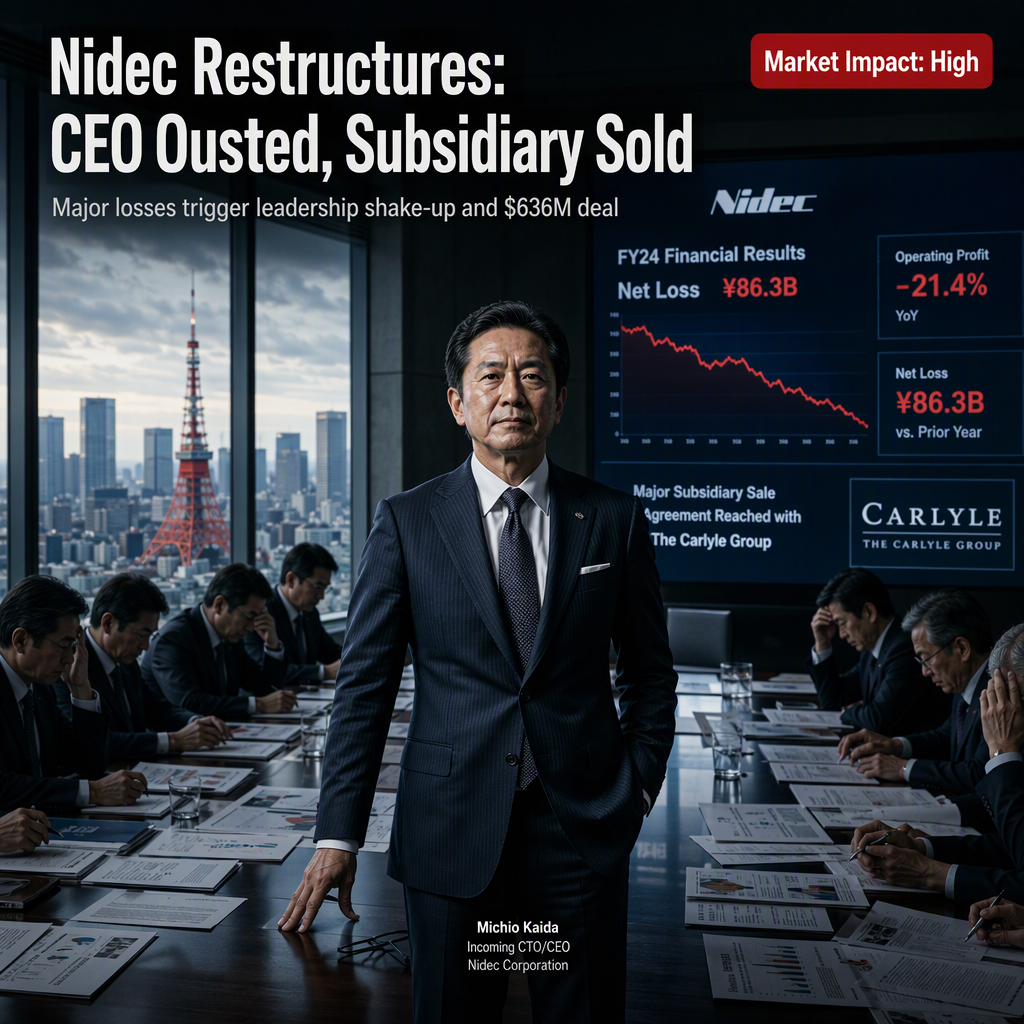
Japanese motor maker Nidec has entered final-stage talks to sell its electronic parts subsidiary, Nidec Components, to U.S. private equity firm Carlyle Group in a deal expected to exceed 100 billion yen ($636 million) [1]. This marks Nidec's first sale of a major subsidiary and is part of a broader restructuring effort as the company faces significant financial difficulties, including accounting irregularities and challenges in its electric vehicles segment [1]. Nidec is expected to book several hundred billion yen in impairment losses related to its electric vehicles business and accounting issues [1].
In a related development, Nidec announced the replacement of CEO Mitsuya Kishida with Chief Technology Officer Michio Kaida on Tuesday [2]. The leadership change comes as the company plans to recognize over $3.8 billion in impairment loss, largely tied to its EV drive unit business [2]. Nidec's recent financial performance has been under pressure, with the company sinking to a $3.6 billion loss on EV motor write-downs [2]. The personnel shake-up follows increased scrutiny over Nidec's business strategy and profitability, especially after its auditor withheld sign-off on its earnings report, which further triggered the leadership change [2].
The company is seeking a turnaround under Kaida's leadership, with a renewed focus on technology and innovation [2]. Analysts and market participants are closely watching Nidec's next steps, including restructuring plans and measures to improve corporate governance [2]. The ability of the new management to address operational issues and restore investor confidence will be crucial for Nidec's future financial health and market position [2].
According to [1], Nidec expects to book several hundred billion yen in impairment losses, while [2] reports the company plans to recognize over $3.8 billion in impairment loss and has sunk to a $3.6 billion loss on EV motor write-downs, indicating a discrepancy in the exact figures reported.
CONCLUSION
Nidec is undergoing significant restructuring, including the sale of a major subsidiary and a change in leadership, as it faces massive losses and governance challenges. The market impact is high, with analysts and investors closely monitoring the company's turnaround strategy and future financial health. The success of these measures will be critical in restoring confidence and stabilizing Nidec's market position.