
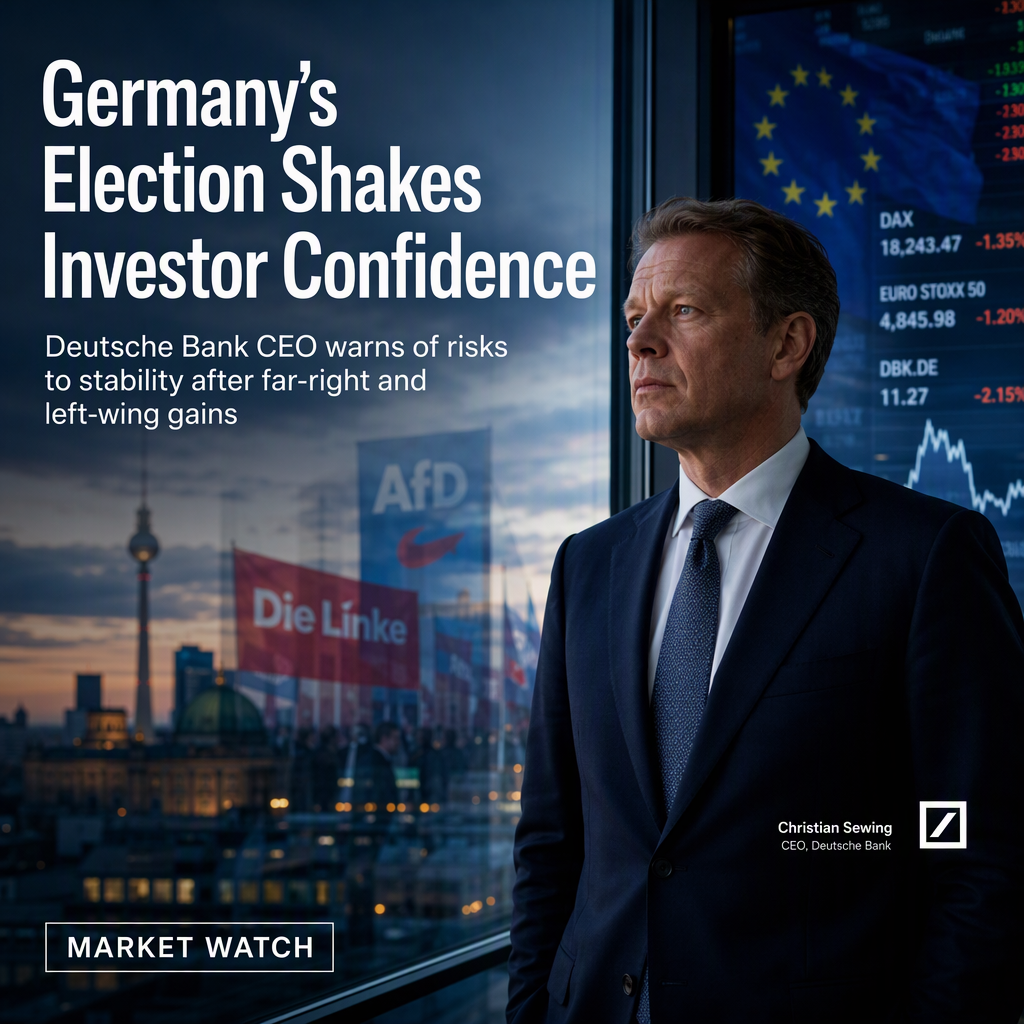
Deutsche Bank CEO Christian Sewing has expressed concerns that recent German state election results could negatively impact Germany's attractiveness to international investors [1]. Sewing described the outcomes as 'not positive for Germany,' emphasizing that the country's traditional appeal has been its stable environment, rule of law, and commitment to the European Union [1].
In the elections, the far-right AfD party secured first place in Saxony-Anhalt and Mecklenburg-Vorpommern, while the left-wing Die Linke won in Berlin [1]. The AfD has advocated for sharply restricting immigration and asylum, whereas Die Linke's campaign in Berlin focused on transferring large corporate landlords' housing into public ownership [1].
An economist previously told CNBC that these results indicate 'not enough popular support' for Chancellor Friedrich Merz's growth reforms, with the federal government reportedly losing support [1]. Sewing warned that parties turning their backs on Europe are 'obviously not in the interest of international investors,' and noted that the recent three weeks 'clearly did not help' Germany's investment climate [1].
Sewing, interviewed alongside Siemens CEO Roland Busch, reiterated the need for Germany to strengthen its position within Europe to meet international investor expectations. Both executives are part of the 'Made for Germany' initiative, which supports Merz's reforms and encourages investment in the country [1].
CONCLUSION
The recent German state election results have raised concerns among business leaders about the country's appeal to international investors. With political shifts challenging pro-growth and pro-European policies, market sentiment has turned cautious regarding Germany's investment climate.