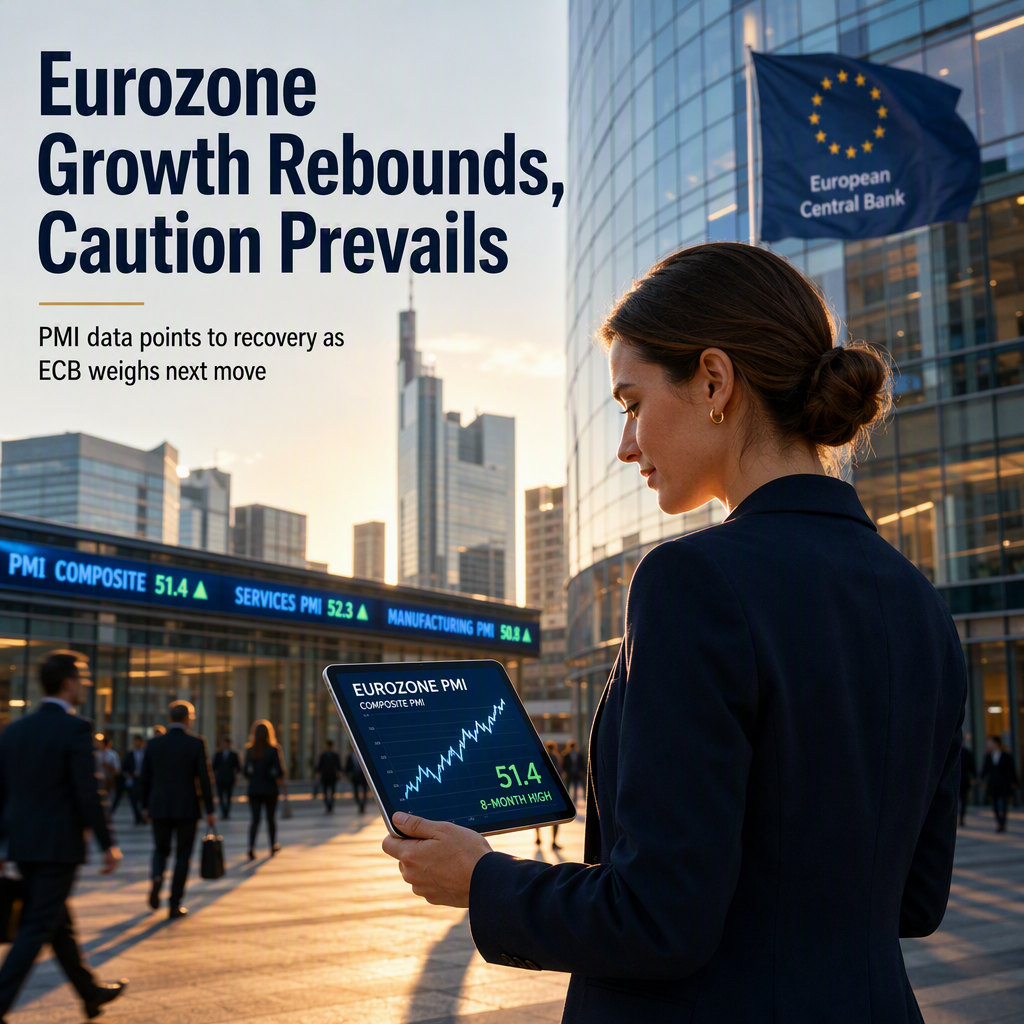
Eurozone Purchasing Managers' Index (PMI) data has surprised to the upside, with the composite PMI reaching 52.0 points in July, up from 50.0 in June, marking an eight-month high and signaling a return to modest private sector growth at the start of the third quarter [1]. The services PMI also moved back into expansion territory at 51.7, up from 49.4, ending a three-month downtrend [1]. Output and new orders increased at the fastest pace since last November, with improvements noted in Germany, Italy, and Spain, while France remained in contraction [1].
The survey indicated softer inflationary pressures, as both input costs and output charges eased further [1]. In Germany, the services PMI for July was 49.8, up from 48.6 in June, suggesting activity fell only fractionally and moved closer to stabilization [1]. The survey also showed the first marginal rise in new business in five months for Germany, although export demand continued to decline, albeit at a slower pace [1].
BNY’s Geoff Yu commented that while the resilience in PMIs is welcome and pushes back against immediate stagflation fears, it does not provide a clear signal for further European Central Bank (ECB) tightening [1]. He cautioned that another rate hike could risk turning a tentative recovery into a policy-driven slowdown for the Euro and regional assets [1].
CONCLUSION
The latest Eurozone PMI data signals a modest recovery and eases immediate stagflation concerns, with notable improvements across several major economies. However, analysts urge caution, warning that further ECB tightening could jeopardize the nascent recovery.