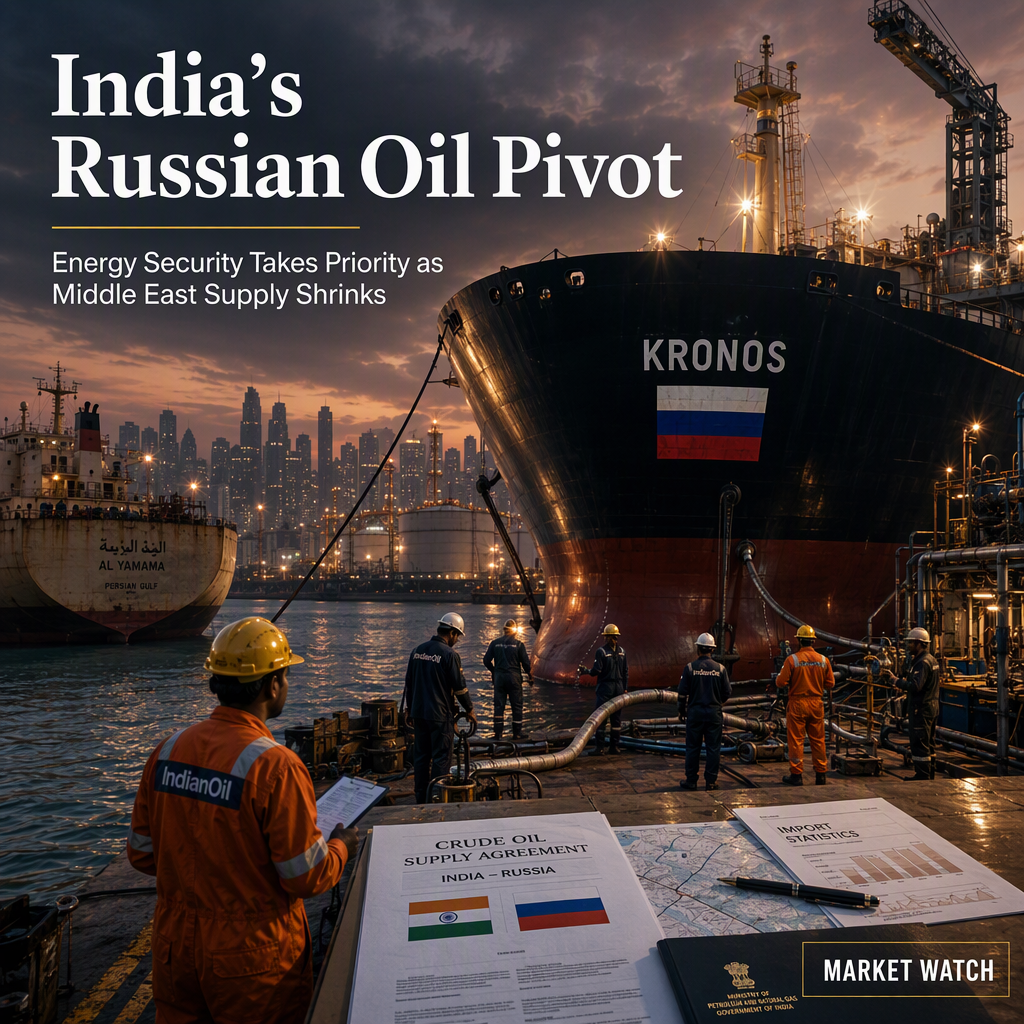
Standard Chartered economists Anubhuti Sahay and Saurav Anand report a significant increase in India's reliance on Russian oil, with Russia now accounting for approximately 44% of India's crude oil imports by volume during April-July 2026, up from 23% in January-February 2026 and just 2% in 2021 [1]. This shift is attributed primarily to energy security concerns rather than cost savings, as the Middle East crisis has reduced the region's share of India's crude imports from 55% in January-February 2026 to 30% in April-July 2026, with Russia filling most of the gap [1]. Supply restoration from the Middle East and Venezuela is deemed necessary to materially reduce India's dependence on Russian oil, while renewed supplies from Venezuela and Iran have only provided modest relief [1].
The passage of the Russia sanctions bill has brought India back into focus, as countries importing energy from Russia could face additional tariffs of up to 100%. However, the implementation of these tariffs is subject to US presidential discretion and ongoing trade negotiations with India, highlighting existing vulnerabilities [1]. Despite the increased imports, the cost savings from Russian crude remain modest and are fading, with estimated annual savings of only 0.1-0.2% of GDP since 2022 [1].
Market implications are significant, as India's energy security strategy is now prioritizing stable supply over cost, potentially exposing the country to geopolitical risks and tariff-related uncertainties. The fading cost advantage and the need for supply restoration from other regions underscore the urgency for India to diversify its energy sources [1].
No forward-looking analyst opinions beyond the need for supply restoration and the vulnerability to sanctions are provided in the source [1].
CONCLUSION
India's rapidly growing dependence on Russian oil is driven by energy security concerns amid reduced Middle East supply, with only modest and diminishing cost savings. The passage of the Russia sanctions bill introduces new risks, and supply restoration from other regions is crucial for reducing vulnerability. Market participants should closely monitor geopolitical developments and India's energy diversification efforts.