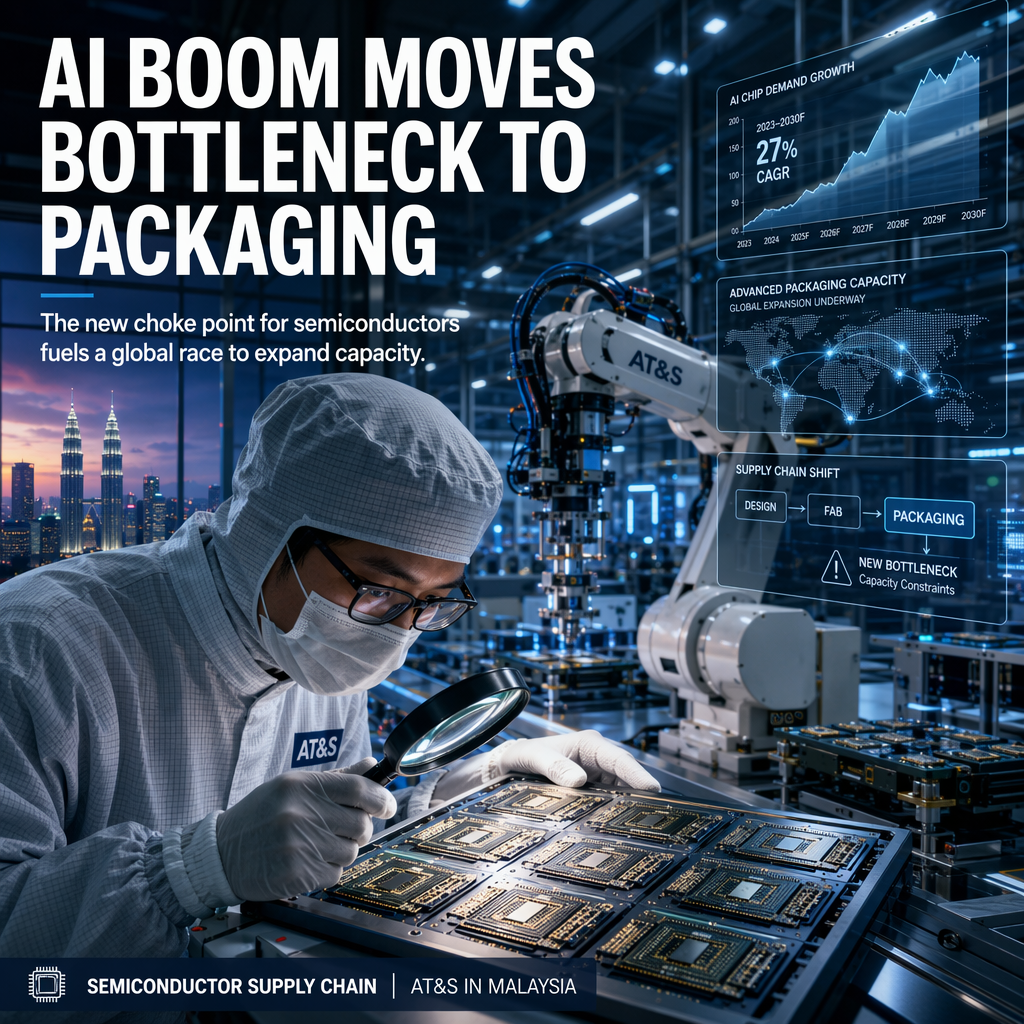
The global boom in artificial intelligence (AI) is creating a new bottleneck in the semiconductor industry, as demand for advanced chip packaging services and substrates now outpaces supply, according to Michael Mertin, CEO of Austrian substrate supplier AT&S [1]. Mertin explained that the rise of AI chips, which require more sophisticated manufacturing processes than traditional chips, has increased the complexity of vendor-supplier relationships and placed significant strain on the supply chain. He stated, 'The bottleneck has shifted from chip fabrication to advanced packaging,' emphasizing that having the best silicon is no longer sufficient without advanced packaging and substrate capabilities to deliver the performance required by AI applications [1].
To address this growing demand, AT&S is expanding its operations in Malaysia, aiming to ramp up production of high-end substrates used in AI chip packaging [1]. While financial details and specific production targets for the expansion were not disclosed, Mertin reiterated the company's commitment to supporting global semiconductor supply chains as the AI revolution accelerates [1].
Industry analysts cited in the article note that investment in advanced packaging facilities is surging, with both established players and newcomers seeking to expand capacity. However, the highly technical nature of substrate manufacturing means that increasing supply will require significant time and capital investment [1]. AT&S's expansion reflects a broader industry trend, as companies race to build infrastructure to support AI-driven growth and secure adequate substrate capacity, which is now seen as a critical factor for semiconductor companies aiming to capitalize on the AI boom [1].
No specific market reactions, financial figures, or analyst forecasts were provided in the article. However, the overall tone suggests that the shift in bottleneck to advanced packaging is a significant development for the semiconductor industry, with major implications for supply chains and future investment priorities [1].
CONCLUSION
The AI chip boom is fundamentally altering the semiconductor supply chain, shifting the bottleneck from chip fabrication to advanced packaging and substrates. AT&S's expansion in Malaysia underscores the industry's urgent need to boost capacity in this area, positioning the company as a key player in meeting the demands of leading AI chipmakers. The market impact is expected to be high as companies race to address this new constraint.