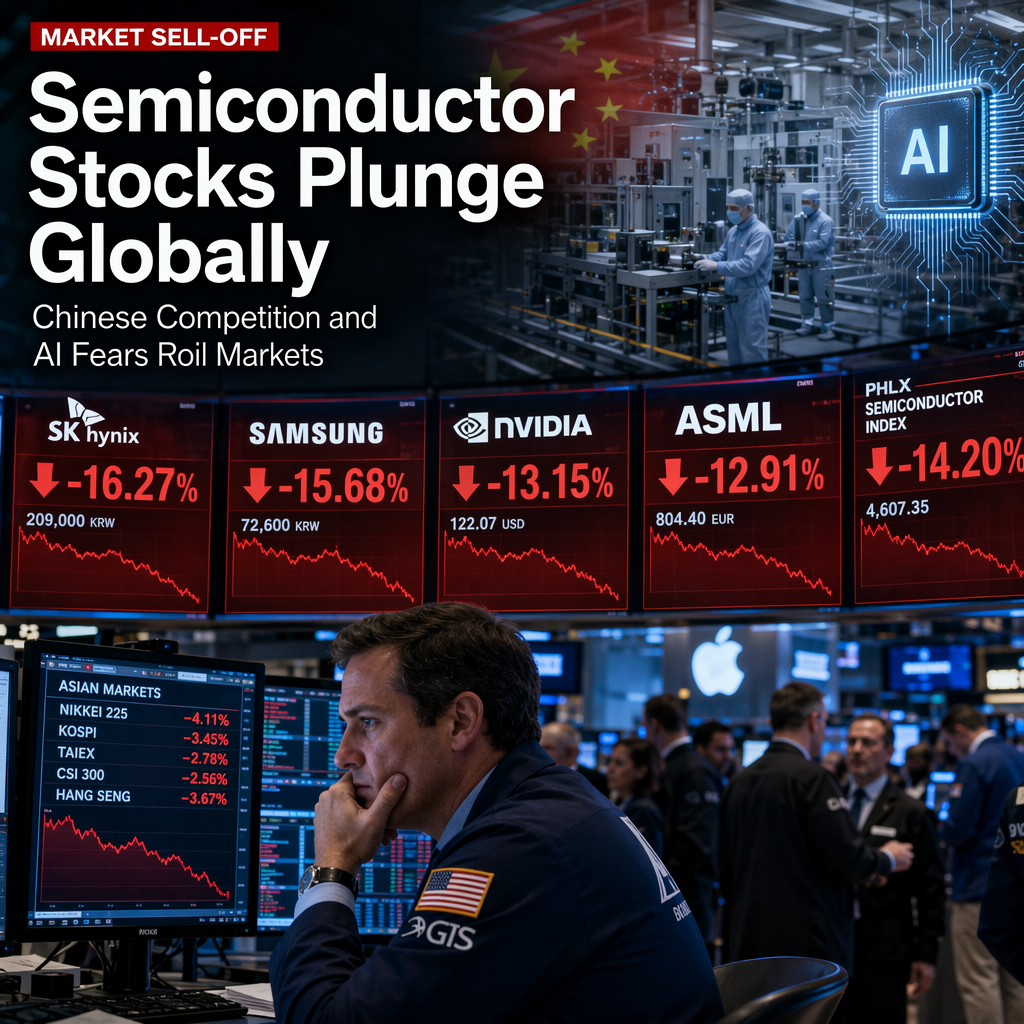
Renewed concerns over Chinese competition and AI investment spending triggered a sharp selloff in global semiconductor stocks, according to Deutsche Bank strategists [1]. Asian technology indices suffered heavy losses, with South Korea's KOSPI index dropping 10.11%, its steepest decline since early March, and circuit-breaker measures were activated during the session [1][2]. Major chipmakers SK Hynix and Samsung Electronics saw their shares fall as much as 13% and 12%, respectively [1], with CNBC reporting double-digit plunges that drove the KOSPI down around 45% from its June highs [2]. The Nikkei index also declined sharply, falling 4.10%, led by tech names such as Kioxia Holdings, which is now roughly 60% lower from its peak in late June [1].
The catalyst for the selloff was multifaceted. ASML shares dropped 8.41% after reports that a Chinese company had successfully started mass production of deep ultraviolet lithography machines needed for advanced semiconductors [1]. This news led to declines across other chip-equipment peers, with the Philly SemiStockExchange Index down 2.23% [1]. Nvidia shares fell 4.99% after it was revealed the company was working on AI deals worth more than $750 billion, renewing investor worries about circular AI financing [1]. CNBC confirmed Nvidia is in talks with OpenAI to provide a $250 billion backstop for AI infrastructure plans, sending Nvidia shares down over 5% and pushing its market cap below $4.8 trillion [2]. This allowed Apple to regain its position as the world's most valuable company at $4.95 trillion [2].
Despite the tech sector's turmoil, broader equity markets showed resilience. Nearly two-thirds of the S&P 500 constituents ended the session higher, and the small cap Russell 2000 rose 0.62% [1]. European indices such as the DAX (+1.04%), CAC 40 (+0.40%), and FTSE 100 (+0.42%) posted gains, although the Stoxx 600 (+0.02%) was dragged down by ASML and other semiconductor companies [1].
In Asia, the CSI 300 and Shanghai Composite also declined, but CXMT Corp. saw a blockbuster debut in Shanghai, with shares surging 466% after its IPO [1].
CONCLUSION
The global semiconductor sector experienced a sharp selloff driven by renewed concerns over Chinese competition and massive AI investment spending, with major Asian indices and chipmakers suffering steep losses. Nvidia's drop and Apple's regained market cap highlight shifting dynamics among tech giants. Despite the turmoil in tech, broader equity markets remained resilient, suggesting that the impact may be concentrated within the semiconductor and AI sectors for now.