
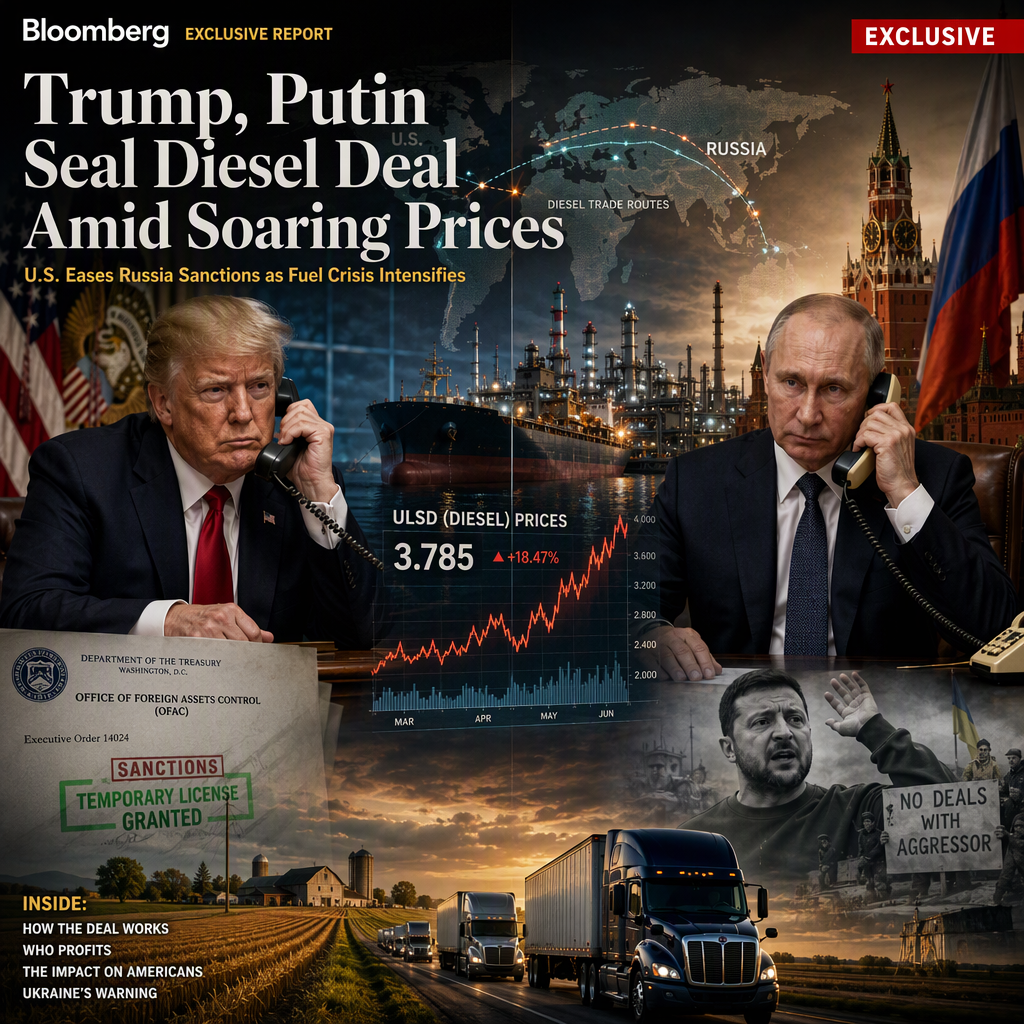
President Donald Trump announced on Friday that Russian President Vladimir Putin has agreed to release hundreds of thousands of tons of diesel fuel onto the global market in an effort to lower surging diesel prices [1][2]. According to Trump, Russia will supply more than 4 million tons of diesel under a deal struck during a phone call with Putin, with an immediate delivery of over 300,000 tons, followed by 500,000 tons in November, and an additional 1 million tons thereafter. Moscow will then deliver another 3 million tons depending on the condition of Russia's refineries [2].
To facilitate the diesel shipments, the U.S. Treasury Department announced a temporary easing of sanctions on Russian diesel through April 7, 2027, via a general license issued by the Office of Foreign Assets Control (OFAC) [1][2]. The license authorizes the sale, delivery, offloading, or importation of Russian diesel, including into the United States, until the specified date [1].
Diesel prices have soared almost 70% since the start of the Iran war in February, with repeated all-time record highs in recent weeks due to escalations in the Russia-Ukraine conflict and Ukrainian attacks on Russian energy assets [1]. Russia had imposed a diesel export ban in July, which was extended through October, further tightening global supply [1][2]. Additional supply constraints have resulted from attacks on Middle Eastern refineries by Iran and Houthi forces [2].
The move comes as Trump faces mounting political pressure to address high fuel prices ahead of the November midterm elections, particularly in agricultural states like Iowa [2]. Trump had previously considered a diesel export ban but abandoned the idea after warnings from the oil industry and business leaders that it would raise gasoline prices [2]. Earlier this week, Trump issued an executive order allowing truckers to use tax-exempt offroad diesel on highways, though the order only defers the tax obligation and has created confusion among truckers [2].
Ukrainian President Volodymyr Zelenskyy condemned the diesel deal, warning that easing sanctions without Russian de-escalation would prolong the war. Zelenskyy stated, "Gifts to Putin will not bring peace or any benefit to the civilized world," and argued that allowing Russia to sell petroleum products is an investment in a war that must be ended, not prolonged [2]. Trump, meanwhile, has publicly urged Zelenskyy to stop targeting Russian diesel refineries, blaming such attacks for driving up prices [1].
CONCLUSION
The U.S. decision to temporarily ease sanctions on Russian diesel marks a significant intervention in response to record-high fuel prices and global supply disruptions. While the move is intended to alleviate inflationary pressures, it has drawn sharp criticism from Ukraine and raises questions about its impact on the ongoing conflict. The market is likely to react strongly to the influx of Russian diesel, though the long-term geopolitical and economic consequences remain uncertain.