
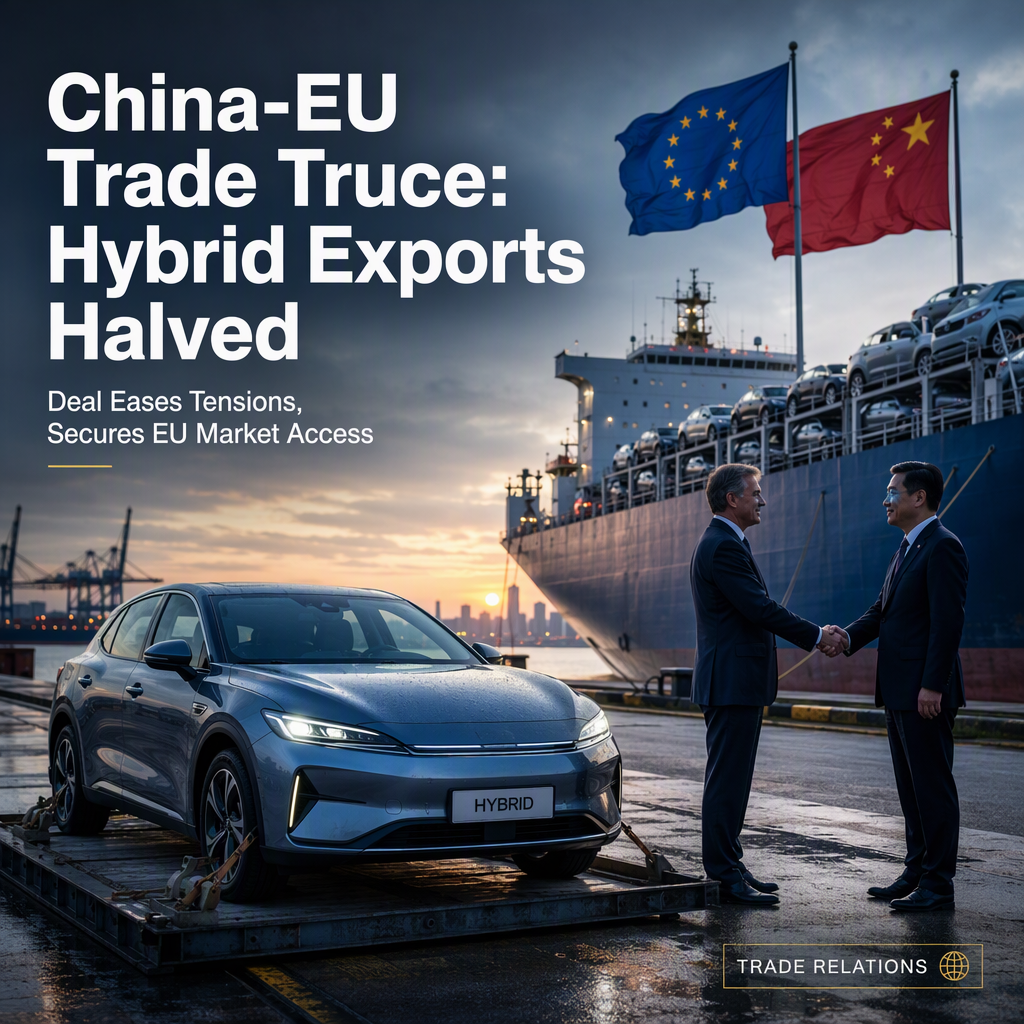
China and the European Union have reached an 'understanding' to halve Chinese exports of hybrid vehicles to the EU following two days of talks between European Commissioner for Trade Maros Sefcovic and Chinese Commerce Minister Wang Wentao [1]. The agreement comes amid heightened concerns in Europe about a surge in Chinese hybrid vehicle exports, which European manufacturers claimed were flooding the market and undermining local industry [1]. The new arrangement aims to reduce these exports by 50% over an unspecified period, addressing overcapacity concerns and helping to rebalance trade relations between the two economies [1].
As part of the outcome, Europe stated it has secured $4.5 billion in improved market access, though Beijing's statement on the talks was more muted and did not elaborate on the specifics [1]. No further financial details or implementation timelines were provided by either side [1]. Both parties emphasized the importance of continued dialogue and cooperation to prevent escalation into a broader trade conflict, with European officials highlighting enhanced access to the Chinese market as a significant achievement [1].
The talks were prompted by months of pressure from major EU economies such as France and Germany, which have advocated for stronger trade defense measures to protect European industries from foreign competition, particularly from China [1]. The agreement is seen as a move to avert a trade war and stabilize relations between the two major trading partners [1].
CONCLUSION
The China-EU agreement to halve Chinese hybrid vehicle exports marks a significant de-escalation of trade tensions and provides the EU with improved market access. While key implementation details remain undisclosed, the outcome is viewed as a positive step toward rebalancing trade relations and protecting European industry.