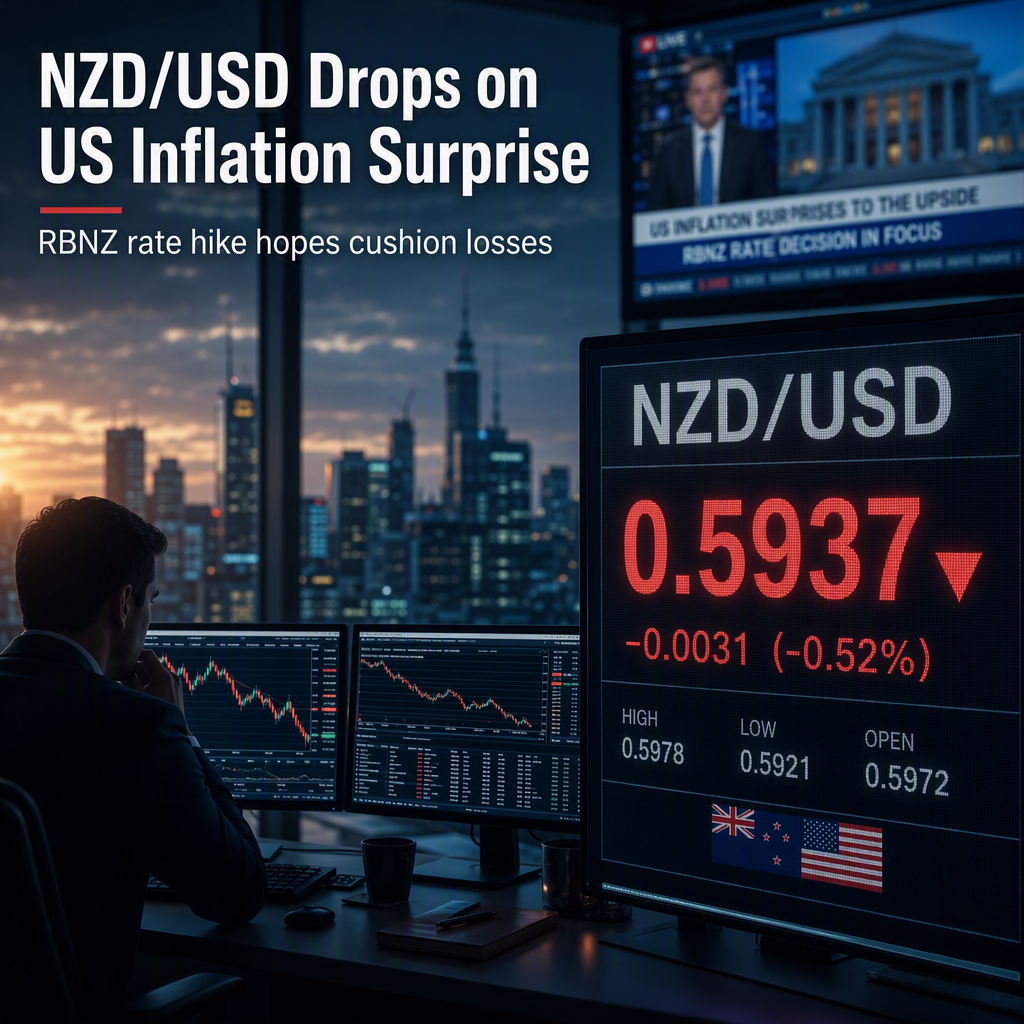
The New Zealand Dollar (NZD) declined against the US Dollar (USD) on Wednesday, with NZD/USD retreating to around 0.5940, marking a 0.60% drop on the day [1]. This movement followed the release of the latest US inflation data, where the Bureau of Economic Analysis reported that the Personal Consumption Expenditures (PCE) Price Index rose 3.7% year-over-year in July, unchanged from June but slightly above the 3.6% expected by markets. On a monthly basis, the PCE index increased by 0.2% [1]. The core PCE Price Index, which excludes food and energy, remained steady at 3.3% year-over-year and also rose 0.2% month-over-month, both in line with expectations [1].
The modest upside surprise in headline inflation lent some support to the US Dollar, as persistent price pressures could prompt the Federal Reserve (Fed) to maintain a restrictive monetary policy stance. However, the market reaction was limited since the core inflation measure met expectations and did not significantly alter the outlook for the Fed's September meeting. According to the CME FedWatch tool, markets are pricing in around a 36% chance of an interest-rate hike at the Fed’s next meeting, a probability largely unchanged from before the PCE data release [1].
Attention now shifts to Fed Chair Kevin Warsh’s upcoming speech at the Jackson Hole Economic Policy Symposium, which could provide further insight into the Fed’s assessment of inflation and its policy intentions ahead of the September decision [1].
On the New Zealand side, expectations for a 25-basis-point interest-rate hike from the Reserve Bank of New Zealand (RBNZ) at its monetary policy meeting next week are providing some support to the Kiwi. If delivered, this move would bring borrowing costs to 3% [1]. The potential for further tightening by the RBNZ, contrasted with the Fed’s more uncertain outlook, could help limit downside pressure on NZD/USD, even as the US Dollar benefits in the short term from firmer-than-expected inflation data [1].
Technically, NZD/USD trades at 0.5937, maintaining a mildly bearish near-term tone as it sits below the 100-period simple moving average (SMA) at 0.5964 and just above the 200-period SMA at 0.5933. The Relative Strength Index (RSI) near 32 suggests the pair is approaching oversold territory, indicating that while downside pressure persists, momentum may slow if sellers fail to push the pair lower [1].
CONCLUSION
The NZD/USD pair is under pressure following a slight upside surprise in US inflation, but expectations for an RBNZ rate hike are helping to limit losses. Market participants are now focused on upcoming Fed commentary and the RBNZ meeting for further direction.