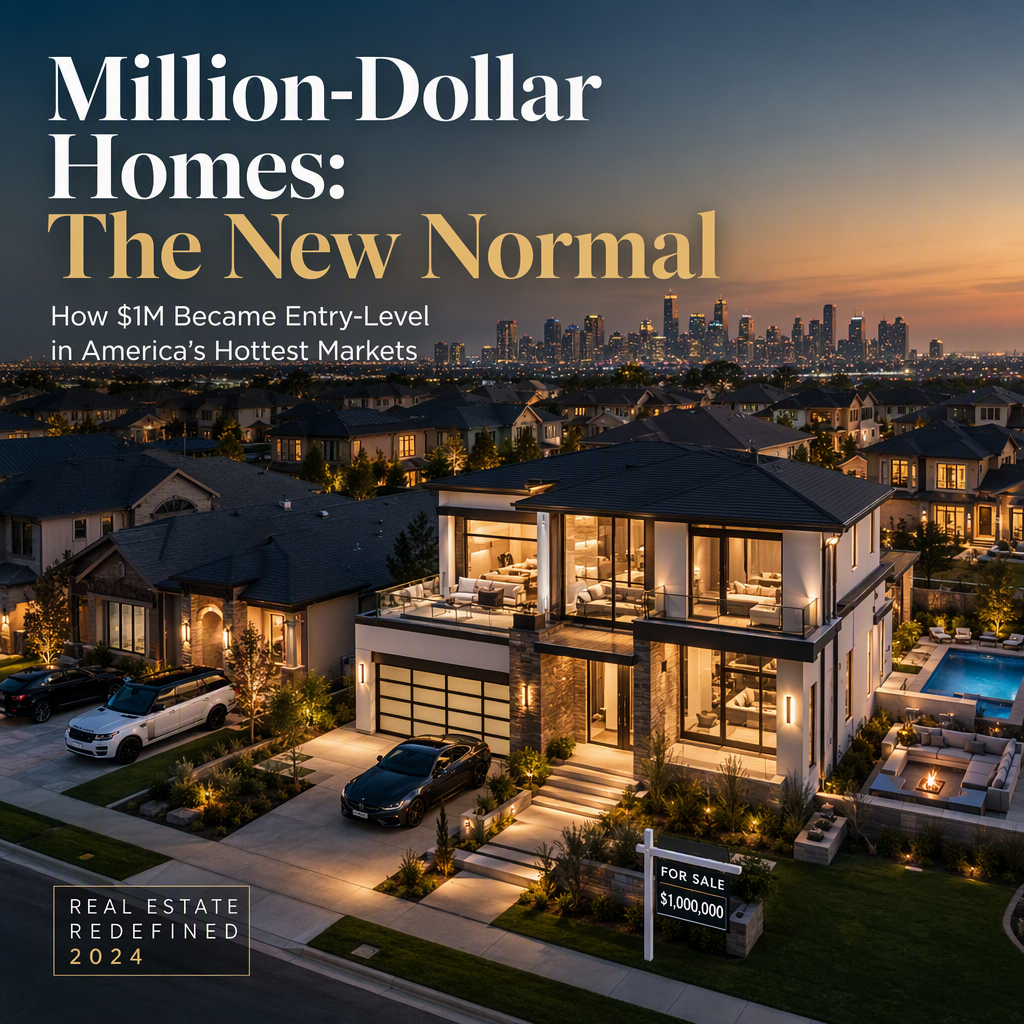
The number of owner-occupied homes in the United States valued at $1 million or more has surged from approximately 1.5 million in 2005 to 6.9 million in 2024, according to an analysis by the National Association of Realtors (NAR) [1]. These properties now represent 8% of the market, a significant increase from just 2% two decades ago [1]. The trend is especially pronounced in high-cost regions: about 40% of owner-occupied homes in Hawaii and roughly one-third in California and Washington, D.C., are now worth at least $1 million [1]. In contrast, only about 1% of homes in Mississippi, North Dakota, and West Virginia reach this valuation [1].
Billy Rose, founder and vice chairman of The Agency, stated that in Los Angeles, the $1 million price point has long ceased to signify luxury, describing it as an 'entry' threshold for the market [1]. Some first-time buyers in the region reportedly begin their searches at $2.5 million to $3 million [1]. Rose also highlighted ongoing market tension, with sellers holding out for prices set during periods of lower borrowing costs, while buyers wait for more favorable deals, resulting in a 'staring contest' between the two sides [1].
The $1 million benchmark influences buyer behavior, with NAR data showing that since 2015, about 2.4 times more homes have sold just below $1 million than just above it [1]. This may be due to buyers setting search limits below the round number, differing mortgage requirements, or taxes that apply at the $1 million mark, such as New York's mansion tax, which adds 1% ($10,000) to purchases at or above $1 million [1]. Rose suggested that such thresholds may need to be updated to reflect current market realities [1].
The shift in what constitutes a luxury home is not unique to the U.S. In the Toronto area, 1 million Canadian dollars (about $731,000) no longer buys a luxury property, with true luxury starting closer to 1.7 million to 3 million Canadian dollars ($1.2 million to $2.2 million), according to Steve Bailey of The Agency [1]. Additionally, a recent Zillow report cited in the article found that luxury home demand is surging in the U.S., while starter-home sales are softening as inventory in that segment grows [1]. Rose described this as indicative of a 'K-shaped economy,' where wealthy buyers continue to drive the upper end of the market [1].
CONCLUSION
The $1 million home has become increasingly common in the U.S., especially in high-cost markets, and no longer guarantees luxury status. Market dynamics show a widening gap between luxury and entry-level segments, with buyers and sellers at an impasse over pricing. The evolving definition of luxury and shifting buyer behavior suggest ongoing changes in the real estate landscape.