
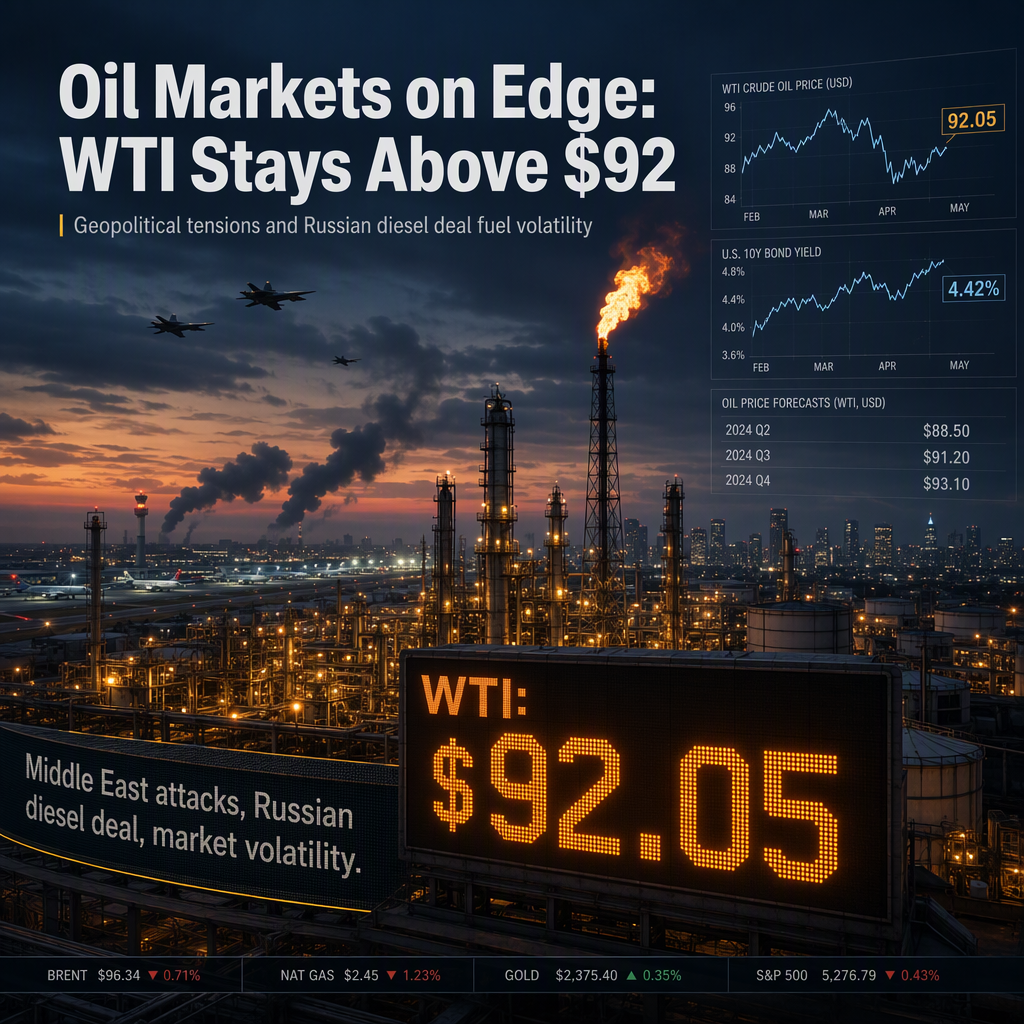
West Texas Intermediate (WTI), the US crude oil benchmark, is trading around $92.05 during early Asian trading hours on Tuesday, maintaining gains following a deadly attack on Saudi Arabia’s airport in Riyadh [1]. The Saudi-led coalition fighting Yemen’s Iran-backed Houthis reported another round of drone and missile attacks directed at Saudi Arabia, with Yemen's Armed Forces warning that no Saudi airspace or airports are safe except Mecca and Medina, urging against travel [1]. Over the weekend, Houthi attacks on Riyadh’s main airport resulted in at least 16 deaths, including a US citizen, and wounded about 300 people [1]. Rising tensions in the Middle East are seen as a factor that could boost WTI prices in the near term [1].
In parallel, US President Donald Trump announced that Russia and Ukraine have agreed to an energy ceasefire, halting attacks on each other's energy facilities [1]. US special envoy Jared Kushner stated that a deal to allow Russian diesel exports is part of efforts to bring Russia back to negotiations after previous talks failed [1]. Trump also said that Moscow will supply more than 4 million tons of diesel to the global market under a deal reached with Russian President Vladimir Putin [1]. Expectations of increased Russian diesel supplies could weigh on WTI prices [1].
Scott Shelton, an energy specialist at TP ICAP Group, described the recent period as “a dizzying few days of headlines,” referencing both the energy ceasefire claims and the Houthi attacks on Saudi Arabia, and noted that the market is off to a “messy start this week” [1]. Traders are awaiting the American Petroleum Institute (API) crude oil stockpiles report later on Tuesday, with a larger-than-expected inventory draw likely to support WTI prices, while a bigger build could undermine them [1].
Strategists at HSBC highlighted that a major factor behind the 2026 bond market shock has been the surge in oil prices caused by the Iran conflict [1]. They observed that while oil volatility has faded, bond market stress persists, noting a recent disconnection between bond and oil market volatility measures (MOVE and oil VIX indices) [1]. HSBC suggests that the initial rise in yields was closely tied to oil price movements, but bond markets have remained choppy even as oil prices have settled [1].
CONCLUSION
WTI prices remain elevated above $92 amid heightened geopolitical risks in the Middle East and evolving developments regarding Russian diesel exports. While increased Russian supply could pressure prices, ongoing regional tensions and market volatility continue to drive uncertainty. Traders are closely watching inventory data and further geopolitical headlines for direction.