
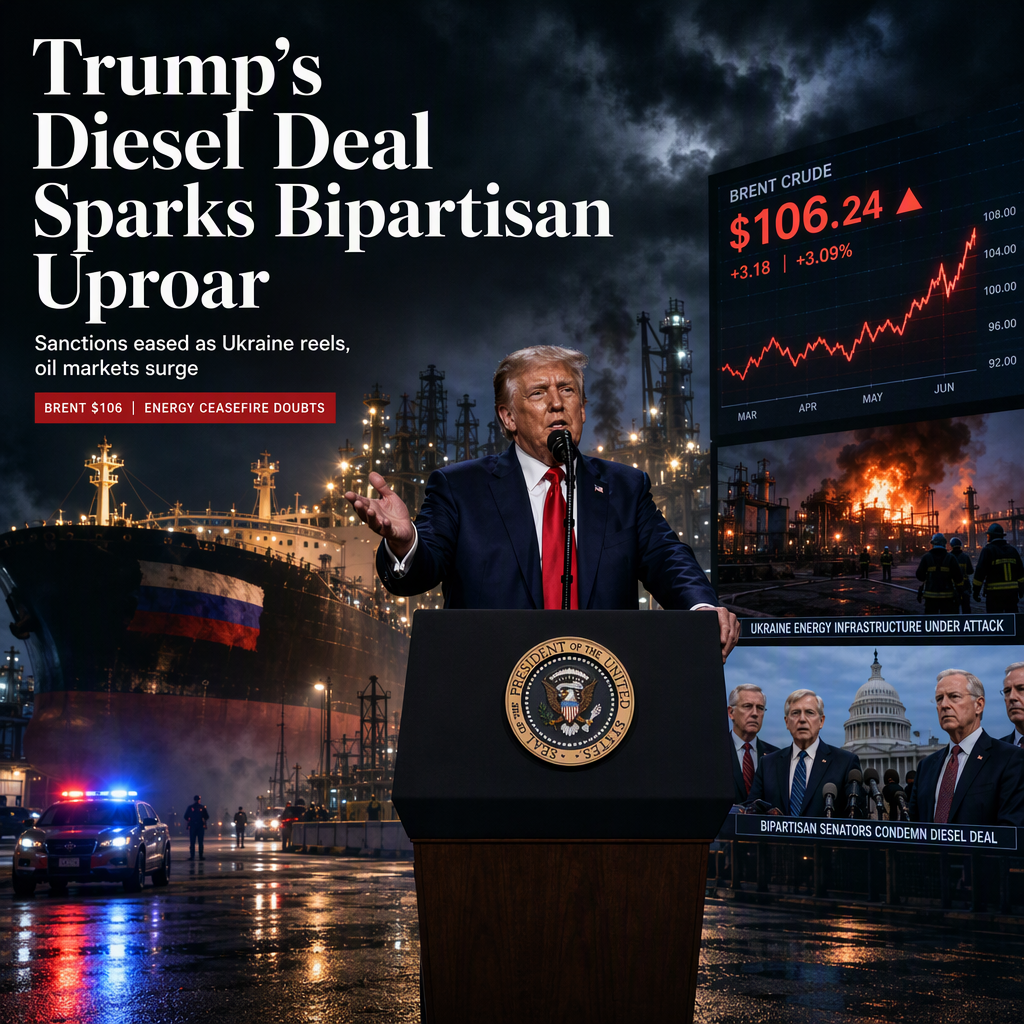
U.S. President Donald Trump defended his decision to temporarily ease sanctions on Russian diesel, despite bipartisan criticism from seven senators—four Republicans and three Democrats—who urged the administration to reverse course, arguing that the deal could provide Moscow with a financial lifeline while Russia continues its military actions in Ukraine [1]. Trump asserted that the move was made in the interest of lowering record diesel prices for Americans ahead of the November midterm elections, stating, 'I made the right choice for the American People — ALWAYS, AMERICA FIRST!' on Truth Social [1]. However, analysts expressed skepticism about the deal's effectiveness, noting that the initial shipments of Russian diesel are modest compared to the global market, and logistical challenges, including damaged Russian refineries, may hinder rapid delivery to the U.S. [1].
The easing of sanctions coincided with Trump's announcement of an 'energy ceasefire' between Russia and Ukraine, which neither side appears to have formally accepted. Trump claimed, 'Well, they agreed. You know why? Because I said, 'You agree.' That's why,' when questioned about the lack of formal acceptance from Russia and Ukraine [1]. Ukrainian President Volodymyr Zelenskyy accused Moscow of violating the ceasefire, reporting that six Ukrainian energy facilities were attacked by Russian drones on Monday and warning of retaliation [1]. Zelenskyy stated, 'It is increasingly evident that Russia is unwilling to accept an energy ceasefire proposed by the United States and intends to continue its terrorist air attacks against our people and communities,' in a post on X [1].
Oil markets reacted to the developments with Brent crude settling above $106, as doubts over the ceasefire and a Houthi attack in Saudi Arabia heightened supply concerns [1]. Additionally, Cleveland Fed President Beth Hammack warned that higher interest rates may be necessary to prevent an 'inflationary mindset' from taking hold, indicating broader economic uncertainty tied to energy market volatility [1].
Analysts remain unconvinced that the Russian diesel deal will significantly lower U.S. fuel prices, citing the modest scale of shipments and ongoing logistical issues [1]. The bipartisan criticism and continued violence in Ukraine underscore the geopolitical risks and market instability surrounding the deal [1].
CONCLUSION
Trump's decision to ease sanctions on Russian diesel has sparked bipartisan criticism and skepticism among analysts regarding its impact on U.S. fuel prices. Ongoing attacks in Ukraine and doubts about the energy ceasefire have contributed to heightened oil market volatility, with Brent crude settling above $106. The situation underscores persistent geopolitical risks and uncertainty in global energy markets.