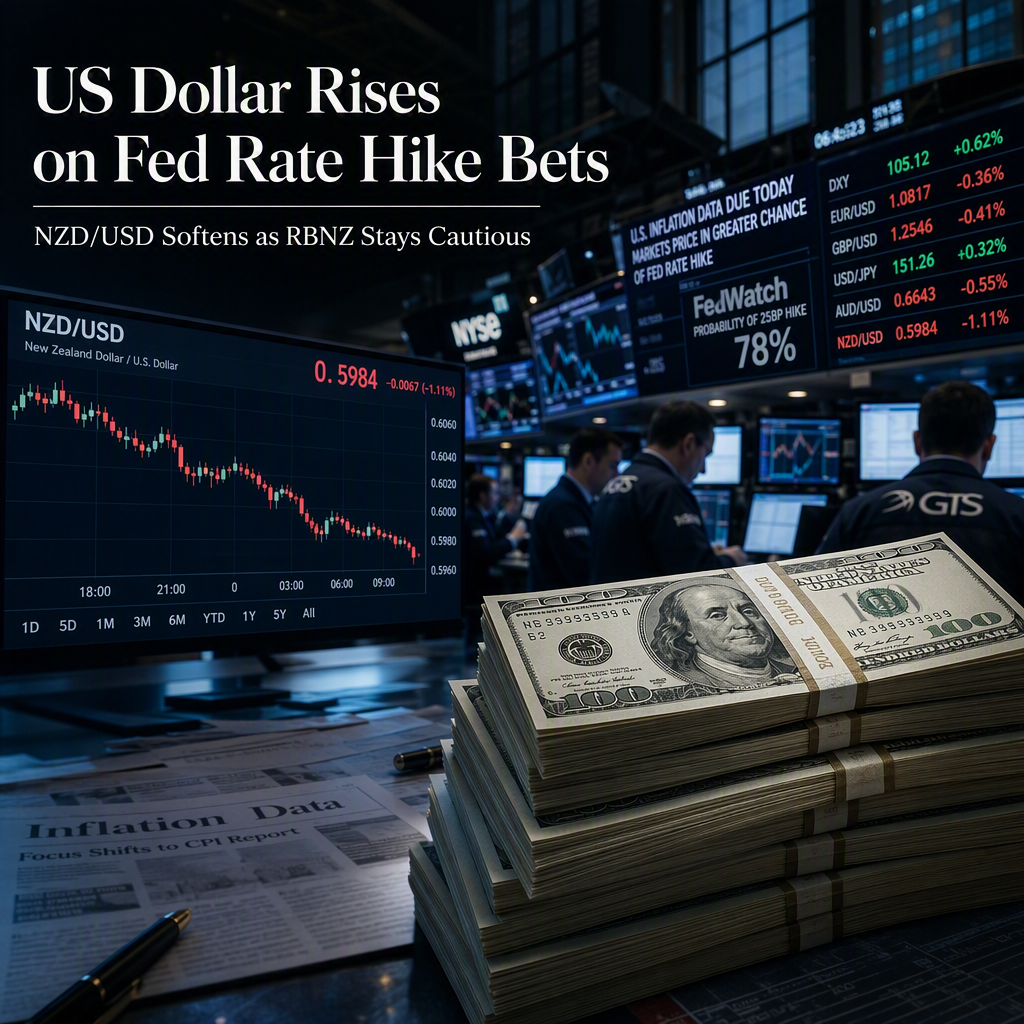
The US Dollar (USD) has firmed as traders increase bets on a potential US Federal Reserve (Fed) rate hike at the September policy meeting, following stronger-than-expected US jobs data. The US Bureau of Labor Statistics reported that Nonfarm Payrolls (NFP) climbed by 162K in August, surpassing the market consensus of 56K and the prior upwardly revised figure of 21K. The Unemployment Rate held steady at 4.1% during the same period. Fed funds futures are now pricing in roughly a 60% probability of a hike, according to the CME FedWatch tool [3]. Commerzbank’s Thu Lan Nguyen notes that the latest US labour market report does not materially alter expectations for a September Fed rate move, leaving August US inflation as the key driver. Market pricing of roughly a 60% probability for a hike suggests divided positioning, with potential for significant USD volatility around the Fed meeting depending on how inflation prints relative to forecasts [2]. An upside inflation surprise would likely increase expectations of a rate hike further and support the US dollar, while weaker-than-expected inflation would have the opposite effect [2].
The NZD/USD pair has softened below 0.5900, trading near 0.5875 during early European hours on Monday, pressured by the firmer USD. The Reserve Bank of New Zealand (RBNZ) raised the Official Cash Rate (OCR) by 25 basis points to 2.75% last week. RBNZ Governor Anna Breman stated that further increases are likely, but policymakers want to take time to assess the impact of the increases to date [3]. Analysts at Commerzbank note that the RBNZ delivered a widely anticipated move, reiterating that a gradual removal of monetary stimulus was appropriate to return inflation sustainably to the target. While headline CPI remains elevated, most core inflation measures are still within the RBNZ’s 1–3% band, suggesting that the pace of any further tightening will depend on the persistence of inflation pressures and the strength of the domestic recovery [3].
Technical analysis shows NZD/USD consolidating in the near term, holding above the 100-day moving average while trading below the Bollinger middle band. The 14-day Relative Strength Index (RSI) is around a neutral 48, indicating a consolidative tone. Initial resistance is seen at the Bollinger middle band around 0.5910, with further upside target at 0.5985. On the downside, support is at the 100-day MA at about 0.5845, and a break below the Bollinger lower band just below 0.5830 could signal a deeper corrective move, exposing the July 27 low of 0.5771 [3].
Commerzbank highlights that the dollar’s post-payrolls rally proved short-lived, and that August US inflation data will be the key determinant for the Fed’s upcoming policy decision. If inflation figures push market expectations clearly in one direction, pronounced volatility in USD exchange rates on the day of the Fed meeting would be likely, as seen after previous policy decisions [2].
CONCLUSION
Stronger US jobs data and heightened Fed rate hike expectations have bolstered the US Dollar, pressuring NZD/USD lower. The RBNZ’s gradual tightening stance and technical consolidation suggest limited near-term upside for NZD/USD. Market participants are closely watching US inflation data, which will be pivotal for Fed policy and could trigger significant USD volatility.