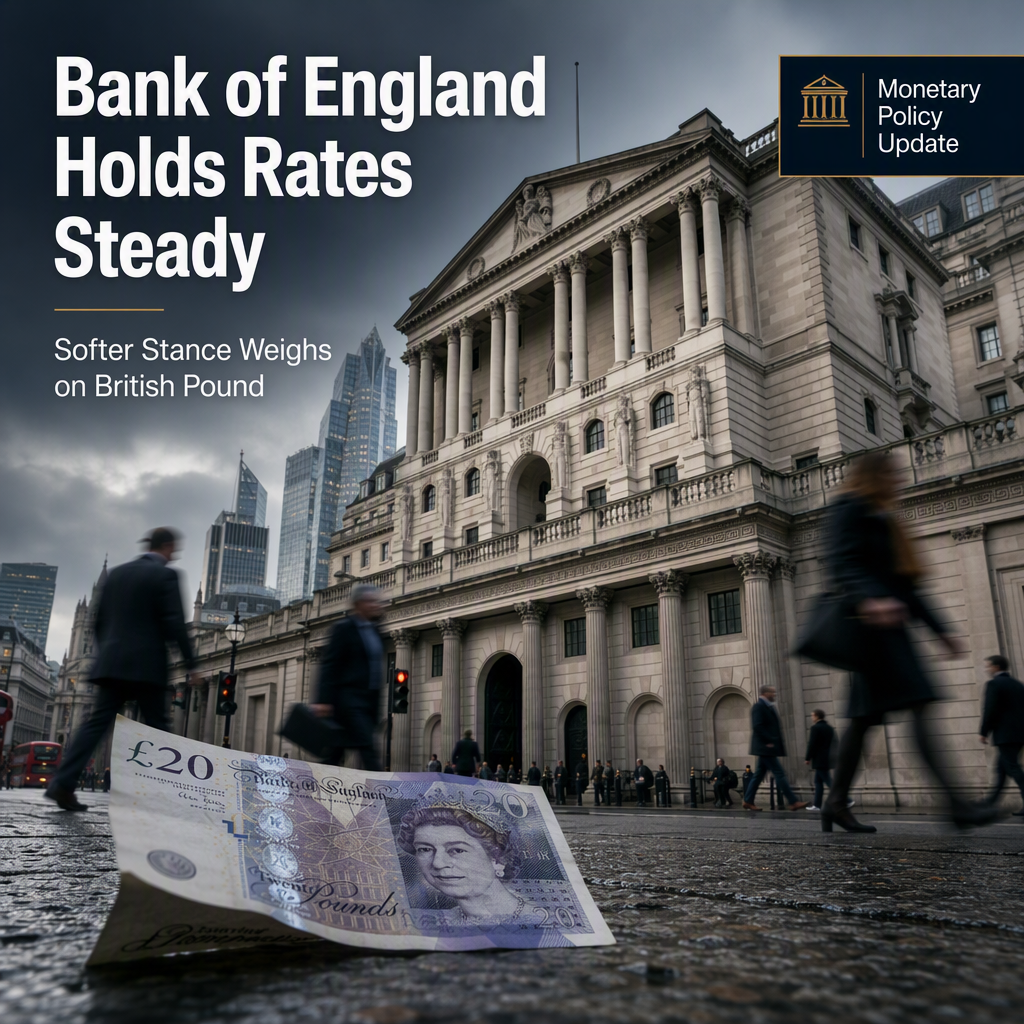
The Bank of England (BoE) maintained its policy rate at 3.75% for the fifth consecutive meeting, a decision that was widely anticipated by the market. The vote among policymakers was split 6–3, with the majority favoring no change in rates [1]. Governor Andrew Bailey pushed back against expectations of an imminent rate hike, signaling a more cautious approach to future tightening [1].
According to Brown Brothers Harriman’s Elias Haddad, there is scope for a downward adjustment to UK rate expectations, which presents a headwind for the British Pound (GBP). The swaps curve currently implies 50 basis points of tightening to 4.35% over the next twelve months [1].
In addition to the rate decision, the BoE indicated it may further slow the pace of its quantitative tightening (QT) program. The central bank raised its estimate for the increase in the term premium on long-term interest rates due to QT by 5 basis points, now expecting a range of 20–30 basis points, suggesting QT is delivering more tightening than previously anticipated. The volume of maturing bonds in the pipeline for next year is also set to decrease significantly, from £49.1bn in the current cycle to £30.5bn [1].
BoE policymakers are scheduled to vote on the QT pace at the September 17 meeting, with expectations that the gilt holdings rundown will be reduced to £50bn over October 2026 to September 2027, down from the current £70bn. However, analysts note that a slower pace of balance sheet runoff is unlikely to offset upward pressure on gilt yields stemming from fiscal policy uncertainty. Prime Minister Andy Burnham is reportedly leaning towards higher spending and borrowing, but further details are not expected until the October budget [1].
CONCLUSION
The Bank of England’s decision to hold rates and signal a softer stance has weighed on the British Pound, with analysts expecting downward revisions to UK rate expectations. While the BoE may slow its quantitative tightening, fiscal policy uncertainty continues to exert upward pressure on yields. Market participants are likely to remain cautious until more clarity emerges from the upcoming budget.