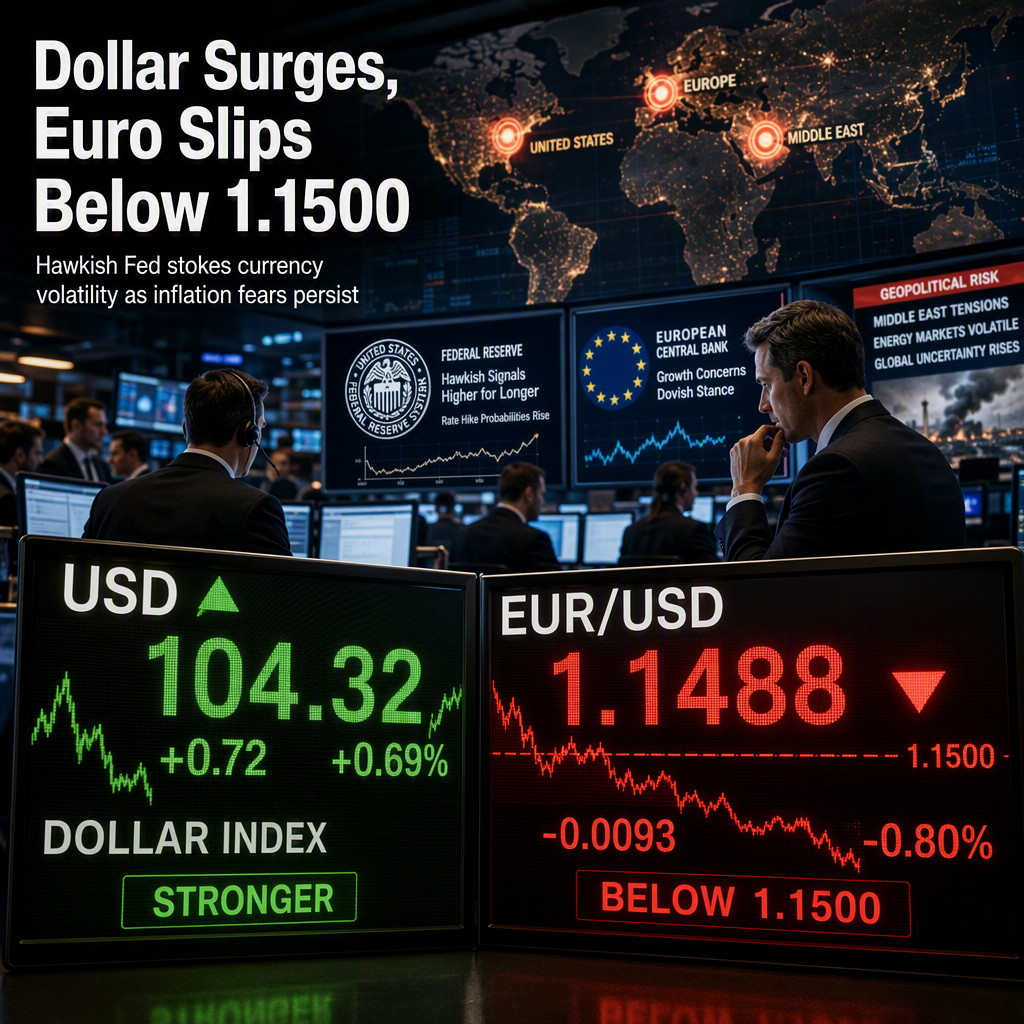
The Euro (EUR) weakened against the US Dollar (USD) on Friday, slipping back below the 1.1500 mark as short-covering in the Greenback followed the previous day’s sharp sell-off. At the time of writing, EUR/USD trades around 1.1488, down from the six-week high of 1.1537 reached on Thursday [1]. The US Dollar Index (DXY) rose 0.37% to 100.34, reflecting renewed strength in the US Dollar amid ongoing geopolitical tensions in the Middle East and persistent hawkish expectations for the Federal Reserve (Fed) [1].
Despite limited forward guidance from Fed Chair Kevin Warsh at this week’s monetary policy meeting, traders are pricing in a 66% probability of a 25-basis-point rate hike in September, according to the CME FedWatch Tool. Elevated oil prices continue to fuel inflation concerns, supporting the case for further tightening [1]. The Fed left interest rates unchanged within the 3.50%-3.75% range on Wednesday, but three policymakers voted for an immediate hike. Cleveland Fed President Beth Hammack and Minneapolis Fed President Neel Kashkari reinforced their hawkish positions on Friday, with Hammack stating that monetary policy is not restrictive enough and Kashkari suggesting that a series of small policy moves would be preferable if inflation remains elevated [1].
On the Eurozone side, preliminary inflation data for July showed the Harmonized Index of Consumer Prices (HICP) rising 2.9% year-on-year, in line with forecasts and up from 2.8% in June. Core inflation accelerated to 2.5% from 2.4% [1]. Analysts at Societe Generale noted that the latest inflation release indicates limited indirect spillovers from the energy shock to consumer prices so far, but cautioned that broader second-round effects could still materialize as upstream energy price pressures pass through supply chains. They believe the figures are consistent with the ECB's June forecast of 2.5% YoY for Q3 2026 and, combined with solid Q2 2026 GDP data, should support another ECB rate hike in September [1].
Traders are now awaiting the final University of Michigan Consumer Sentiment and Inflation Expectations data due later on Friday, which could further influence market direction [1].
CONCLUSION
The Euro’s decline below 1.1500 reflects renewed US Dollar strength driven by hawkish Fed signals and geopolitical tensions. With both the Fed and ECB expected to maintain tightening bias amid persistent inflation, market volatility may persist as traders await further economic data. The outlook remains cautious, with central banks poised for potential rate hikes in September.