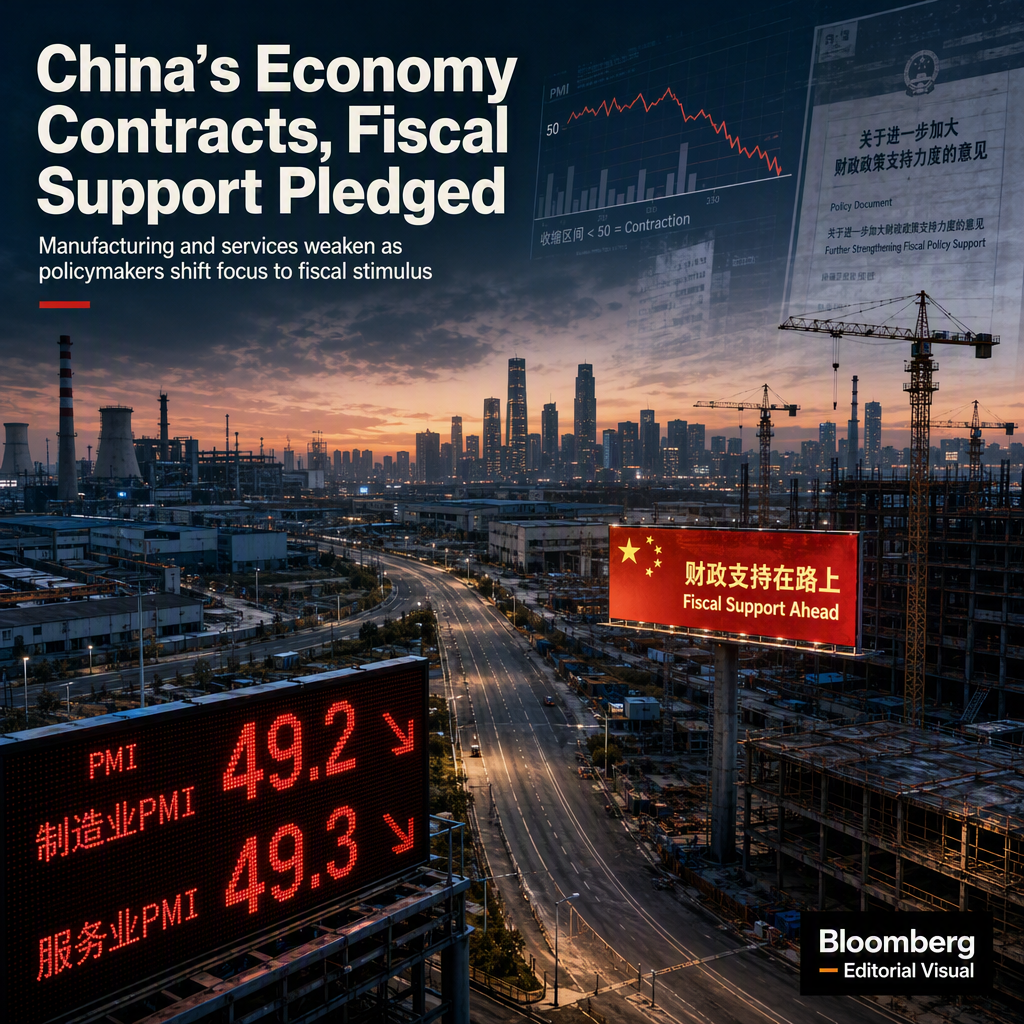
China's July CFLP PMIs slipped into contraction, with both manufacturing and non-manufacturing indices falling below the 50 threshold, signaling broad-based weakness in economic activity [1]. The composite PMI dropped 1.3 points to 49.3, marking its lowest level since December 2022 [1]. The manufacturing PMI recorded its first contraction in five months, declining 1.1 points to 49.2, missing Bloomberg's estimate of 50.1 and falling from June's reading of 50.3 [1]. Key components such as production (49.9 from 51.4 in June), new orders (48.5 from 51.2 in June), and new export orders (49.6 from 50.1 in June) all registered declines, although employment improved to 49.0, its highest reading in 40 months [1].
The report highlights that industrial output and services were particularly soft, with construction also declining [1]. Policymakers have been relying on external demand and export growth to offset prolonged weakness in domestic demand [1]. In response, the Politburo meeting on July 30 pledged to promptly plan and introduce practical and effective incremental policies, increase counter-cyclical adjustments, intensify efforts to expand domestic demand, and optimize supply [1]. The pace of fiscal spending and bond fund utilization will be accelerated to promote key projects, new infrastructure, and social development initiatives [1].
Monetary policy tools will be comprehensively utilized and adjusted in a timely manner, but UOB expects further easing to be skewed toward fiscal measures, with limited room for additional monetary loosening [1]. The PBOC is expected to keep its benchmark seven-day reverse repo rate unchanged at 1.40% through 2026 [1]. Growth remains the primary policy focus, especially after 2Q26 GDP growth undershot the official target range of 4.5%-5.0% [1].
Analyst Ho Woei Chen from UOB notes that any additional policy easing will likely be measured and increasingly driven by fiscal rather than monetary stimulus, consistent with signals from the Politburo meeting [1].
CONCLUSION
China's July PMIs indicate a broad-based contraction in economic activity, prompting policymakers to accelerate fiscal support and infrastructure spending. While monetary policy is expected to remain steady, the focus will shift toward fiscal measures to stimulate growth. The market may view these developments as moderately negative, but supportive policy actions could help stabilize sentiment.