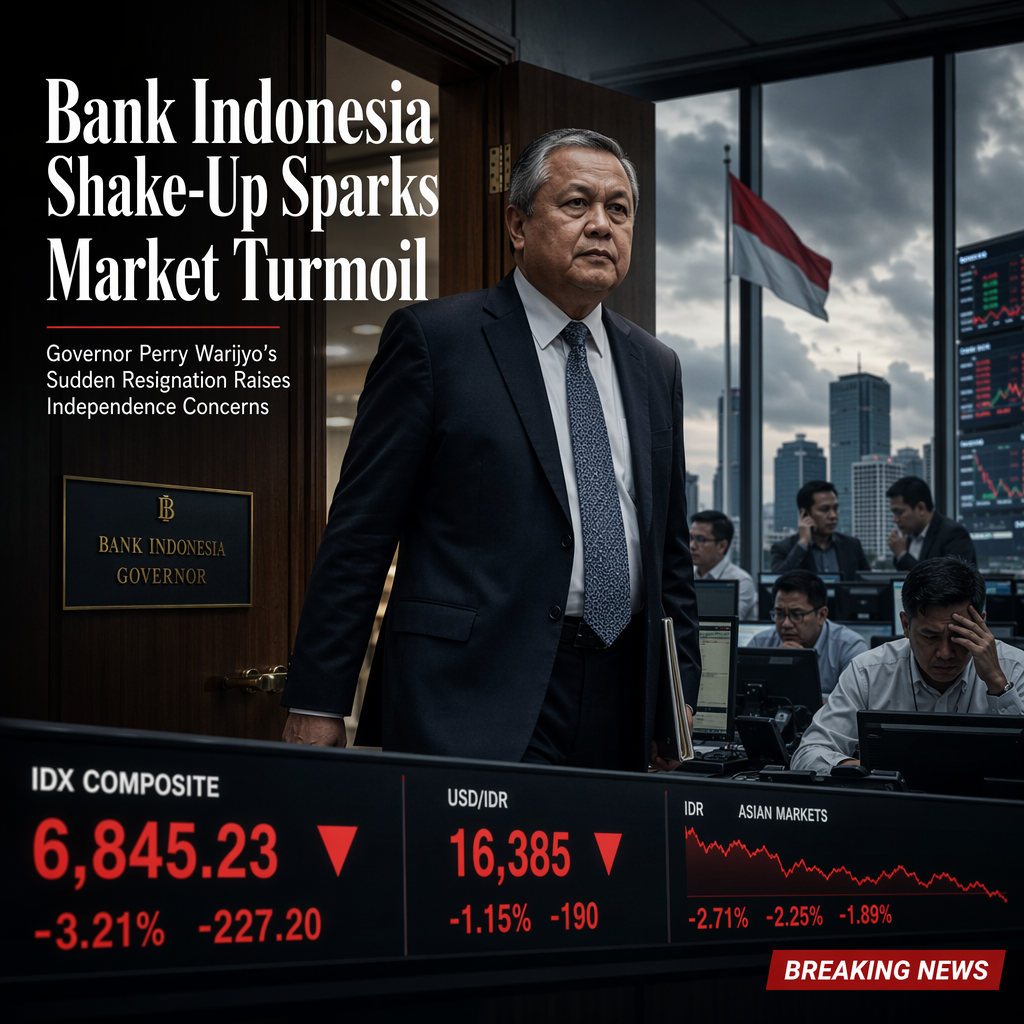
Bank Indonesia Governor Perry Warjiyo resigned on July 27, 2026, a move that surprised the market and immediately sent Indonesian stocks and the rupiah lower, reflecting heightened investor concerns about the central bank's independence in Southeast Asia's largest economy [1]. Following Warjiyo's resignation, Senior Deputy Governor Destry Damayanti was appointed as acting governor [1].
Analysts expressed apprehension that Thomas Djiwandono, a deputy governor and nephew of President Prabowo Subianto, could be nominated as the next governor, which has intensified worries about potential political interference in monetary policy [1]. The resignation is seen as 'a real test' of Bank Indonesia's autonomy, especially as the country faces both external and internal economic pressures [1].
The market reaction was swift, with both Indonesian stocks and the rupiah declining on the news, underscoring investor unease and the risk of further volatility if political pressure on the central bank persists [1]. The leadership change comes on the heels of recent policy uncertainty and a series of rate hikes by Bank Indonesia totaling 1% within a month, further affecting investor sentiment [1].
International investors and ratings agencies are expected to closely monitor the appointment process for the new governor, as the central bank's independence is viewed as a crucial factor for Indonesia's financial stability [1].
CONCLUSION
The unexpected resignation of Bank Indonesia Governor Perry Warjiyo has rattled markets, with immediate declines in stocks and the rupiah reflecting investor anxiety over the central bank's independence. The upcoming appointment process for a new governor, particularly if it involves candidates with political connections, will be closely watched by both domestic and international stakeholders.